
Child Language Development: Stages, Warning Signs and Home Activities

Child language stimulation means offering your child, every day, conversations, words and experiences that give them reasons and models to speak. You don’t need worksheets or apps. All it takes is an adult who names things, listens and waits for the reply. In this guide you’ll see the four stages of language development, the warning signs that deserve a check-up and ten simple activities for home.
- The short version
- How to support language development at home
- The four stages of child language development
- Warning signs: how to tell if a child has DLD
- Ten activities to work on language difficulties
- Child language development in a Montessori classroom
- Home checklist: ten minutes a day
- Frequently asked questions
The short version
- Language grows through real interaction: talk with your child, not in front of them, and give them time to answer.
- There are four rough stages: pre-linguistic (0-12 months), first words (12-18 months), vocabulary explosion (18-36 months) and consolidation (3-6 years).
- If by age 2 your child isn’t combining two words, or at 3 people outside the family can barely understand them, talk to your paediatrician.
- Ten minutes a day of screen-free word play does more than any bought learning material.

How to support language development at home
To support language development, talk with your child during everyday routines, name what they are doing and leave pauses so they can respond. The quality of the conversation matters more than the number of words they hear. For example, a 2018 MIT study published in Psychological Science linked back-and-forth conversational turns (I speak, you respond) with greater activity in the brain’s language areas. The sheer volume of words heard explained much less.
Make the most of moments you already have
You don’t need to set aside an hour. Think of bath time with a 15-month-old: “Where’s the duck? There it is. The yellow duck is floating.” You wait three or four seconds. They point, babble something like “ato”, and you smile: “Yes, the duck.” That twenty-second exchange is a complete language lesson. Likewise, getting dressed, setting the table or hanging out the washing offer dozens of concrete words every day.
The typical mistake: making them repeat
Many families correct like this: “We don’t say tae, we say tea. Say it again.” The child freezes and, on top of that, learns that talking is an exam. The better approach is recasting. If your 2-year-old says “agua tía” (an English speaker might hear something like “tea water”), you respond naturally: “Yes, the water is cold.” They receive the correct model without feeling corrected.

The four stages of child language development
Spoken language develops through four broad stages, although each child sets their own pace within them. The ages are approximate and overlap.
Pre-linguistic stage (0-12 months)
The baby cries, smiles, coos and, around 6-8 months, babbles syllables like “ba-ba”. Understanding, however, runs ahead: they recognise their name and familiar voices long before they say anything.
First words (12-18 months)
Single words appear that carry the meaning of a whole sentence. “Water” might mean “I’m thirsty” or “look, a puddle”. Pointing gestures are just as valuable.
Vocabulary explosion (18-36 months)
Vocabulary takes off and the first combinations emerge: “more bread”, “daddy car”. By around age 2, the US Centers for Disease Control and Prevention (CDC) expect a child to put together at least two words.
Consolidation (3-6 years)
Longer sentences arrive, along with “why” questions and stories. By age 3, most people outside the family understand them almost all the time. Meanwhile, some sounds such as the Spanish-style rolled /r/ or the English /r/ can take until 5 or 6 years.

Warning signs: how to tell if a child has DLD
Developmental Language Disorder (DLD, known in Spanish as TDL) is a persistent difficulty understanding or producing language that cannot be explained by deafness, intellectual disability or lack of exposure. Only a speech and language therapist or a specialist team can assess it, usually from age 4 or 5. A 2016 British study (Norbury and colleagues) put it at around 7% of school-age children, so it is not rare.
Before that age we talk about signs, not diagnosis. Consult your paediatrician if by age 2 your child isn’t combining words, if at 3 they struggle to follow simple instructions, or if at 4 their sentences are still very short and disorganised. Any loss of words they previously used also merits a check-up. At that appointment, ask your paediatrician to check their hearing, because the American Academy of Pediatrics lists delayed speech among the signs of possible hearing loss. However, being bilingual does not cause DLD: a trilingual child may mix languages without that indicating any problem.
Ten activities to work on language difficulties
These ten activities support vocabulary and storytelling. If a speech and language therapist is already involved, ask which ones fit their plan.
- Blowing: bubbles, feathers or paper balls through a straw.
- Mouth exercises in front of the mirror: tongue up, down, to the sides and noisy kisses.
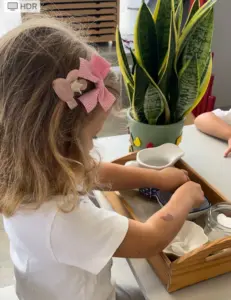
- A basket of real objects (spoon, brush, orange) to name and touch.
- The three-period lesson: “this is a lemon”, “give me the lemon”, “what is this?”.
- Songs with gestures and pauses so the child fills in the missing word.
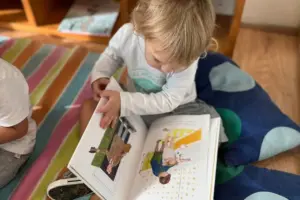
- Picture books with realistic images and open questions: “what do you think will happen?”.
- “I spy” with starting sounds: “I spy something that begins with /m/”.
- Parallel talk: narrate what they are doing while they play, without quizzing them.
- Pretend play with a toy kitchen, dolls or a toy telephone.
- Three-card sequences to talk about what happened first, next and last.
Child language development in a Montessori classroom
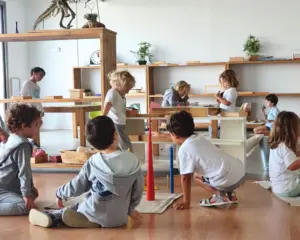
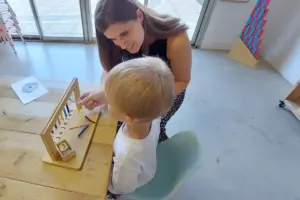
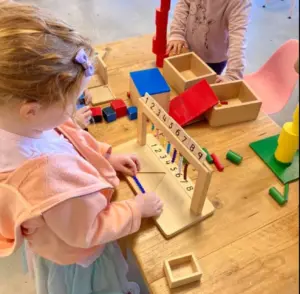
In a Montessori classroom, spoken language is worked on with real objects, precise vocabulary and lots of conversation between peers. Child language development is not a separate subject: it runs through practical life, sensorial materials and grace-and-courtesy routines. For example, in the Children’s House (ages 3-6) children learn exact names (“sphere”, “cylinder”, “petal”) rather than “ball” or “thing”.
Three languages without fear of delay
Take Leo, 3 years old, who has just arrived in Sotogrande from Gibraltar. At home he speaks English and at school he also hears Spanish and French. In the first few months he mixes words and sometimes stays quiet. This is the silent phase, common in children exposed to a new language. Over time, if the exposure is rich, he usually starts using sentences in the second language. At IMS we work with Spanish-English and French immersion from the Children’s House, so many families from the Campo de Gibraltar go through this process. UNESCO also advocates keeping the mother tongue at home: it strengthens the foundation on which the other languages are built.
Home checklist: ten minutes a day
- A shared story, with open questions and no rush to finish.
- A routine narrated out loud (bath, dinner or a walk).
- Three or four seconds of waiting after each question.
- A recast instead of a correction.
- No background screens while you talk: the American Academy of Pediatrics recommends avoiding them before 18 months, except video calls.
- One new, precise word a day: “colander”, “seagull”, “rough”.
Frequently asked questions
How do you support child language development?
You support it by talking with your child during daily routines, naming what they see and do, reading stories together and leaving pauses so they can respond, always without correcting them directly or forcing them to repeat. Back-and-forth conversations matter more than the number of words. It also helps to reduce background screens.
What are the 4 stages of child language development?
The four stages are pre-linguistic (0-12 months), first words (12-18 months), vocabulary explosion with two-word combinations (18-36 months) and consolidation with longer sentences and storytelling (3-6 years). The ages are approximate. Each child progresses at their own pace within a wide range.
How do you know if a child has DLD?
Only a speech and language therapist or a specialist team can assess it, usually from age 4 or 5, when difficulties understanding or building sentences persist without another cause such as deafness or lack of exposure. Before that age, if you notice signs such as not combining words by age 2, speak to your paediatrician.
What are 10 activities to work on language difficulties?
Ten useful activities are blowing, mirror mouth exercises, baskets of real objects, the three-period lesson, songs with pauses, picture books with questions, “I spy” with sounds, parallel talk, pretend play and card sequences. They complement, but do not replace, the work of a speech and language therapist when real difficulties exist.
Start this week with one narrated routine and a daily story, and observe for a month how your child responds. If you’d like to see how language is worked on in a trilingual Montessori environment in Sotogrande, book a personalised school visit.