
Bilingual Nurseries near San Pedro de Alcántara: How to Choose the Best for Your Child

When you start looking at bilingual nurseries near San Pedro de Alcántara , you quickly realize they are not all the same. Some promise bilingualism, but only expose the child to one English song a day. Others provide true immersion. This guide helps you distinguish what to look for, what to ask, and why the environment matters as much as the language.
- Key points before choosing a bilingual nursery
- What does ‘bilingual’ really mean in a nursery?
- How to evaluate the prepared environment in bilingual nurseries
- San Pedro de Alcántara and the bilingual education offering
- Why Montessori pedagogy and bilingualism enhance each other
- Frequently asked questions about bilingual nurseries near San Pedro de Alcántara
- Key takeaways
Key points before choosing a bilingual nursery
- Not all bilingual nurseries use the same method. True immersion requires a native speaker present for most of the day.
- Location and commute matter: a center 30 minutes away by car may be worthwhile if the atmosphere and educational quality make up for it.
- Ask to observe a morning class. The adult’s attitude with the children will tell you more than any brochure.
- Montessori education, with its focus on autonomy and respecting the child’s rhythm, combines especially well with language immersion.

What does ‘bilingual’ really mean in a nursery?
Many centers use the bilingual label very loosely. For a nursery to deserve that name, it must meet at least two conditions: have a native or bilingual professional who interacts consistently with the children, and offer exposure to the second language in real situations, not just through songs or worksheets. The Association Montessori Internationale (AMI) emphasizes that language acquisition in the early years depends on the quality of interaction, not the quantity of isolated stimuli. When it comes to bilingual nurseries near San Pedro de Alcántara, it pays to listen to what families and lead guides actually report.
In practice, this means that if your child is in a classroom where a guide speaks to them in English during meals, care routines, and individual work, bilingualism is integrated naturally. It is not an ‘English class,’ but part of the day. That is the difference between exposure and immersion. Daily practice with bilingual nurseries near San Pedro de Alcántara reveals nuances no handbook fully captures.

How to evaluate the prepared environment in bilingual nurseries
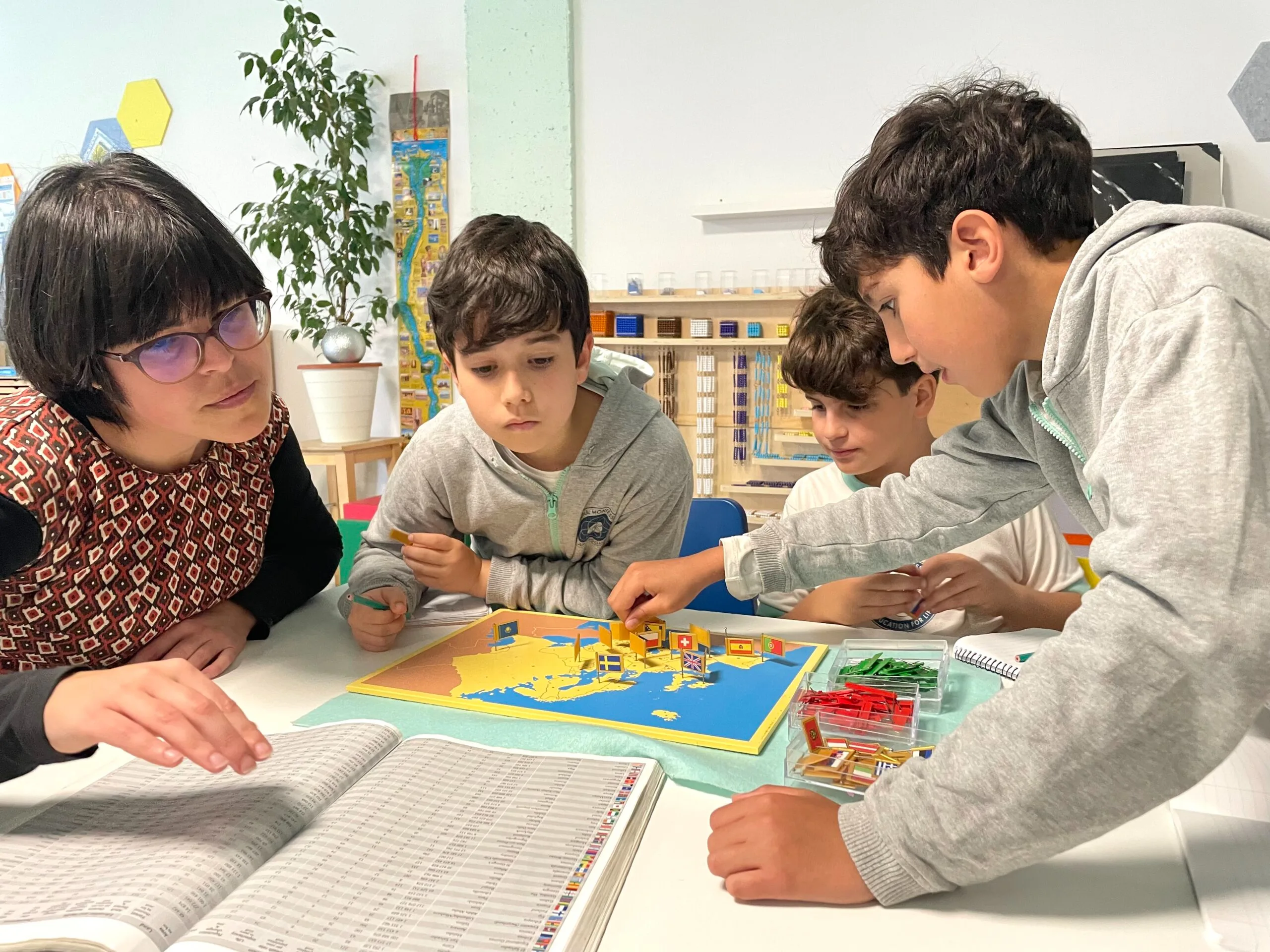
The physical space says a lot about a center’s philosophy. In a Montessori classroom, for example, materials are within the child’s reach, shelves are low, and everything invites autonomous exploration. If the environment is also bilingual, you will see labels in two languages, books in both languages, and adults who switch languages fluidly and coherently.
Look for these details when visiting a bilingual nursery near San Pedro de Alcántara or surrounding areas:
- Are the materials organized and accessible to children?
- Are there adults who speak the second language natively?
- Does the outdoor space allow for movement and contact with nature?
- Does the routine include moments of personal care (eating, hygiene) in both languages?
If the center does not allow you to observe a session, that already gives you information. Schools confident in their method open their doors.

San Pedro de Alcántara and the bilingual education offering
San Pedro de Alcántara has a growing community of international families, and this is reflected in the demand for bilingual education. However, the availability of quality bilingual nurseries in the area is limited. Many families end up expanding their search towards Sotogrande, Estepona, or even La Línea de la Concepción.
From San Pedro, the drive to our campus in Sotogrande is about 30 minutes via the AP-7, a direct and straightforward route. For many families, that commute is well worth it when the center offers true immersion in Spanish and English, AMI accreditation, and a Montessori environment that respects the child’s natural development.
Book a personalized visit to the school and see for yourself if the atmosphere fits what you are looking for for your child.
Why Montessori pedagogy and bilingualism enhance each other
Maria Montessori observed that young children absorb language naturally, without conscious effort. She called this capacity the ‘absorbent mind.’ When a 2-year-old is in a bilingual Montessori environment, they are not ‘learning English’: they are absorbing two languages as part of their vital experience.
The Montessori method facilitates this because it respects individual rhythm. There is no pressure to repeat, no exams, no constant corrections. The child listens, observes, and reproduces when ready. Research from the Association Montessori Internationale confirms that children in bilingual Montessori environments develop solid linguistic competencies in both languages without anxiety.
At IMS Sotogrande, for example, dual Spanish-English immersion is the cornerstone of all programs, from Nido (0-3 years) to Taller (6-12 years). French is added from Casa de Niños, offering a trilingual foundation that few bilingual nurseries in the area can replicate.
Frequently asked questions about bilingual nurseries near San Pedro de Alcántara
At what age is it best to start in a bilingual nursery?
The sensitive period for language runs from birth to 6 years. The sooner a child is exposed to two languages in a natural and respectful environment, the easier acquisition will be. There is no age ‘too early’ for bilingual immersion if the environment is safe and warm.
Do bilingual nurseries confuse young children?
No. Young children have an extraordinary ability to distinguish and separate two languages. Studies in educational neuroscience show that early bilingualism strengthens executive functions, such as attention and cognitive flexibility. ‘Confusion’ is a myth that science has already debunked.
Is it worth looking for a bilingual nursery outside San Pedro de Alcántara?
If the local offering does not meet your criteria, expanding your search makes sense. Many families from San Pedro, Estepona, or Marbella choose schools in Sotogrande because the educational quality, accreditations (AMI, NEASC, Junta de Andalucía), and environment justify the commute. The important thing is to visit, observe, and trust your instinct as a mother or father.
Key takeaways
Choosing between bilingual nurseries near San Pedro de Alcántara requires going beyond marketing. Look for true immersion, a prepared environment that respects the child’s rhythm, and professionals who live the language, not just teach it from a book. If bilingualism is accompanied by a pedagogy that trusts the child, like Montessori, the result is holistic development that is priceless.
Your next step: visit at least two centers, observe a morning class, and ask yourself these questions. Would my child be happy here? Do the adults treat them with real respect? Does the language flow naturally? If the answer is yes, you have found the right place.









