
Baby Sleep Schedule by Age: A Complete Guide for Parents
In short
Knowing how much a baby sleeps by age is one of the first questions new parents ask. And for good reason: sleep influences brain development, physical growth, and a child’s temperament. Data from the American Academy of Pediatrics (AAP) offers clear ranges, but every baby has their own rhythm.

Knowing how much a baby sleeps by age is one of the first questions new parents ask. And for good reason: sleep influences brain development, physical growth, and a child’s temperament. Data from the American Academy of Pediatrics (AAP) offers clear ranges, but every baby has their own rhythm. Let’s break it down month by month, with real examples of how it works at home and in a Montessori environment. In this article we explore baby sleep schedule by age in depth with practical examples.
- Newborns sleep 14 to 17 hours a day, but in short cycles of 2-4 hours.
- By 6 months, most babies consolidate nighttime sleep with 1-2 wake-ups.
- Naps reduce from 3-4 to 1-2 between 12 and 18 months.
- Tiredness cues (eye rubbing, yawning, irritability) are more reliable than the clock.
- A calm environment and a predictable routine promote restful sleep.
- How many hours does a newborn (0-3 months) sleep?
- Baby sleep schedule: 3 to 6 months
- How much sleep does a baby need from 6 to 12 months?
- Baby naps by age: 12 to 24 months
- How does the environment influence children’s sleep?
- Children’s sleep from 2 to 3 years
- Frequently Asked Questions
- Key Takeaways
How many hours does a newborn (0-3 months) sleep?
A newborn sleeps between 14 and 17 hours daily, according to the AAP, though rarely for more than 2-4 hours at a stretch. Their biological clock doesn’t yet distinguish day from night. That’s why frequent wake-ups are normal and necessary: the baby needs to feed often, and their brain is maturing at high speed. When it comes to baby sleep schedule by age, it pays to listen to what families and lead guides actually report.
At this stage, there’s no point in forcing strict schedules. What you can do is help them associate daylight with activity and darkness with rest. For example, opening curtains in the morning and reducing stimuli (dim lights, soft voice) from 7-8 pm. In our Montessori Nido (0-3 years) in Sotogrande, we observe that babies who have a clear and orderly environment begin to regulate their rhythm naturally by 2-3 months. Daily practice with baby sleep schedule by age reveals nuances no handbook fully captures.

Baby sleep schedule: 3 to 6 months
Between 3 and 6 months, a baby sleeps about 12-15 hours a day. The morning nap consolidates, a second nap appears at midday, and sometimes a shorter third one in the late afternoon. Many parents notice the baby starts to stretch their nights: it’s not uncommon for them to have a 5-6 hour stretch. Understanding baby sleep schedule by age from inside the classroom reshapes everyday decisions.
This is a good time to introduce a brief, predictable sleep routine: bath, pajamas, song or story, and into the crib. The repetition tells the brain that rest is near. If your family lives in the Algeciras, La Línea, or Gibraltar area and you value a bilingual Montessori environment, you can request a visit to our center to see how we work on rest routines with the little ones. Concrete data on baby sleep schedule by age is worth reviewing before acting on assumptions.
Book a personalized school visit

How much sleep does a baby need from 6 to 12 months?
From 6 months, most babies need between 12 and 15 hours of total sleep. Nighttime stretches (though 1-2 wake-ups are still common) and naps reduce to two: one in the morning and one after lunch. By 9-10 months, some babies start to refuse the morning nap: it’s not a problem, simply their cycle is reorganizing.
Separation anxiety appears at this phase. The baby might cry when you put them in the crib because they now understand you are leaving. Staying calm, always saying goodbye with the same phrase, and not returning repeatedly helps create security. At IMS, we work on this in the classroom with smooth transitions and materials the child can manipulate independently before resting.
Tiredness cues you shouldn’t ignore
Before the baby becomes overtired (and then it becomes much harder to fall asleep), watch for these signs: eye rubbing, yawning, staring into space, pulling ears, sucking their fist, or becoming irritable. Each baby shows a different combination. When you see them, act within the next 5-10 minutes: the longer you wait, the more cortisol is released and the harder it gets.

Baby naps by age: 12 to 24 months
Between 12 and 18 months, most children transition from two naps to one, usually after lunch. This midday nap can last between 1 and 2 hours and often continues until 3 years or more. Total daily sleep is around 11-14 hours, including nighttime.
If your child is 18 months and still needs two naps, don’t worry. The transition is gradual and depends on daily activity, the quality of nighttime sleep, and individual temperament. The important thing is to respect their rhythm and offer a quiet rest space, without screens or strong stimuli in the hour before.
How does the environment influence children’s sleep?
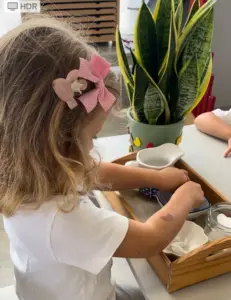
Montessori pedagogy pays close attention to the prepared environment, and sleep is no exception. An orderly room, with adjustable natural light, temperature between 18 and 21 degrees, and a crib or floor bed (from 6-8 months) promotes autonomy and rest. Avoid flashy toys in the sleeping area: the crib is for sleeping, not for playing.
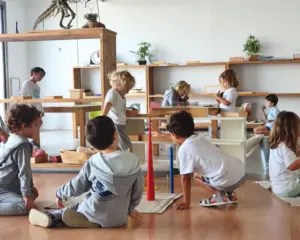
In our Children’s House (3-6 years) at IMS Sotogrande, we’ve seen that children who arrive with consolidated sleep routines adapt better to the classroom rhythm. Rest is not a minor topic: it’s the foundation of learning. If your family has recently moved to the Costa del Sol and you’re looking for an international school with a respectful approach to children’s rhythms, we invite you to get to know us.
Children’s sleep from 2 to 3 years
Between 2 and 3 years, the child sleeps between 11 and 14 hours daily. The single nap is maintained in most cases, though some children start to skip it on weekends or when they’re especially stimulated. Nighttime should be at least 10 hours.
Nightmares and night terrors are common at this stage. Don’t confuse the two: nightmares occur in the second half of the night and the child remembers. Terrors occur in the first third and the child seems awake but doesn’t recognize you. In both cases, the response is to contain without questioning. A comfort object (blanket, stuffed animal) can provide security.
Frequently Asked Questions
Is it normal for my 4-month-old not to sleep through the night?
Yes, it’s completely normal. At 4 months, many babies experience a sleep regression linked to a developmental leap. Their brain is processing new skills (rolling, babbling), and that can wake them more at night. Stay calm, offer brief comfort, and avoid creating habits you don’t want to maintain long-term.
How many naps should an 8-month-old take?
At 8 months, most babies take two naps a day: one in the morning (around 9-10 am) and one after lunch (around 1-2 pm). The first usually lasts 30-45 minutes, and the second can stretch to 1.5-2 hours. If your baby resists the second nap, it might need to be moved earlier or the first one shortened.
When should I worry about my child’s sleep?
Consult your pediatrician if your child habitually snores, has breathing pauses during sleep, sweats a lot at night, wakes up more than 4-5 times after 12 months, or if daytime drowsiness interferes with play and learning. These signs can indicate sleep apnea or other conditions requiring professional evaluation.
Key Takeaways
Sleep needs change rapidly during the first three years: from the newborn’s 14-17 hours to the two-year-old’s 11-14 hours. There’s no magic formula, but there are two principles that work: observing your child’s cues and offering a calm, predictable environment.
If you’d like to see how a Montessori environment supports a child’s holistic development, including their rest and activity rhythms, we invite you to book a visit to our center in Sotogrande. We are just minutes from La Línea, Algeciras, Estepona, and the entire Campo de Gibraltar area.