
10 reasons to choose a school with Montessori Methodology
At IMS Sotogrande, Reasons choose is one of the key topics we explore in Montessori education. 1.Respect for the child.
What is Reasons choose?
The child is the protagonist of his learning. Choose your own learning activities, according to your interest, level and learning style. We do not intend to create equal children: calm and passive children who spend hours sitting without attractive stimuli to capture their attention, but we accept the uniqueness of the child and enhance their abilities to reach their maximum development.
2.Promotes independence.
We want our children to become functional adults, yet we spend our days paving the way for them and cleaning up the messes they leave behind. In this way, we will hardly be successful. When they begin to communicate and discover the world around them, it is the perfect time to give them their first responsibilities.
3.Multisensory work.
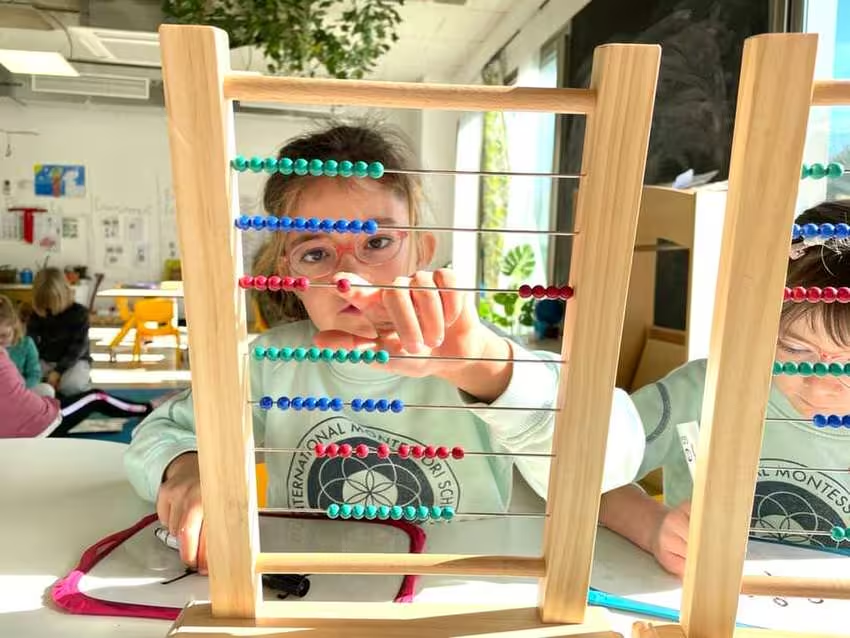
In the Montessori philosophy, great importance is given to hands. It is said that the hands are the extension of the brain, because through them we perceive the sensations that go directly to our structures. They are like the key to intelligence. That is why all areas are worked in a sensory way, manipulating and exploring materials.

4.Promotes responsibility.
The child learns to work, he learns a sense of respect for his own work and that of others. He learns the responsibility of taking care of the material he has chosen, he learns the opportunity to use the material freely but within certain limits, he learns that actions have natural consequences that derive from the use of raw materials such as the fragility of glass or the sonority of metal.
5.It is universal.
The methodology adapts to the child, not the child to the method. Therefore, there are no curricular adaptations, there are no specific classrooms and there are no religion classes because it is a method that embraces any ethnicity or belief in its fullness.
6.Take into account the needs and interests of the child.
The class changes as the child changes. The materials are different, the times are different, and the only clock that keeps time is the child’s. The change in level is requested by the child, not the adult, and occurs at any time during the school year.

7.It is a philosophy of life.
Educating in Montessori is educating in values, educating in the present for the future. The family is a fundamental part of the process and is integrated into the school naturally. The school transmits to parents the values of the philosophy to unite educational criteria and receive the education of life in a coherent way.
8.An environment prepared for learning.
This refers to an environment that has been carefully organized for the child, designed to encourage self-learning and growth. It develops social, emotional and intellectual aspects and responds to the needs of order and security. The characteristics of this Prepared Environment allow the child to develop without the constant assistance and supervision of an adult. The design of these environments is based on the principles of simplicity, beauty and order.
9.The materials themselves.
María Montessori developed specific teaching material that constitutes the fundamental axis for the development and implementation of her method. They are designed to capture the child’s curiosity, to guide him by the desire to learn. These teaching materials can be used individually or in groups. Another feature is that almost all equipment is self-correcting, so no task can be completed incorrectly without the child realizing it himself.
10.Create happy, autonomous, critical and respectful children.
Educating in values is educating responsibly. A child who feels heard, loved, integrated, accepted as he is, is a child capable of expressing his emotions, capable of questioning his thoughts while respecting differences and accepting what unites him with others. Educating with Montessori is educating for happiness. Is there a more important goal in life than being happy?










