
Chores for 5-Year-Olds: Practical Montessori Guide for Sotogrande Families

Chores for 5-year-olds are short activities with a real purpose, suited to their hands and attention span: setting the table, pouring water, sorting socks, tracing letters in sand or counting objects around the house. At this age a child usually concentrates for 10 to 20 minutes if the task interests them. So quality matters more than quantity. Here are ideas for home and classroom, a table by area, and a very common mistake with worksheets, along with its solution.
- Key takeaways
- What a 5-year-old can do on their own
- If your child is 3: how to start
- Sensorial activities for 3 to 5-year-olds
- Chores for 5-year-olds organised by area
- How to keep a 5-year-old busy at home without screens
- Printable worksheets: when they help and when they get in the way
- Chores for 5-year-olds that teach reading and maths
- Stimulation without overload: less is more
- Frequently asked questions
Key takeaways
- At 5, a child can take on real household jobs: setting the table, watering plants, folding napkins or packing their own school bag.
- Sessions work best in blocks of 10 to 20 minutes, with materials within reach and no interruptions.
- Sensorial activities (pouring, sounds, textures) prepare the hand and attention for reading and writing.
- Printable worksheets are a supplement, never a substitute for hands-on work.

What a 5-year-old can do on their own
A 5-year-old can get dressed almost entirely alone, help in the kitchen with safe utensils, tidy up after themselves and follow three-step instructions. Many already write their name, recognise the initial sound of words and count objects beyond ten. Not every child gets there at the same time, and that is normal.
Maria Montessori described this stage as the end of the first plane of development (0-6 years). The Association Montessori Internationale presents it as a period in which the absorbent mind becomes conscious. The child no longer just absorbs; they want to understand, order and perfect. That is why at five they will repeat a task ten times in a row. It is not stubbornness, it is training.
Household responsibilities at five
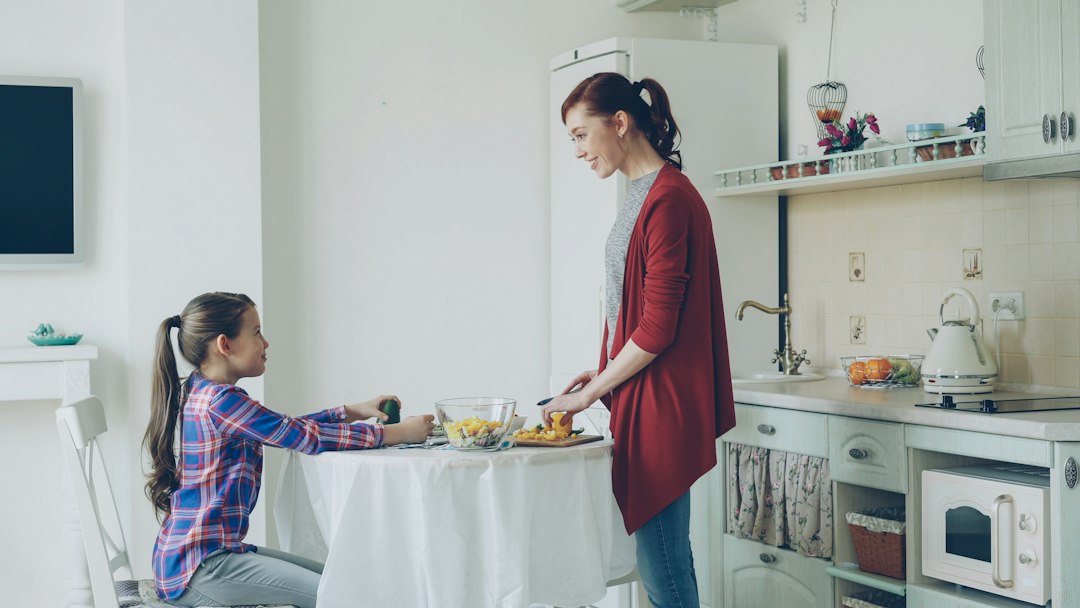
What makes the difference here is that the task is real, not an imitation. Setting the table for four people, folding napkins, feeding the cat, packing their school bag or peeling a mandarin for their sibling are meaningful jobs. A plastic toy kitchen entertains, but it does not give the feeling of contributing. When your child sees that their work serves the family, motivation appears on its own.

If your child is 3: how to start
At 3, it is best to offer single-step tasks, with materials at their height and slow demonstrations, almost without words. Carrying their plate to the sink, wiping the table with a small sponge or hanging their coat on a low hook are good starting points.
Progression is simple. At 3, one step. At 4, two or three chained steps (take out the tablecloth, spread it, place the glasses). And at 5, the complete task, with the child deciding when to do it. While at first the adult shows, gradually they step back. Your role shifts from teaching to trusting.

Sensorial activities for 3 to 5-year-olds
The best sensorial activities for this age group isolate one sense at a time: touch, hearing, smell or sight. In this way the child refines perception and, along the way, prepares the hand and attention for literacy. These activities for 5-year-olds and younger cost very little:
- Pouring: moving water or pulses from one jug to another, starting with two containers and working up to several glasses.
- Sound bottles: six opaque bottles filled in pairs (rice, chickpeas, sand) to match by ear.
- Smell bottles: cotton with cinnamon, lemon, lavender or coffee, for naming and matching.
- Mystery bag: everyday objects inside a cloth bag to recognise by touch alone.
- Semolina tray: tracing shapes, numbers and letters with a finger.
Always use objects sized for their age and stay close by. At 3, one new activity a week is enough. At 5, you can propose variations, such as matching textures with eyes closed or ordering the sound bottles from softest to loudest.
Chores for 5-year-olds organised by area
Chores for 5-year-olds fit the same areas worked on in a Montessori 3-6 environment: practical life, sensorial, language, mathematics and knowledge of the world. This table helps you choose based on what you want to reinforce.
| Area | Concrete example | Approximate time | What it develops |
|---|---|---|---|
| Practical life | Setting the table for 4 people | 10 min | Order, sequence, independence |
| Sensorial | Matching 6 sound bottles | 10 min | Auditory discrimination |
| Language | Finding 5 objects at home that start with /m/ | 10-15 min | Phonological awareness |
| Mathematics | Counting cutlery and checking there is one per person | 5-10 min | One-to-one correspondence |
| Movement | Walking along a line carrying a glass of water | 5 min | Balance and control |
| Nature | Watering plants and sorting leaves by shape | 15 min | Observation and care |
There is no need to cover every area each day. However, if you notice your child always chooses the same thing, place a task from another area next to their favourite.
How to keep a 5-year-old busy at home without screens
To keep a 5-year-old entertained at home, a prepared corner with a few options works better than a box full of toys. Four or five activities on a low shelf, each on its own tray, rotated every week. Also, invite them into what you are already doing: cooking, hanging laundry, unpacking the shopping. These home activities for 5-year-olds require buying nothing.
Screens have their place, but a limited one. The American Academy of Pediatrics recommends for children aged 2 to 5 around one hour a day of quality content at most, ideally watched together with an adult.
An example afternoon with chores for 5-year-olds
Take Lucía, 5 years old, on any Tuesday after school:
- 17:30. Waters the balcony plants with her small watering can (5 minutes).
- 17:40. Prepares her snack: spreads bread and slices a banana with a round-tipped knife (15 minutes).
- 18:00. Chooses a tray from the shelf: today, letters in semolina (10 minutes).
- 18:15. Free play with blocks or dress-up, without adult intervention.
- 19:00. Sets the dinner table and counts the plates out loud.
Notice that there is no long task. Even on a tiring day, Lucía ends the afternoon feeling she has done important things.
Printable worksheets: when they help and when they get in the way
Printable worksheets help when they consolidate something the child has already experienced with their hands, and get in the way when they replace that experience. Many families look for a PDF or an activity book for 4 to 5-year-olds. As a supplement, that is not a bad idea.
The typical mistake is sitting the child down for 30 minutes with a tracing workbook because next year is the start of primary school. Let us look at a common case. A family who had just moved to Sotogrande from London did exactly that with their 5-year-old, and within two weeks the child was crying as soon as they saw a pencil. The hand was not ready and the exercises had turned into punishment.
The solution is to reverse the order. First, trace sandpaper letters with two fingers, then in a semolina tray (5-8 minutes). Then, a single worksheet, and only if the child asks for it. With this change, the pencil stops being a threat. Chores for 5-year-olds to print therefore work as a closing step to learning, never as a starting point.
Chores for 5-year-olds that teach reading and maths
The educational activities that hook children most at this age mix movement, an achievable challenge and a visible result. A simple recipe, for example, works on measurement, sequence and vocabulary all at once: two cups of flour, one egg, stir ten times and count out loud.
For reading, the most effective exercises are oral before written. Play I spy with sounds (I spy something that starts with /s/), prepare a box of objects and name cards to match, or read stories pointing with a finger. Likewise, if your household speaks two or three languages, use the kitchen to name ingredients in each one. At the IMS Children’s House we work this way with immersion in Spanish and English, with French from this same stage.
Stimulation without overload: less is more
Stimulating a child does not mean filling their schedule, but offering a few well-chosen things and leaving them time to repeat them. A child who repeats the same pouring tray all week is building concentration. A child who switches activity every five minutes becomes scattered.
There is no point buying twenty stimulation games when a jug, two glasses and a sponge do the same job. If you want to go deeper, montessori.es has resources in Spanish about the method. And when your child turns 6, these activities for 5-year-olds evolve into longer, research-based projects, which is what is worked on in Taller (6-12).
Frequently asked questions
What should a 5-year-old be able to do?
A 5-year-old can usually get dressed almost entirely alone, tidy up after themselves, help with simple household tasks, follow three-step instructions and sustain attention for 10 to 20 minutes on something that interests them, although each child follows their own pace. If you are worried about a specific aspect, discuss it with their paediatrician.
What activity guide works for a 3-year-old?
With a 3-year-old, a simple guide works: single-step tasks, materials at their height, slow demonstrations with almost no words, and free repetition. Carrying their plate, wiping with a sponge or hanging their coat are good starts. Add steps only once they master the previous one.
Which sensorial activities are good for 3 to 5-year-olds?
For 3 to 5-year-olds, pouring water or pulses, sound bottles, smell bottles, the mystery bag and the semolina tray are ideal, because they work one sense at a time and prepare the hand for writing. Use appropriately sized objects and always supervise.
How do you keep 5-year-olds entertained at home?
The most effective way to keep 5-year-olds entertained at home is to combine a corner with four or five activities rotated weekly and their participation in real chores, such as cooking or setting the table. Limit screen time and leave room for free play without directing it.
This week, choose three tasks from the table, prepare the materials at their height and let your child repeat them without correcting every movement. If you want to see how this is done in a Montessori 3-6 environment in Sotogrande, book a personalised school visit and see it live.









