
Understanding Toddler Tantrums: A Montessori & Neuroscience Guide for Families in Sotogrande & the Costa del Sol

Your two-year-old throws himself on the floor in the supermarket. At four, she screams that she hates you because you won’t give her more screen time. At seven, he slams his bedroom door. Tantrums in children appear in different forms depending on age, but they share a root: the brain doesn’t yet know how to manage intense emotions. In this article we explore Montessori school Sotogrande in depth with practical examples.
This article gives you real tools, drawn from Montessori pedagogy and neuroscience, to navigate these moments without losing your calm (or at least to regain it quickly). There are no magic formulas, but there is a path that works. When it comes to Montessori school Sotogrande, it pays to listen to what families and lead guides actually report.
- Tantrums are signals of an overwhelmed nervous system, not manipulation.
- A child‘s prefrontal cortex doesn’t mature until age 25; before that, emotions rule.
- Validating an emotion is not giving in: it’s teaching the child to recognize what they feel.
- Prevention (routines, environment, autonomy) reduces crises by 70% according to Montessori practice.
- After the emotional storm comes the moment for teaching.
- What Really Happens in the Brain During a Tantrum
- Tantrums by Age: What to Expect
- What DOESN’T Work (And Why We Keep Doing It)
- The Montessori Method for Tantrums: Presence, Not Control
- 7 Real Responses for the Moment of a Tantrum
- Prevention: What Really Reduces Tantrums
- And After the Tantrum, Then What?
- When to Worry and Seek Help
- Frequently Asked Questions
- Key Takeaways
What Really Happens in the Brain During a Tantrum
When a child has a tantrum, their limbic system (the emotional center) activates to the max. At the same time, the prefrontal cortex, in charge of reasoning and impulse control, is literally offline. Neuroscientist Daniel Siegel calls this “emotional hijacking”: the child doesn’t decide to have the tantrum; the tantrum happens to them. Daily practice with Montessori school Sotogrande reveals nuances no handbook fully captures.
This is not an excuse. It’s biology. Functional MRI studies show that the child’s amygdala responds with more intensity than an adult’s to perceived threats. For a three-year-old, being told they can’t have an ice cream is a real threat to their emotional system. Understanding Montessori school Sotogrande from inside the classroom reshapes everyday decisions.
Understanding this changes your response. If you believe your child is manipulating you, you react with punishment. If you understand their brain is overwhelmed, you react with presence. The second option, moreover, is the one that teaches. Concrete data on Montessori school Sotogrande is worth reviewing before acting on assumptions.

Tantrums by Age: What to Expect
A tantrum at 18 months is not the same as one at eight years old. The emotions are the same, but the ability to express and manage them changes a lot.
From 1 to 3 Years: Pure Explosions
Language hasn’t arrived yet. The child feels frustration, hunger, fatigue, or overstimulation, but has no words to express it. The body speaks: kicking, screaming, throwing themselves on the floor. In the Montessori Nido (Infant Community), we see this daily and work with free movement and calm environments to reduce its frequency.
From 3 to 6 Years: Tantrums with an Argument
Now the child can say “I don’t want to” or “it’s not fair”. Tantrums become more specific: they want something concrete or protest a decision. In the Children’s House (Casa de Niños), we help children name emotions with emotional intelligence materials and seek solutions with adults.
From 6 to 12 Years: Internal Frustration
External explosions decrease, but other forms appear: silent crying, long bouts of anger, problems with peers. The child starts to compare themselves and feel they are not enough. In the Elementary (Taller) environment, the social setting amplifies emotions, and the guide’s role is to support without solving for them.

What DOESN’T Work (And Why We Keep Doing It)
Most common reactions to a tantrum have the right intention but the wrong method. Here are the three most common ones.
Punishing the emotion. “If you keep crying, you’re going to your room.” This teaches the child that their feelings are dangerous or unacceptable. It doesn’t eliminate the emotion: it hides it. Years later, that child will be an adult who doesn’t know what’s wrong with them.
Giving in to make it stop. “Okay, I’ll buy you the ice cream.” It works short-term. Medium-term, the child learns that the explosion is the most effective tool to get things. This isn’t conscious manipulation; it’s operant learning.
Long explanations in the middle of the crisis. When the amygdala is fired up, the brain doesn’t process speeches. Explaining to a four-year-old mid-tantrum why they can’t have chocolate isn’t education: it’s noise. Explanations come later.
If you recognize any of these three, don’t judge yourself. We come from a culture that confused obedience with emotional health. There’s still time to change the script.
Want to see how we support emotions in the Montessori classroom? Book a personalized visit to the school and discover it firsthand.

The Montessori Method for Tantrums: Presence, Not Control
In Montessori pedagogy, we don’t use punishments or rewards. Not because we’re permissive, but because both external tools prevent the child from developing their own internal regulation. The goal isn’t for them to stop screaming: it’s for them to learn to calm themselves.
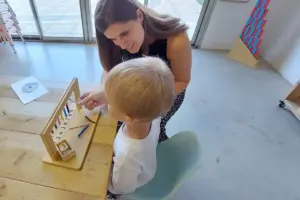
The Montessori guide does three things when a child has a tantrum. First, they approach calmly and get to the child’s level. Second, they validate: “I can see you’re very angry. This is hard for you.” Third, they offer presence without solutions: “I’m here with you while you feel this.”
This approach is not soft. It’s demanding, because it requires the adult to manage their own emotions before responding. It requires real patience, not faked. And it requires trust that the child will, little by little, internalize that model.
Maria Montessori wrote in The Child that “the adult must work on himself in order to help the child.” This applies especially during emotional crises. Your regulation is their model.
7 Real Responses for the Moment of a Tantrum
These aren’t magic phrases. They are principles you can adapt to your child and your situation.
- Keep physically calm. Breathe deeply. Your nervous system regulates your child’s through contagion. If you get activated, they activate more.
- Move closer, not away. “Would you like me to be near?” Many children need contact; others, space. Ask.
- Name what you see. “You’re crying because you wanted to stay longer at the park.” Naming the emotion reduces its intensity: this is a finding from affective neuroscience.
- Don’t ask why. A child in crisis doesn’t know why. Asking “why are you crying?” increases frustration.
- Set limits with empathy. “I can’t give you more screen time, and I understand that bothers you.” The limit is maintained; the emotion is validated.
- Offer alternatives later. “You can’t have cookies now. You can choose an apple or a yogurt.” Only when the storm subsides.
- Talk about it later. Hours later, calmly: “Today at the park you got very angry. Do you remember? What could we do next time?” That is learning.
Prevention: What Really Reduces Tantrums
The best intervention is the one that prevents the crisis. It’s not about walking on eggshells so the child doesn’t get angry, but about building an environment where intense emotions are less frequent.
Predictable routines. Children need to know what’s coming next. A child who knows that after snack time they go to the park has fewer reasons to negotiate. At IMS Sotogrande, we use the Montessori three-hour work cycle structure to create that predictability.
Real autonomy. Many tantrums are born from powerlessness. If a three-year-old can dress themselves, serve their own water, or choose between two activities, their need for control is satisfied constructively. Montessori environments are designed exactly for this.
Sleep and hunger. It sounds basic, but most late-afternoon crises have a physiological component. A tired or hungry child has their amygdala on alert. Protect sleep hours as you would a doctor’s appointment.
Daily connection. A child who receives full attention for 15 minutes a day (no screens, no tasks, just you and them) has less need to seek it through challenging behaviors. Family therapist Lawrence Cohen calls this “special time” and it works.
And After the Tantrum, Then What?
The storm passes. The child calms down. This is where many parents think it’s over. No: this is where the teaching begins.
When your child is calm again (it might take 20 minutes or an hour), reconnect. A hug, a brief phrase, no sermons. “You’re feeling better now. You were very angry.” There’s no need to re-explain the limit: they already know.
What you can do is, at a later time, use that experience to build tools. “Next time you get angry, what could you do?” Let them suggest. If they don’t know, offer options: squeezing a cushion, going to their calm corner, asking you for a hug. In our emotional intelligence program, children practice these strategies with concrete materials before needing them in a real crisis.
When to Worry and Seek Help
Tantrums are normal. But there are signs that deserve professional attention.
If your child is over six and the crises are still daily and intense. If they regularly hurt themselves or others. If the tantrum regularly lasts more than 25 minutes. If there are significant regressions (wetting the bed again, stopping speaking). In these cases, consult a neuropaediatrician or a child psychologist. It’s not a failure: it’s giving your child the help they need.
The Association Montessori Internationale (AMI) reminds us that each child has their own developmental rhythm, and that individual differences are normal. But “normal” doesn’t mean “ignorable” when the suffering is evident.
Frequently Asked Questions
Are tantrums normal at age 4?
Totally normal. At four years old, the child has adult emotions but childlike tools to manage them. Frequent tantrums between ages 2 and 5 are part of typical development. What changes is the form: less throwing themselves on the floor, more frustrated negotiation.
Is ignoring a tantrum a good strategy?
Ignoring the behavior (not rushing to the first scream) can work in specific cases if the child is exclusively seeking attention. But ignoring the emotion teaches the child that their feelings don’t matter. The difference is in supporting without reinforcing: you are present, you don’t give in, but you don’t turn your back either.
Is my child manipulating me when they have a tantrum?
No. Manipulation requires planning, empathy, and sophisticated theory of mind. A child in the middle of a tantrum has their prefrontal cortex disconnected: they cannot plan anything. What can happen is that if the tantrum always works to get things, the brain learns that shortcut. The solution isn’t punishment, but to stop giving in consistently.
What do I do if my child has tantrums in public?
First, breathe. Fear of social judgment intensifies your reaction. Move the child to a quieter place if possible, without dragging them. Maintain the limit with a low voice. And remember: most parents watching you have been through the same thing. Tantrums in children are universal.
Key Takeaways
Tantrums in children are not a behavioral problem: they are a window into emotional development. When you understand that the child’s brain functions differently from the adult’s, you stop taking it personally and start seeing it as an opportunity for support. Montessori tools (prepared environment, autonomy, emotional validation) reduce the frequency of crises and, above all, teach the child to manage them from the inside.
If your family is in the Campo de Gibraltar or the Costa del Sol and you’re looking for a school that addresses emotions with the same rigor as mathematics, come and visit us. At IMS Sotogrande, we support every tantrum for what it is: a life lesson. Book your visit here.