Fine Motor Skills in Children: Practical Guide with Home & Classroom Activities | IMS Sotogrande

When an 18-month-old tries to fit a puzzle piece or a 4-year-old cuts paper with scissors, they are training their fine motor skills . This set of skills allows the small muscles of the hands, fingers, and wrists to move with precision. Without them, everyday activities like writing, buttoning a shirt, or eating with utensils become a source of frustration. In this article we explore fine motor skills children in depth with practical examples.
- Key Points About Fine Motor Skills
- What Are Fine Motor Skills and Why They Matter So Much
- Stages of Fine Motor Development by Age
- Activities to Stimulate Fine Motor Skills at Home
- Montessori Materials for Fine Motor Control
- Warning Signs in Fine Motor Development
- Frequently Asked Questions
- Key Takeaways
Key Points About Fine Motor Skills
- Fine motor skills develop progressively from birth to age 12, with sensitive windows between 0-3 and 3-6.
- Practical life activities (dressing, eating, tidying) are the best real-world training.
- Montessori pedagogy integrates fine motor control into every material and classroom routine.
- You don’t need expensive toys: kitchen tongs, large buttons, and homemade playdough are valid resources.
- If a child systematically avoids tasks requiring manual precision, it’s worth observing and consulting.

What Are Fine Motor Skills and Why They Matter So Much
Fine motor skills are the ability to coordinate small, precise movements with the hands, fingers, and feet. They allow a child to hold a pencil with a pincer grasp, thread a lace, or turn a page without tearing it. Each of these gestures requires the brain and muscles to work in synchrony. When it comes to fine motor skills children, it pays to listen to what families and lead guides actually report.
Their importance goes beyond the physical. A child with good manual dexterity feels competent: they can dress themselves, help set the table, or finish a drawing without feeling overwhelmed. Conversely, difficulties with fine motor control often appear as tantrums when trying to tie shoes or a refusal to color. The Association Montessori Internationale (AMI) emphasizes that eye-hand coordination is one of the foundations of autonomous learning in the early years. Daily practice with fine motor skills children reveals nuances no handbook fully captures.

Stages of Fine Motor Development by Age
Each child has their own pace, but there are milestones most reach in similar age ranges. Knowing them helps offer the right challenge at the right moment. Understanding fine motor skills children from inside the classroom reshapes everyday decisions.
0 to 12 Months: From Reflex to Intention
At birth, the baby closes their fist reflexively. Around 3-4 months, they begin bringing objects to their mouth and hitting surfaces. Between 6 and 9 months, they develop the inferior pincer grasp (thumb against index finger), and by their first birthday, they achieve the superior pincer grasp , allowing them to pick up crumbs from the floor or hold a spoon. Concrete data on fine motor skills children is worth reviewing before acting on assumptions.
1 to 3 Years: Eye-Hand Coordination in Action
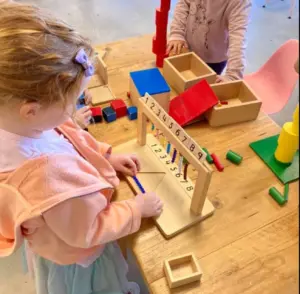
At this stage, the child fits cylinders, stacks blocks, pours water from one container to another, and begins to scribble. In our Montessori Nido (0-3 years) in Sotogrande, we work with transferring, threading, and buttoning activities that prepare the hand for future writing.
3 to 6 Years: Precision and Autonomy
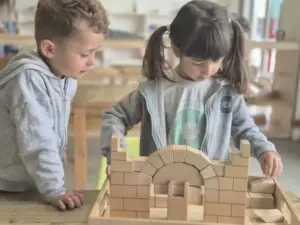
The child cuts with scissors, molds playdough, sews with plastic needles, and uses tongs for transferring. In Children’s House (3-6 years), each material has a built-in control of error: the child checks for themselves if they did it right. This reinforces confidence as much as dexterity.
6 to 12 Years: Complexity and Creativity
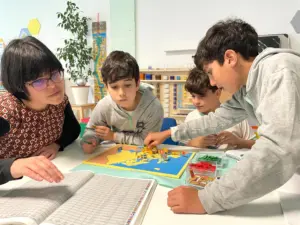
In Elementary (6-12 years), the hands master real tools: compass, ruler, sewing needle, small saw. Geometry, carpentry, and art projects require sophisticated fine motor control. This is the stage where fine motor skills become a means of expression.

Activities to Stimulate Fine Motor Skills at Home
You don’t need to buy specialized kits. The best opportunities are in daily routines.
- 1 to 2 years: Inserting coins into a piggy bank slot, opening and closing jar lids, tearing off adhesive tape.
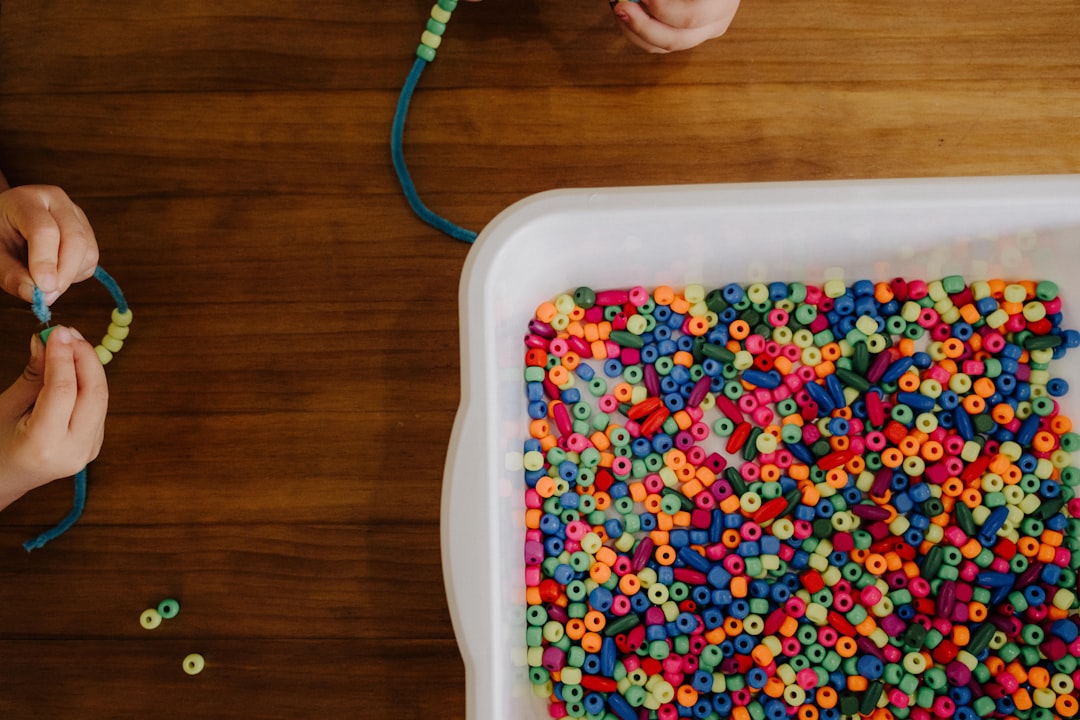
- 2 to 3 years: Threading large beads with a cord, using a spoon to transfer beans, stacking towers of 5-6 blocks.
- 3 to 5 years: Cutting paper strips with blunt-tip scissors, buttoning and unbuttoning, shaping playdough balls.
- 5 to 8 years: Sewing with a blunt needle, making bracelets with small beads, folding paper (simple origami).
At IMS, we incorporate these activities into the daily classroom routine. If you want to see how we do it, book a personalized school visit and discover the prepared environment firsthand.
Montessori Materials for Fine Motor Control
Montessori pedagogy designed specific materials to train manual precision. Each has a clear purpose and a built-in control of error that allows the child to self-correct.
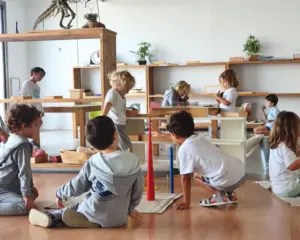
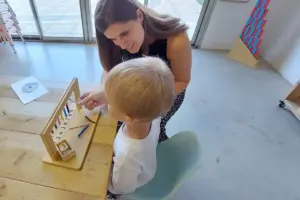
- Pink Tower and Brown Stair: Stacking cubes of different sizes trains the pincer grasp and visual coordination.
- Cylinder Blocks: Extracting and reinserting cylinders develops prehension and size discrimination.
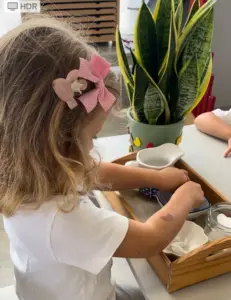
- Transferring Trays: Pouring water or grains from one container to another demands movement control and concentration.
- Buttoning and Fastening Frames: Practicing with zippers, ties, buttons, and clasps prepares for personal autonomy.
These materials are present in our Nido, Children’s House, and Elementary classrooms. They are not toys: they are work tools with a concrete developmental objective.
Warning Signs in Fine Motor Development
Each child follows their own timeline, but certain patterns warrant attention. Consult a professional if you observe:
- They do not achieve the thumb-index pincer grasp by 15-18 months.
- They systematically avoid activities that involve using their hands (drawing, cutting, manipulating).
- They cannot hold a pencil with a pincer grasp by age 4.
- Extreme difficulty buttoning or using scissors at 5-6 years old.
The American Academy of Pediatrics recommends observation as the first tool. At IMS, we have the Rainbow classroom, specialized in diversity and attention to special educational needs, to accompany each child in their process.
Frequently Asked Questions
At what age should a child be able to cut with scissors?
Most children can make straight cuts with blunt-tip scissors between ages 3 and 4. Before that age, tearing paper with their hands or ripping strips is valid training. The important thing isn’t the exact date, but that the child has regular opportunities to practice.
Do electronic toys help with fine motor skills?
Not significantly. Fine motor skills are developed by manipulating real objects with texture, weight, and volume: threading, cutting, molding, transferring. Touch screens work a limited gesture (swiping, tapping) that does not replace the sensory richness of physical materials.
What if my child doesn’t want to do crafts?
First, observe if they avoid all manual activities or just directed ones. Many children reject crafts with a pre-set template but enjoy molding playdough or building with free-form pieces. Offer varied alternatives without pressure. If avoidance is widespread, consult a child development specialist.
At IMS, do you teach fine motor skills as a separate subject?
No. In Montessori pedagogy, fine motor skills are not an isolated subject: they are integrated into every classroom activity. From pouring water into a glass to drawing a map, each task trains hand control in a contextualized and meaningful way.
Key Takeaways
Fine motor skills are the foundation of a child’s manual autonomy. They are built with real practice, suitable materials, and time. They don’t need technology or expensive programs: they need free hands, interesting objects, and an adult who trusts the child’s ability.
If you want to see how eye-hand coordination is worked in an authentic Montessori environment, book a visit to IMS Sotogrande. We are in Sotomarket, just minutes from La Línea, Algeciras, Estepona, and the entire Campo de Gibraltar area.