Montessori & Brain Science: How Neuroscience Explains Our Classroom | IMS Sotogrande
In short
When a parent asks me on a school tour if Montessori is ‘just a trend,’ my answer is always the same: it’s not a passing fad, it’s a method that modern neuroscience is confirming step by step.

When a parent asks me on a school tour if Montessori is ‘just a trend,’ my answer is always the same: it’s not a passing fad, it’s a method that modern neuroscience is confirming step by step. The link between Montessori and neuroscience isn’t a coincidence, and understanding it will help you see why your child learns the way they do in our classroom.
Key points:
- Montessori education anticipated neuroscientific discoveries decades before science proved them.
- The child’s brain learns best with guided freedom, movement, and repetition, three Montessori pillars.
- At IMS Sotogrande, we apply these principles every day in Nido, Children’s House, and Workshop (Taller).
What Brain Science Says About How Children Learn
A child’s brain isn’t a miniature adult brain. From birth to age six, neuronal plasticity is at its peak: synaptic connections form at an astonishing rate, and every sensory experience leaves a mark. Educational neuroscience shows that deep learning happens when a child manipulates, moves, and chooses, not when passively listening to an explanation.
Studies from the Karolinska Institute in Stockholm and publications in the journal Frontiers in Human Neuroscience confirm that environments combining freedom with structure generate greater activity in the prefrontal cortex. This brain region is linked to decision-making, self-regulation, and logical reasoning, exactly what we aim for in Montessori education.
Book a personalized school visit and discover how this looks in our classrooms.

How Montessori Pedagogy Anticipated Brain Science
Maria Montessori observed children’s behavior for decades without access to MRI scanners or brain imaging. Yet, her conclusions match point by point what neuroscientists measure today. That’s the power of Montessori and neuroscience : a convergence that isn’t coincidental but logical.
For example, Montessori identified ‘sensitive periods’ in the 1900s. Today, neuroscience calls them ‘windows of opportunity’ or critical periods. These are phases when the brain is especially receptive to certain learnings: language from 0-6 years, order from 1-4, movement from 0-3. If the environment offers the right stimuli at that time, learning integrates easily. If not, the brain redirects those resources elsewhere.
Another example: the three-hour work cycle Montessori designed for classrooms. Neuroscience explains why it works. The brain needs time to enter a state of deep concentration, what Mihaly Csikszentmihalyi called ‘flow.’ Interrupting that state every 45 minutes with a subject change (as in traditional education) prevents learning from consolidating.

The Role of Movement in Brain Development
Neuroscience confirms that movement isn’t a distraction, it’s a learning facilitator. In Montessori, children get up, walk, manipulate materials with their hands, and work on the floor or at a table sized for them. They aren’t sitting still for eight hours staring at a blackboard.
Why? Because the brain’s motor areas are interconnected with language and cognition areas. A study published in Psychological Science showed that kinesthetic learning (with hands and body) improves information retention by up to 75% compared to passive listening. In our IMS classrooms, we see this daily: a Children’s House child working with sandpaper letters is simultaneously integrating touch, sound, and visual tracing. That’s applied neuroscience.

How We Apply This Every Day at IMS Sotogrande
At IMS Sotogrande, the link between Montessori and neuroscience isn’t marketing talk. It’s what happens daily in our classrooms, from Nido to Workshop (Taller).
In Nido (0-3 years)
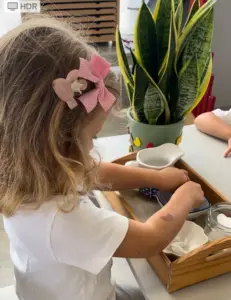
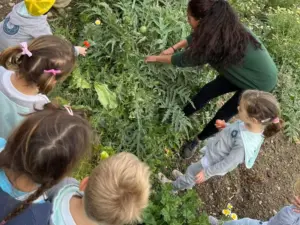
Babies and toddlers work with sensory materials designed to activate multiple brain areas at once. Freedom of movement within a safe environment stimulates neuronal plasticity at the stage of greatest development. Our guides observe, not direct, respecting the brain’s natural rhythm.
In Children’s House (3-6 years)
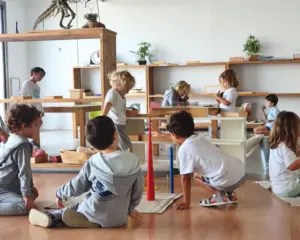
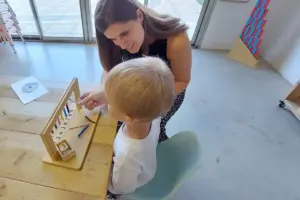
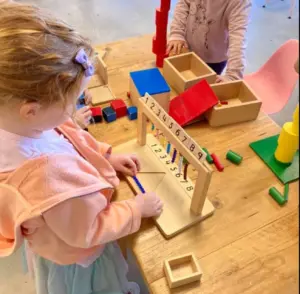
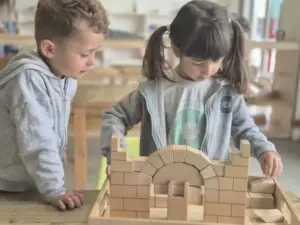
Here, sensitive periods are in full swing. Montessori materials (the pink tower, cylinders, language materials) are designed to exploit these windows of opportunity. Children repeat as many times as they want, because repetition consolidates neural networks. The guide introduces the material at just the right moment, not before, not after.
In Workshop/Taller (6-12 years)
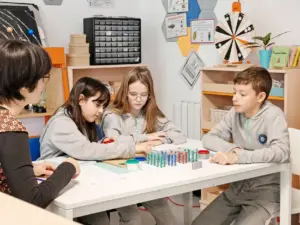
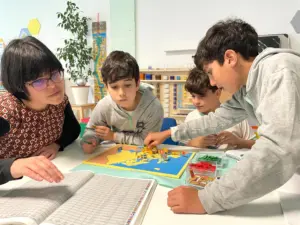
The brain of an elementary-age child begins to reason abstractly. Montessori materials evolve toward symbolic representation, and collaborative projects stimulate the prefrontal cortex and social skills. Neuroscience shows that peer learning activates neural networks that individual learning doesn’t.
Additionally, at IMS we are trilingual (Spanish, English, and German), and neuroscience confirms that bilingualism and multilingualism strengthen the brain’s executive function: more connections, more cognitive flexibility, greater problem-solving capacity.
What Parents Can Do at Home Based on Neuroscience
You don’t need to be a neuroscientist to apply these principles at home. Here are four practical ideas:
- Offer limited choices. A child’s brain saturates with too many options. Two or three toys at a time are enough to activate decision-making without generating anxiety.
- Respect concentration periods. If your child is absorbed in an activity, don’t interrupt them. You’re witnessing ‘flow’ in action.
- Allow movement. A child who moves while learning isn’t distracted, they’re integrating information through their body.
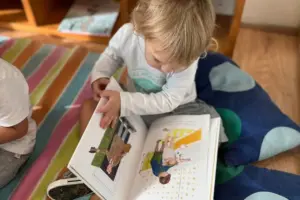
- Repeat without embarrassment. If they want to read the same book 15 times, let them. Repetition strengthens synapses.
To learn more, I recommend the resources of the Spanish Montessori Association and publications from the Association Montessori Internationale, the organization that accredits our training.
Frequently Asked Questions
Are Montessori and neuroscience the same thing?
They aren’t the same, but they complement each other naturally. Montessori is a pedagogy based on observing children. Neuroscience is a science that studies the brain. What’s fascinating is that Maria Montessori’s conclusions, formulated over a century ago, align with what brain scans and clinical studies measure today. That’s why we say Montessori is a method backed by brain science.
Which Montessori materials are designed according to neuroscience?
All sensory and manipulative Montessori materials are designed to activate multiple brain areas. The pink tower works on visual perception and fine motor coordination. Knobbed cylinders activate sensory discrimination. Sandpaper letters integrate touch, sight, and phonetics. Each material is a neuroscientific tool disguised as a toy.
At what age is the combination of Montessori and neuroscience most effective?
The greatest impact occurs from birth to age six, when brain plasticity is at its peak. But the principles remain effective in the elementary stage (6-12 years) and adolescence. The brain never stops learning. The mechanisms simply change. In the Workshop (Taller), collaborative and abstract learning leverages the new capacities of the pre-adolescent brain.
Does bilingualism at IMS have a neuroscientific basis?
Yes. Multiple studies show that speaking two or more languages strengthens executive function, improves attention, and delays cognitive decline. At IMS, we offer immersion in Spanish and English from Nido, and add German in later stages. It’s not just a linguistic value-add, it’s a constant neural exercise.
Key Takeaways
The connection between Montessori and neuroscience isn’t a marketing strategy, it’s a reality that backs every decision we make in our classrooms. From freedom of movement to three-hour work periods, each element has a scientific explanation that confirms what Maria Montessori intuited by observing children.
If you want to see how this union works in practice, we invite you to visit us in Sotogrande. Book a personalized visit and see for yourself why families from La Línea, Algeciras, Estepona, and across the Costa del Sol choose IMS as the school where their child’s brain thrives.