Montessori Sandpaper Letters: A Guide for Parents | IMS Sotogrande
In Montessori pedagogy, learning to read and write doesn’t start by sitting a child down with a blank sheet of paper. It starts much earlier, with the hands. One of the most elegant materials for this process is Montessori sandpaper letters , a sensorial resource that allows young children to memorize the shape of each letterform through touch before ever picking up a pencil.
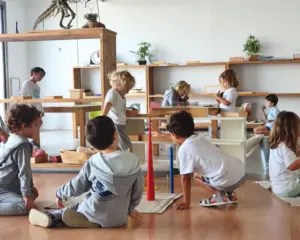
At IMS Sotogrande, these letters are part of the prepared environment in our Children’s House (ages 3-6) and are a fundamental tool in our trilingual approach. But you don’t need a full Montessori classroom to start working with them at home. With a little patience and knowledge, any family can incorporate them into their daily routine. When it comes to Montessori sandpaper letters, it pays to listen to what families and lead guides actually report.
- Key points
- Sandpaper letters develop the muscle memory and visual discrimination necessary for writing.
- They are presented in three phases: introducing the sound, tracing the letter, and associating sound-grapheme.
- The material is multisensory: it involves touch, sight, and hearing.
- The goal is not to memorize the letter’s name, but its sound and shape.
- They can be used from around 2.5-3 years old, when a child shows interest in symbols.
What exactly are Montessori sandpaper letters?
Sandpaper letters are a teaching material designed by Maria Montessori. They consist of wooden tablets where each letter of the alphabet is cut out of sandpaper—green for vowels and blue for consonants. The child traces them with their index and middle fingers, following the correct stroke direction, while the adult names the letter’s sound. This exercise combines three learning channels: visual, tactile, and auditory. Daily practice with Montessori sandpaper letters reveals nuances no handbook fully captures.
The difference from other materials is its phonetic approach. We don’t tell the child “em,” but the sound /m/. This makes the later blending of sounds to read words much easier. According to the AMI (Association Montessori Internationale), this material is essential for developing written language in early childhood. Understanding Montessori sandpaper letters from inside the classroom reshapes everyday decisions.
The presentation process: three key steps
Montessori’s three-period lesson is applied here rigorously. First, you introduce two or three letters that the child can distinguish well phonetically and visually, such as “m”, “s”, and “a”. The sandpaper letters are presented on a stand, and you trace them with your fingers while naming the sound.
In the second step, you ask the child to point to the letter that sounds a certain way (“Which one is /s/?”). In the third step, you touch a letter and the child names the sound. This method, proven in thousands of classrooms, avoids confusion and builds solid learning.
Book a personalized school visit to see how our guides present this material in the classroom.
Common mistakes when using them at home
The most frequent mistake is presenting the entire alphabet at once. That overwhelms the child. Another common error is naming the letter by its name (“em”) instead of its sound (/m/). This creates a serious obstacle when they try to read, because they’ll associate “em-a-em” instead of “ma-ma”. It’s also important not to force pencil writing too soon; hand preparation is done with fingers on the sandpaper.
Remember: the goal is not for the child to repeat like a parrot, but to feel the shape and connect the stroke with the sound. Repetition should be voluntary and enjoyable, never an obligation.
What age to start with sandpaper letters?
There’s no fixed age, but the sensitive period usually appears between 2.5 and 4 years old. The child starts asking “what does this say?”, tries to “write” intentional scribbles, or shows fascination with books. In the Montessori Children’s House environment (ages 3-6), sandpaper letters are available independently on the language shelf. The child chooses them when they are ready.
At home, you can offer them as just another game. If the child ignores them, that’s fine. Put the material away and offer it again in a few weeks. Observation is your best tool.
Sandpaper letters in a trilingual environment
At IMS Sotogrande, our Spanish-English bilingual immersion program uses this material to introduce the phonemes of both languages in parallel. A child might be working on the “s” in Spanish and the “th” in English, strengthening their auditory perception and phonetic discrimination skills. This approach, supported by the EU-funded Bilingual Montessori program, is one of the reasons families from La Línea, Algeciras, and the Campo de Gibraltar area choose us. The combination of sensorial learning and bilingualism creates an incredibly solid linguistic foundation.
Frequently asked questions
Do sandpaper letters teach reading directly?
Not directly, but they are a fundamental step. Sandpaper letters prepare the hand for writing and train the ear to recognize phonemes. When a child knows the sounds and shapes, the transition to pencil-writing movements and reading words happens naturally and fluidly.
Can I make my own sandpaper letters at home?
Yes, though it requires precision. You need wooden tablets, fine-grit sandpaper, scissors, and paint. Vowels are made in green and consonants in blue, following the AMI standard. The most important thing is that each letter’s stroke is exact and that you use the correct direction. If you don’t have experience, it might be safer to purchase them from a certified Montessori material supplier.
What’s the difference between sandpaper letters and writing movements?
Sandpaper letters are a sensorial material for memorizing shape and sound. Writing movements are fine motor exercises (lines, circles, zigzags) done on paper or in sand trays. They complement each other. Sandpaper letters provide the content (the letters), and writing movements provide the motor skill to form them.
Key takeaways
Sandpaper letters are not a toy or an educational marketing gimmick. They are a scientific material designed over a century ago that continues to prove its effectiveness in thousands of classrooms and homes. If your child is between 2 and 5 years old and is starting to show interest in symbols, this is the time to introduce them calmly and without rush.
If you want to see how we work with this material in our Children’s House classrooms, we invite you to book a visit. There you can observe the entire process and get your questions answered by our AMI-certified guides.