Montessori Activities at Home: A Practical Guide for Parents
In short
When a family considers doing Montessori activities at home, the first question is: do I need to buy special materials? The answer is a resounding no. Montessori is not about objects. It's about attitude. It's about looking at your child with respect and offering real opportunities to do things themselves. And that, at home, is easier than it seems.

When a family considers doing Montessori activities at home , the first question is: do I need to buy special materials? The answer is a resounding no. Montessori is not about objects. It’s about attitude. It’s about looking at your child with respect and offering real opportunities to do things themselves. And that, at home, is easier than it seems.
At International Montessori School Sotogrande, we see this every day. Our children, from 18 months, put on their own coats, cut fruit, or sweep up crumbs. They’re not gifted. The environment allows it. If you want to start at your home, here’s a practical guide without jargon.
- Montessori Activities at Home: Where to Start
- The Prepared Environment: The Foundation of Montessori Activities at Home
- Montessori Activities at Home by Age: 0-3 and 3-6 Years
- Practical Life: Montessori Activities at Home That Transform Daily Routines
- Observe Without Judgment: The Engine of Montessori Activities at Home
- Common Mistakes When Bringing Montessori Home (And How to Avoid Them)
- Frequently Asked Questions
- Key Takeaways
Montessori Activities at Home: Where to Start
When we talk about Montessori activities at home, we don’t mean sitting a 2-year-old with a pouring tray for 20 minutes while you have coffee. That would be ideal, but reality is much more organic. Everyday activities, setting the table, watering plants, folding napkins, are the heart of the method. So first, you don’t need a budget. You need a shift in perspective.
The Association Montessori Internationale (AMI) defines the prepared environment as one that meets the child’s needs and invites exploration. At home, that means adapting some spaces to their scale, yes, but also slowing down. For example, instead of dressing them in 2 minutes because we’re late, we let them try to put on their socks (even if it takes 10 minutes). That’s already a top-level Montessori activity at home.
If you’d like to see how we apply these principles in a real setting, I encourage you to book a personalized visit to our school in Sotogrande. You’ll see the prepared environment in action and can ask all your questions.

The Prepared Environment: The Foundation of Montessori Activities at Home
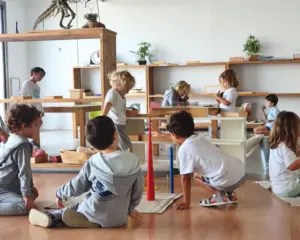
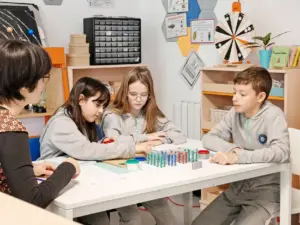
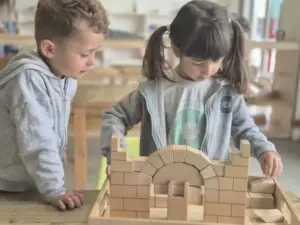
In a Montessori school, classrooms are precisely designed: low furniture, beautiful and fragile objects, everything in its place. At home, you don’t need to replicate a school, but you can apply three keys: order and beauty, independence, and reality.
Order and Beauty
Young children absorb external order to build internal order. So having toys organized in baskets, with only a few visible, helps them focus. It’s not decorative minimalism. It’s concentration. If your child gets easily distracted, check how many stimuli surround them. Less is more. So put out only 6-8 items and rotate weekly.
Low Shelves
A low shelf with trays in the living room or bedroom becomes a small lab. You don’t need the most expensive learning tower. A coffee table or sturdy stool works. The key is that they can get and return materials without help. When a child puts an object back, they complete a cycle of activity. For their brain, that’s a bigger reward than any praise.
Montessori Activities at Home by Age: 0-3 and 3-6 Years
Not all activities suit every stage. In Montessori, we follow sensitive periods. So here are some ideas for each range.
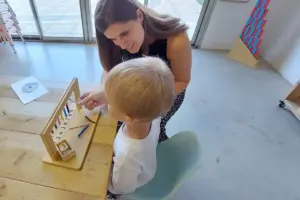
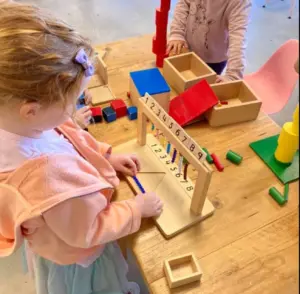
0 to 3 years : The focus is movement and language. Simple activities: opening and closing jars, pouring beans with a spoon, matching socks, or pointing to body parts while bathing. Anything that involves hand-eye coordination and lots of conversation. At IMS, Nido (0-3) children spend much of the morning exploring like this.
3 to 6 years : Here, sensory refinement and practical life dominate. You can prepare trays with tongs and pom-poms, color sorting boards, or involve them in cooking: washing vegetables, peeling hard-boiled eggs, measuring ingredients. Also, puzzles and memory games. Repetition is key. Don’t interrupt if they’re focused. A mother from our Sotogrande community told me her 4-year-old spent 25 minutes threading pasta. That’s Montessori concentration.
- Pouring with a spoon (12-18 months)
- Threading macaroni (2-3 years)
- Sorting seeds by color (3-4 years)
- Cutting banana with a blunt knife (3-4 years)
- Setting up an hourglass timer (4-5 years)
Practical Life: Montessori Activities at Home That Transform Daily Routines
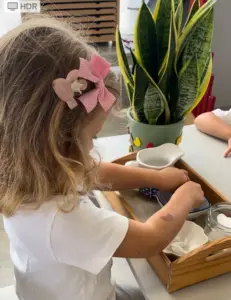
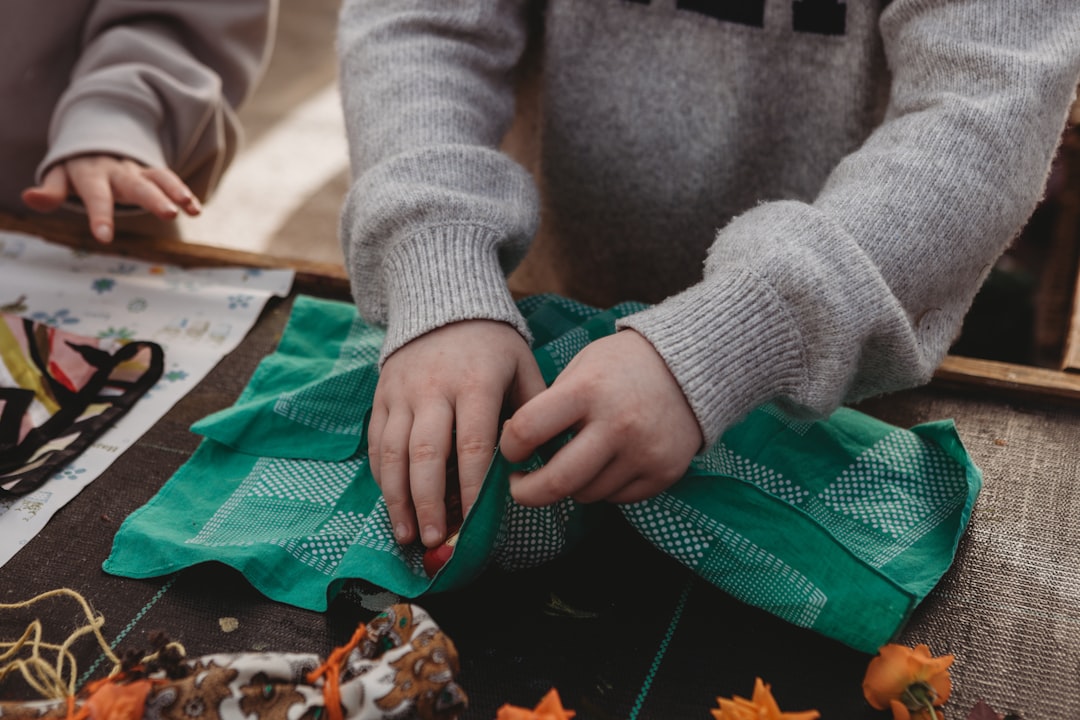
Often, parents search for Montessori activities on Pinterest and forget that the real workshop is the kitchen, bathroom, or garden. Practical life is the backbone of the Montessori curriculum. Instead of preparing a special tray, ask yourself: what real task can I share with my child today? Watering a plant, filling the dog’s bowl, cleaning a small mirror, folding napkins. All this develops coordination, sequencing, and self-esteem.
At IMS, for example, after snack, each child cleans their table and sweeps if needed. It’s not punishment. It’s contribution. Children who feel useful develop an impressive sense of belonging. So avoid isolated, artificial activities: daily life is the best material.
Observe Without Judgment: The Engine of Montessori Activities at Home
We often jump to teach before observing. Montessori invites the opposite: first watch what your child is trying, what movements they repeat, what frustrates them. That information tells you what tray to prepare tomorrow. For example, if they struggle with jacket buttons, instead of correcting, you can make a dressing frame with large buttons. It’s not about perfection, but about practicing the sequence successfully.
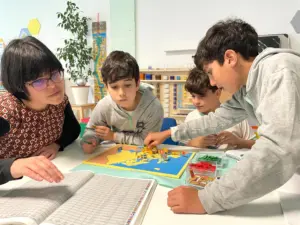
In our IMS Sotogrande classrooms, guides spend much of the day sitting on a stool, taking notes. That silent observation is their main tool. At home, you can do the same: 5 minutes a day without your phone, just watching. You’ll discover your little one already knows how to do much more than we allow.
Common Mistakes When Bringing Montessori Home (And How to Avoid Them)
I’ve seen many enthusiastic parents end up frustrated. Here are the most repeated mistakes:
- Correcting too much : If the child doesn’t do it “right,” it’s fine. The process matters. Saying “try it this way next time” instead of “that’s not how you do it” makes a difference.
- Too many choices : Two or three options are enough. More than five overwhelms and leads to abandonment.
- Lack of clear boundaries : Montessori isn’t just letting them do anything. You must set rules firmly and kindly. “This material stays on the table. We don’t run with it.” Boundaries provide security.
- Comparing with school : At home, we’re not professional guides. Don’t expect perfection. The relationship is different, and that’s okay.
If your child rejects an activity, put it away for a while and offer it later. Sensitivity changes. At IMS, guides observe without judgment and adjust to the moment’s need.
Frequently Asked Questions
At what age can you start Montessori activities at home?
From birth. Initially, it’s about preparing the environment: a mirror at the changing table, a high-contrast mobile, freedom of movement on a mat. Around 8-10 months, with the start of solids, many families introduce a small cup and bib. The key is to observe what the child is trying to do independently and give them just the right step.
Do I need to buy Montessori materials?
Most activities can be set up with everyday objects. Old keys, a cloth, a brush, spices to smell… Specific Montessori materials like the pink tower are wonderful but not essential at home unless you have training. If you decide to buy some, ensure they are wooden, realistic, and self-correcting. At IMS, we always recommend families spend time with what they already have before investing. You’ll likely discover a treasure in the cleaning cupboard.
Can I apply Montessori if my child goes to a traditional school?
Absolutely. Montessori isn’t a piece of wooden furniture. It’s a philosophy. Respecting their pace, giving independence in dressing, involving them in cooking, not interrupting their play… All of that is pure Montessori. Many families from our community in Campo de Gibraltar have told us: when they change their perspective at home, the child thrives even if they attend a different type of school during the day. Although nothing beats experiencing it daily, of course.
How do I maintain order without burning out?
Rotating toys and materials every week cuts chaos in half. You store baskets out of sight and leave only 6-8 items. Children participate in cleanup if you model it without anger: “Now let’s pick up the blocks together.” Gradually, this routine becomes a habit. And remember: an orderly environment is not a museum. It’s a living space. Some days will be messier, and that’s okay.
Key Takeaways
Introducing Montessori activities at home doesn’t require a master’s degree or a lot of money. It comes down to slowing down, observing, and giving your child an active role in family life. The result isn’t always immediate, but when you see your little one rinsing their plate or setting the table with pride, you understand why the effort is worth it.
If you’d like to learn more and see how we work these same principles in a trilingual school with AMI-trained guides, come visit us. At IMS Sotogrande (San Roque, Cádiz), we accompany families from Campo de Gibraltar, Estepona, Gibraltar, and beyond. We’d be delighted to show you our bright, lively classrooms. Book your visit here or email us at [email protected].