
Montessori Sleep Guide: Help Your Child Sleep Better Naturally (2026) - IMS Sotogrande
In short
“My child doesn’t sleep well” is a phrase I hear almost daily in tutorials and workshops. And I say it with the calm of someone who has accompanied hundreds of nights: infant sleep is not a problem to fix, but a maturational process that asks for observation, respect, and a prepared environment.
![Mi hijo no duerme bien: guía Montessori para familias [Guía 2026]](https://ims-sotogrande.com/wp-content/uploads/2026/06/post-289-img-1-1780554165351-398cb5c7.jpg)
“My child doesn’t sleep well” is a phrase I hear almost daily in tutorials and workshops. And I say it with the calm of someone who has accompanied hundreds of nights: infant sleep is not a problem to fix, but a maturational process that asks for observation, respect, and a prepared environment. In this article I share how we apply Montessori pedagogy to rest, from birth to age 6, so that family nights are a little kinder. In this article we explore Montessori sleep guide in depth with practical examples.
- The Montessori perspective on infant sleep
- Why my child does not sleep well: understanding the planes of development
- Respectful routines when your child does not sleep well
- The prepared environment for rest: from crib to Montessori bed
- How to accompany night wakings without losing calm
- The role of diet and movement in infant sleep
- Signs that you need to consult a professional
- Frequently asked questions
- Key takeaways
The Montessori perspective on infant sleep
Maria Montessori never wrote a sleep manual, but her philosophy gives us the keys: the child is a developing being who needs predictable rhythms and an environment that offers security. When a child doesn’t sleep well, they are not “misbehaving” or trying to manipulate. Simply, their nervous system is maturing or some need, physical, emotional, or sensory, is not covered. When it comes to Montessori sleep guide, it pays to listen to what families and lead guides actually report.
From the Montessori perspective, sleeping is not training. It is a conquest that the child makes when they feel safe. Therefore, instead of imposing rigid schedules or letting them cry, we observe and adjust. Sleep, like movement or language, follows development plans: in the first plane (0-6 years) the child absorbs the world, and the way they fall asleep is also part of that absorption. Daily practice with Montessori sleep guide reveals nuances no handbook fully captures.

Why my child does not sleep well: understanding the planes of development
When a family tells us “my child doesn’t sleep well,” the first thing we do at IMS is ask the age. Because the sleep of a 6-month-old baby is nothing like that of a 3-year-old child. And here neuroscience supports us: sleep cycles change with brain myelination and sensitive periods. Understanding Montessori sleep guide from inside the classroom reshapes everyday decisions.
In the sub-plane 0-3 years, the child goes through the stage of “self and environment.” They need to feel the adult’s presence to relax. Frequent night wakings are physiological: the Spanish Association of Pediatrics reminds us that up to 30% of children under 2 years wake up several times a night. It is not a disorder. It is a survival mechanism that asks for contact. Concrete data on Montessori sleep guide is worth reviewing before acting on assumptions.
From 3 to 6 years the child enters the sub-plane of the “conscious absorbent mind.” They begin to understand sequences and can participate in the bedtime routine. But their nighttime fears also increase, because their imagination is at full capacity. That “fear of the monster” is not nonsense: it is the manifestation of a brain that, finally, can create mental images.
If you want to see how we apply these principles in a trilingual environment with guides trained by the Association Montessori Internationale (AMI), book a personalized visit to the school. We will show you our prepared environments and how we respect each child’s individual rhythms.
Respectful routines when your child does not sleep well
A routine is not a military schedule. It is a predictable pattern that tells the child’s brain: “you are safe, you can let go of control.” Families who come to IMS from Sotogrande, Alcaidesa or La Línea confirm that when they establish a simple sleep ritual, resistance decreases.
What does a Montessori routine look like? Short, sensory, and participatory. No screens or blue lights. The last 30-45 minutes before sleep are sacred. Here is a sequence that works:
- Warm bath or hand and face wash with warm water (water relaxes the autonomic nervous system).
- Pajamas chosen by the child, even if they combine eccentrically: choosing gives autonomy and calms the need for control.
- A quiet story, on the sofa or in an armchair, never in bed. Thus the bed is only associated with sleeping.
- Lullaby or three deep breaths together. Children 3-6 enjoy imitating breaths.
- Clear goodbye: “Goodnight, mommy/daddy loves you. Now I close the door and I’ll see you in the morning.” Without dragging on.
The key is consistency. It doesn’t matter if one day fails. What matters is that the child knows what to expect 80% of the time. In the Children’s House Montessori classrooms we apply the same principle: work and rest periods have an order, and children self-regulate because they trust the environment.

The prepared environment for rest: from crib to Montessori bed
Maria Montessori spoke of the low bed from her first book. The idea is radically simple: a mattress on the floor, at the child’s height, so they can get in and out by themselves. This eliminates the feeling of confinement and fosters autonomy even at night.
Many families from Campo de Gibraltar ask us if it is safe. The answer is yes, as long as the room is adapted: covered outlets, furniture anchored to the wall, no small objects within reach, and a soft barrier at the door if there are stairs. The child can crawl to the floor, explore for a while, and return to their mattress when sleep comes.
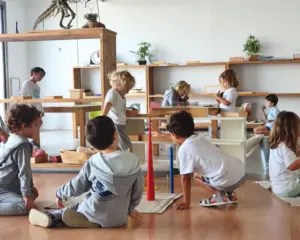
But the environment is not just furniture. It includes temperature (18-20°C is ideal), darkness (a very dim red nightlight if the child asks), and silence. In a Montessori environment, external order helps internal order. Toys are stored, clothes are in low baskets, and there is a calm corner with a cushion and a stuffed animal. This reduces the sensory chaos that often triggers “I don’t sleep well.”
How to accompany night wakings without losing calm
Wakings are normal. What makes the difference is how we respond. If every time the child cries we run, turn on lights, and offer a thousand options, we are overstimulating. If we ignore them, we break the bond. Montessori proposes a middle point: serene presence and minimal intervention.
A technique I share in the “Accompanying you” workshops at IMS is the whisper-guide : we enter the room, sit at a meter distance, and in a very low whisper say “mommy is here, you are safe, go back to sleep.” Without direct eye contact, without picking up unless there is panic. Most wakings resolve in less than five minutes, and the child learns that they can fall back asleep with their own resource.
For the youngest (0-3 years), respectful co-sleeping is an option that many families choose, and Montessori does not demonize it. The important thing is that the decision is conscious and that the family bed is safe. The opposite is what exhausts: improvising solutions every night and ending up all on the sofa at three in the morning.
The role of diet and movement in infant sleep
We cannot talk about “my child doesn’t sleep well” without looking at what happens during the day. A child who spends the afternoon sitting in front of a screen has not used the motor energy their brain needs to secrete melatonin. Montessori environments are designed for free movement: from 0 years, on the tummy, crawling, then walking, climbing. At the end of the day, the body asks for rest.
Dinner also matters. Sugar spikes just before sleep alter the cycle. An early dinner with light proteins and complex carbohydrates, a plate of vegetables with quinoa, for example, helps stabilize glucose. At IMS, the school menu follows this philosophy, and many families notice that on school days children sleep better because they have had an active day and balanced diet.
Signs that you need to consult a professional
Most sleep problems resolve with adjustments at home. However, there are situations that require pediatric evaluation or a sleep specialist:
- Loud snoring with breathing pauses (possible apnea).
- Frequent sleepwalking with risk of injury.
- Insomnia lasting more than two hours every night for weeks.
- Extremely irritable child during the day despite sleeping enough hours.
- Abrupt sleep regression coinciding with family stress or major environmental change.
In these cases, Montessori guides do not replace a doctor. At IMS we always recommend seeing a trusted pediatrician and, if necessary, a pediatric sleep unit. As a school, we support with routines, environment, and communication with the family, but we do not make clinical diagnoses.
Frequently asked questions
What to do when my child does not sleep well and wakes up many times?
First check the environment: are there noises, lights, inadequate temperature? Then observe if wakings coincide with developmental leaps (week 26, 37, 46 in babies, 18-month or 4-year crises). Accompany with calm presence and maintain a consistent bedtime routine. If wakings last more than three weeks without improvement, consult a pediatrician.
Is Montessori against co-sleeping?
No. Montessori respects the family’s informed decision. Co-sleeping can be a valid tool during breastfeeding and the first year, as long as it is practiced safely. What Montessori does promote is that from age 2-3, the child has their own space, a low bed on the floor, to foster autonomy. But the transition is gradual and without pressure.
At what age can a child sleep alone according to Montessori?
There is no fixed age. It depends on emotional development and the security the child has built. Some children are ready at 2. Others need company until 5 or 6. The important thing is that the process is gradual and respectful. At IMS, when a child in Children’s House (3-6 years) verbalizes that they want to sleep in their own room, we help the family with transition strategies starting with daytime naps in that space.
Do sleep training methods work in a Montessori approach?
Methods that involve leaving the child to cry alone are not compatible with Montessori because they ignore the need for bonding. Instead, we propose progressive accompaniment: the adult is present, but gradually withdraws help, as in learning any other skill. Some families combine elements of the “Montessori bed method” with gradual distancing strategies, always listening to the child’s signals.
Key takeaways
Infant sleep is a journey, not a destination. When you repeat “my child doesn’t sleep well,” transform that complaint into observation: what do they really need? Perhaps just time, or a softer routine, or a mattress on the floor where they feel free. Montessori pedagogy gives you tools, but the true expert on your child’s sleep is you, their family.
If this article has been useful, I invite you to visit our school in Sotogrande, where every day we see how children who feel safe and respected also rest better. Book your personalized visit and discover an educational environment that cares for body, mind, and sleep.
By Viviane Dumont, Director of Studies at IMS Montessori Sotogrande.