
Montessori Guide: How to Motivate Your Child to Study (Without Conflict)
In short
The question "how do I get my child to study" echoes in many homes when school starts. Homework becomes a daily battle, grades create tension, and we exhaust the "it's important for your future" speech. I've seen this in families who come to IMS Sotogrande exhausted from fighting.
![Como hacer que mi hijo estudie [Guía Montessori]](https://ims-sotogrande.com/wp-content/uploads/2026/06/post-270-img-1-1780496499978-641b04e3.jpg)
The question “how do I get my child to study” echoes in many homes when school starts. Homework becomes a daily battle, grades create tension, and we exhaust the “it’s important for your future” speech. I’ve seen this in families who come to IMS Sotogrande exhausted from fighting. The answer isn’t more control, but a shift in perspective: from obligation to intrinsic motivation. In this article we explore Montessori study motivation in depth with practical examples.
In Montessori, studying isn’t an external imposition. It’s an internal need of the child when the environment and guidance are right. Maria Montessori called this “sensitive periods”: windows of opportunity when the brain is ready to absorb certain skills with almost voracious interest. When we force learning outside these rhythms, we extinguish curiosity. So the question isn’t how to make them study, but what they need for studying to flow naturally. When it comes to Montessori study motivation, it pays to listen to what families and lead guides actually report.
How to Get Your Child to Study Without Forcing Them: The Montessori Answer
Intrinsic motivation doesn’t come from rewards or punishments. It’s cultivated with three elements: autonomy, purpose, and connection. A child who chooses their activity, understands its purpose, and feels safe will concentrate without being asked. Daily practice with Montessori study motivation reveals nuances no handbook fully captures.
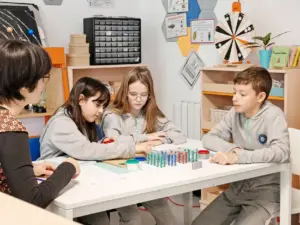
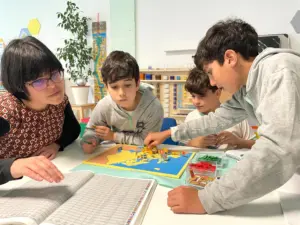
At our school in Sotogrande, we see daily how 6-year-olds spend forty-five minutes practicing addition because they decided to do it themselves. There’s no reward beyond the satisfaction of completing the material. The Montessori guide only observes and offers the next lesson when the child has mastered the previous one. It’s a process that respects individual pace and removes external pressure. Understanding Montessori study motivation from inside the classroom reshapes everyday decisions.
According to the Association Montessori Internationale, Montessori education develops self-discipline and a love for learning because the child is the protagonist of their own process. They don’t study for the teacher or the grade: they study because their brain is hungry to understand the world. Concrete data on Montessori study motivation is worth reviewing before acting on assumptions.
If you’re looking for a school where studying stems from curiosity, not obligation, we invite you to visit our environment in Sotogrande. Book a personalized school tour and see how our students learn from ages 0 to 12.

Prepare the Study Environment: Less Is More
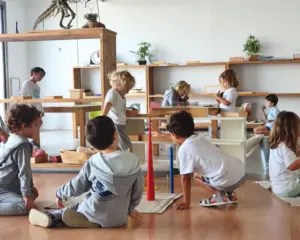
The environment is the third teacher. A table full of stimuli, screens on, or background noise destroys any child’s concentration. In Montessori, we design orderly spaces with few materials in sight, rotated according to current interests.
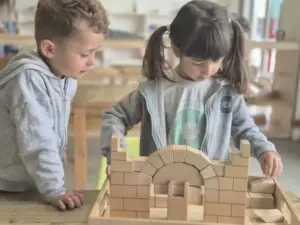
At home, you can replicate this principle on a budget. A low shelf with four or five activities: puzzles, sandpaper letters, pouring jars, or an abacus. Nothing more. The child chooses, works, and returns the material before taking another. This external structure creates mental order and, over time, a study habit without constant reminders.
Neuroscience supports this idea. The American Academy of Pediatrics warns that multitasking and information overload reduce children’s attention spans. A sober environment, in contrast, invites calm and facilitates the deep concentration Montessori calls “normalization.”

Flexible Routines That Invite Focus
A child’s brain needs predictable rhythms. Not rigid schedules, but sequences that repeat: arrive, hang up coat, choose work, work, clean up, share. At IMS Sotogrande, the day begins with a greeting circle, and then each child goes to their chosen workspace. No one says “time to study.” Studying is the natural activity of the environment.
At home, a workspace with a plant, good light, and an hourglass (not a digital timer) helps the child perceive time sensorially. Before starting, a small connection routine: three breaths together or choosing a song to mark the start. This way, the brain associates study time with calm, not tension.
Many families from Estepona, Algeciras, or San Roque tell us that once they implemented these routines, homework tantrums disappeared within days. There was no need to say “you have to study.” Just preparing the environment and trusting the process was enough.

The Adult as Guide: Accompany, Not Control
Our role isn’t to correct every mistake or sit beside them with the textbook. It’s to observe, connect, and offer the next step just when the child is ready. A child who feels watched will study to please us. A child who feels accompanied will study for themselves.
When a family asks me “how do I get my child to study” without conflict, I always suggest a language shift. Replace “did you do your homework?” with “what was the most interesting thing you learned today?” Focus the conversation on the process, not the outcome. No rush. No comparisons.
In Montessori, error is a learning tool. Materials are designed for self-correction: the pink tower falls if a block is misplaced, sandpaper letters don’t fit if the stroke is wrong. So the adult doesn’t need to point out the mistake. The material does it itself. And the child learns that making mistakes is part of the journey, not a failure.
Materials That Ignite the Spark of Learning
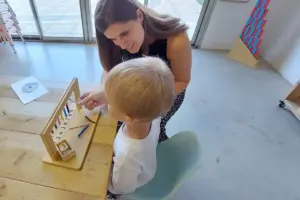
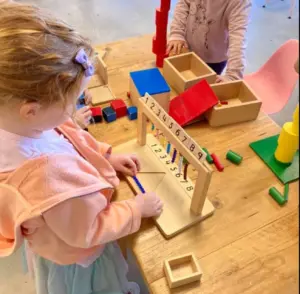
Montessori materials are hands-on, sensory, and isolate a single difficulty. A 4-year-old working with the Seguin boards isn’t memorizing abstract numbers: they are touching golden beads representing units, tens, and hundreds. Learning enters through the hands before the eyes.
At home, you can create simple versions: sandpaper letters with cardboard and sandpaper, jars with marbles for counting, or a sand tray for tracing. The key is that the material is self-correcting and attractive. A handwriting worksheet doesn’t spark the same interest as a sand tray where you draw the letter “a” with your finger.
You don’t need to buy an entire classroom. With three materials rotated weekly, you maintain novelty and avoid boredom. At IMS Sotogrande, children move from practical life materials (pouring water, buttoning) to sensorial, then to academic materials when their brains are ready. Respecting this sequence is key to preventing studying from becoming premature imposition.
Frequently Asked Questions
At what age can a child study independently with the Montessori method?
Autonomy is built from age 0. In the Children’s House (3-6), children already choose their work from the shelf and concentrate without help for increasingly long periods. There’s no magic age. It depends on the environment and how much we’ve respected their pace from early on. What we do observe is that a 6-year-old Montessori child typically has a much stronger concentration capacity than a child in traditional education.
How can I adapt the Montessori method at home if I don’t have a Montessori school nearby?
Start by transforming a corner: low shelf, four activities, orderly baskets. Observe what interests your child and offer related materials. Avoid correcting: instead of “that’s not how you do it,” ask “would you like me to show you another way?” And above all, slow down the pace. Children need time to explore without interruptions.
What do I do if my child flatly refuses to do homework from school?
Instead of fighting, first connect with their emotion: “I see you’re not in the mood today. Can you tell me how you’re feeling?” Sometimes traditional homework lacks meaning. You can turn it into a sensory game: write words in a sand tray, count with beans, draw the math problem. If the refusal is constant, talk to the school. Perhaps the volume or format doesn’t match their developmental stage.
In the end, the key isn’t to find tricks to make them study more hours. It’s to awaken their desire to learn. That only happens when they feel heard, valued, and in charge of their own path. As Olimpia Tardá, founder of IMS, reminds us: “At IMS, your child will grow up feeling heard, valued, and safe, ready to transform the world with their own voice.”