
![Bilingual Montessori School in Sotogrande: Real Immersion vs Traditional? [Ultimate Guide]](https://ims-sotogrande.com/wp-content/uploads/2026/05/unsplash-65fe806de22f.jpg "Bilingual Montessori School in Sotogrande: Real Immersion vs Traditional? [Ultimate Guide]")
Bilingual Montessori School in Sotogrande: Real Immersion vs Traditional? [Ultimate Guide]
In short
Most families who visit us at IMS Sotogrande arrive with a clear idea: they want a bilingual school. But when we dig a little deeper, almost all share the same concern: will my child actually speak English or just memorize vocabulary?
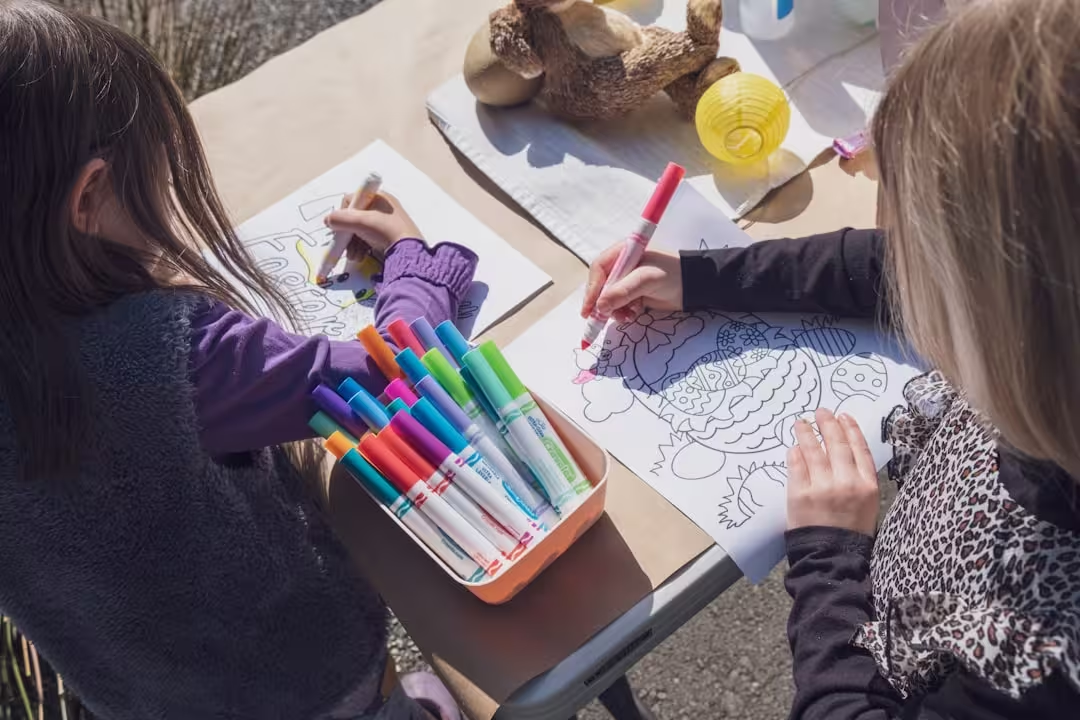
Most families who visit us at IMS Sotogrande arrive with a clear idea: they want a bilingual school. But when we dig a little deeper, almost all share the same concern: will my child actually speak English or just memorize vocabulary? Rightfully so. In the Campo de Gibraltar, there is no shortage of bilingual school options, but what truly makes the difference is how the second language is integrated into daily life. Here’s how we do it at our bilingual Montessori school and why so many families choose us. In this article we explore bilingual Montessori school Sotogrande in depth with practical examples.
What to Expect from a Bilingual Montessori School in Sotogrande
When we talk about a bilingual school, many think of more hours of English, imported textbooks, perhaps language assistants. In Montessori, the approach is radically different. We don’t add the language. We incorporate it into the environment. From age 0, children are exposed to two languages simultaneously, each with a native guide who lives it, not teaches it. There is no English class. English and Spanish are the vehicle for discovering the world. When it comes to bilingual Montessori school Sotogrande, it pays to listen to what families and lead guides actually report.
At IMS, each environment has at least one guide who communicates exclusively in English and another in Spanish. We don’t translate. Children learn through natural immersion, just as they learned their mother tongue. This method, backed by neuroscience, respects sensitive periods for language and achieves functional, not just academic, bilingualism. This approach is supported by the Bilingual Montessori Program funded by the European Union, of which IMS is a part. It’s not a trend: it’s the logical evolution of a pedagogy that has always trusted the child’s innate ability to absorb language. Daily practice with bilingual Montessori school Sotogrande reveals nuances no handbook fully captures.
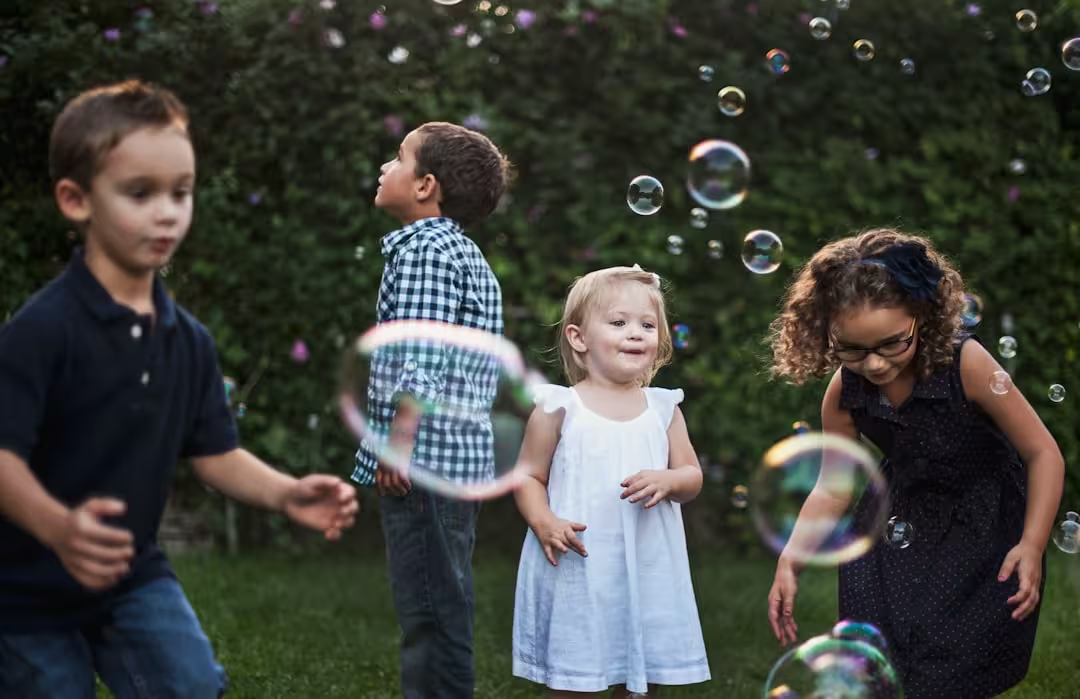
Advantages of a Bilingual School with a Montessori Approach
A bilingual Montessori school not only prepares your child for a globalized world. The advantages go far beyond that. According to the American Psychological Association (APA), bilingual children show greater cognitive flexibility, better executive control, and superior problem-solving skills. And the best part: when bilingualism is acquired naturally and early, as in Montessori, these benefits multiply.
In the Montessori classroom, language is not imposed. The child chooses materials that interest them and the guide presents them in the corresponding language. There are no exams or pressure. Motivation comes from the desire to communicate. That’s why children from our bilingual school speak English as naturally as they ask for water. And that confidence stays with them for life. Families from Algeciras, La Línea, even Gibraltar, cross the Campo de Gibraltar daily to bring their children to our bilingual school. They know the journey is worth it.
If you’d like to see it up close, Book a personalized school visit.
Choosing a Bilingual School: 3 Foolproof Criteria
Not all bilingual schools are the same. If you’re comparing options in Sotogrande, Campo de Gibraltar, or even as a newly arrived expat, pay attention to these three points:
- Real immersion, not a subject. Ask how much real exposure to the second language there is, and whether the adults are native speakers. At IMS, English is present in every interaction of the day, not just a slot on the timetable.
- Guide training. A good bilingual school needs guides specifically trained in bilingual Montessori education. Ask to see their credentials. All our guides are AMI certified and bilingual or native speakers.
- Prepared environment. Materials and surroundings should reflect both languages: books, posters, songs. If English disappears when you leave the language classroom, it’s not a real bilingual school.
In the end, choosing a bilingual school is a decision based on trust. That’s why at IMS we always recommend visiting the center and observing for a while. The best evidence is seeing a 5-year-old explaining their materials in perfect English without even noticing.
Frequently Asked Questions About Bilingual Montessori Schools
What sets a bilingual Montessori school apart from a traditional one?
In a traditional bilingual school, English is often just another subject. In Montessori, the language is lived: one guide always speaks in English, another in Spanish, and children absorb it naturally, without force. There is no difference between “English time” and “math time.” Everything is a complete experience.
What is the best age to start at a bilingual school?
The absorbent mind is at its peak from 0 to 6 years. At IMS, we welcome children from age 0 in our Nest, so the sooner, the more natural the bilingualism. But even if your child starts later, the Montessori method allows gradual adaptation, respecting their pace.
Can bilingualism delay my child’s speech?
There is no scientific evidence linking bilingualism to language delays. Bilingual children typically have a comparable total vocabulary, simply distributed across two languages. In our bilingual school, we see daily how children develop both languages perfectly normally.
Key Takeaways
Choosing a bilingual school for your child is one of the most important educational decisions you will make. At IMS Sotogrande, we offer much more than two languages: we offer a prepared environment where bilingualism becomes a tool for freedom and discovery, not an academic obligation. Families from all over Campo de Gibraltar, newly arrived expats on the Costa del Sol, and locals trust us with their children because they know that here, English and Spanish are a natural part of daily life.
If you want to experience it for yourself, we invite you to request a visit. There’s no better way to understand a bilingual Montessori school than to step into a classroom and feel the atmosphere. Book your appointment at admissions and take the first step towards an education without borders.









