
![Montessori Preschool Sotogrande: A Practical Guide for Families [3-6]](https://ims-sotogrande.com/wp-content/uploads/2026/05/unsplash-5d6dd6d3f086.jpg "Montessori Preschool Sotogrande: A Practical Guide for Families [3-6]")
Montessori Preschool Sotogrande: A Practical Guide for Families [3-6]
In short
Montessori Preschool Sotogrande: Did you know that the first six years of life concentrate the greatest brain development? A Montessori preschool takes advantage of this window with an approach that respects the child's natural rhythms. Instead of rows of desks and lectures, imagine a lab where each child explores, decides, and builds their own learning.

Did you know that the first six years of life concentrate the greatest brain development? A Montessori preschool takes advantage of this window with an approach that respects the child’s natural rhythms. Instead of rows of desks and lectures, imagine a lab where each child explores, decides, and builds their own learning. In this article we explore Montessori preschool Sotogrande in depth with practical examples.
In Sotogrande, International Montessori School Sotogrande (IMS) has been applying these principles for over two decades with a trilingual program and accreditations few schools can match. But what makes a Montessori preschool unique, and why do so many families in the Campo de Gibraltar choose it for their children aged 3 to 6?
- What is a Montessori Preschool?
- Benefits of Montessori Preschool for Ages 3-6
- The Prepared Environment: The Third Teacher in Montessori Preschool
- Montessori Preschool vs. Traditional: What's the Real Difference?
- How to Choose a Montessori Preschool: Essential Criteria
- IMS Sotogrande: When a Montessori Preschool Becomes a Trilingual Journey
- Frequently Asked Questions
- The True Value of Montessori Preschool
What is a Montessori Preschool?
A Montessori preschool is an educational environment designed for children aged 3 to 6, what Maria Montessori called the Children’s House. Here, materials are not random toys but scientific tools that guide sensory, mathematical, and language development. Classrooms bring together children of different ages, the youngest learn from the older ones, who reinforce their knowledge by teaching, and the adult acts as a guide, not the sole instructor.
In an authentic Montessori preschool , there are no tests or external rewards. Motivation comes from the internal satisfaction of mastering a task, from tying shoes to counting to a thousand with golden beads. The Association Montessori Internationale (AMI) defines this stage as the period of the absorbent mind, where the child assimilates everything around them effortlessly.
Benefits of Montessori Preschool for Ages 3-6
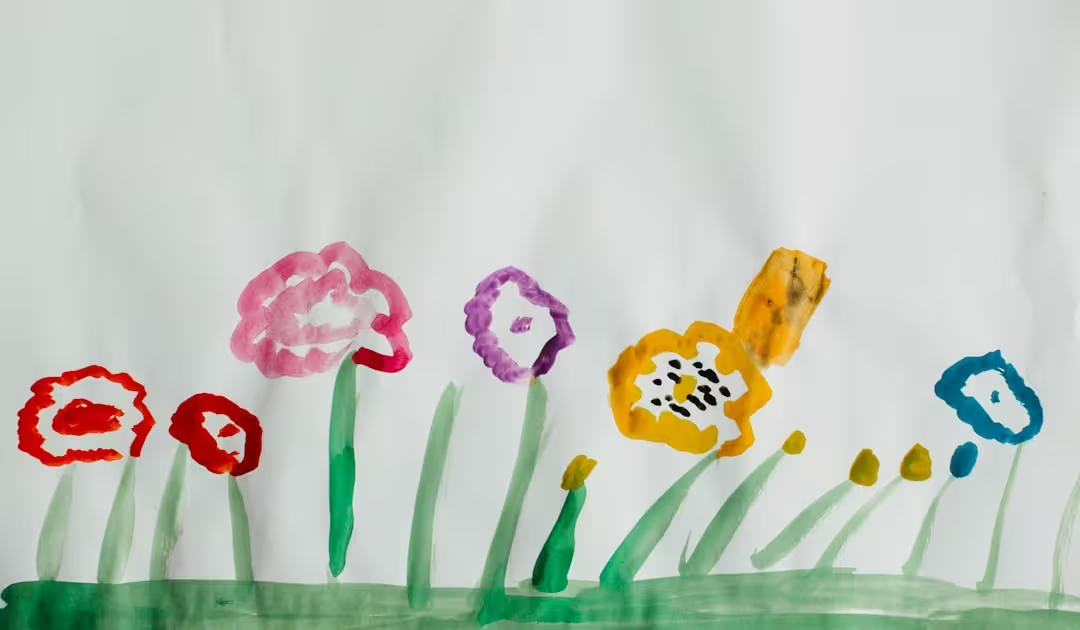
Studies show that children attending a Montessori preschool demonstrate significant advantages in executive, social, and academic skills (Lillard & Else-Quest, 2006). But beyond the numbers, families observe a holistic development that is hard to replicate in conventional settings.
Some concrete benefits families notice daily:
- Real autonomy: From day one, children serve their own breakfast, clean up spills, and choose their work. This builds unshakeable confidence.
- Deep concentration: By respecting uninterrupted work cycles, a Montessori child can spend 20 or 30 minutes stringing beads or tracing sandpaper letters. This attention span is not imposed, it’s cultivated.
- Sensory and hands-on learning: Numbers and letters are not memorized, they are touched, weighed, and built. Concrete materials allow abstract concepts to take root without frustration.
- Emotional management: Far from time-outs or punishments, the guide helps children verbalize emotions and resolve conflicts with empathy. Many parents notice their young children starting to say “I’m angry because…” instead of hitting.
The Prepared Environment: The Third Teacher in Montessori Preschool
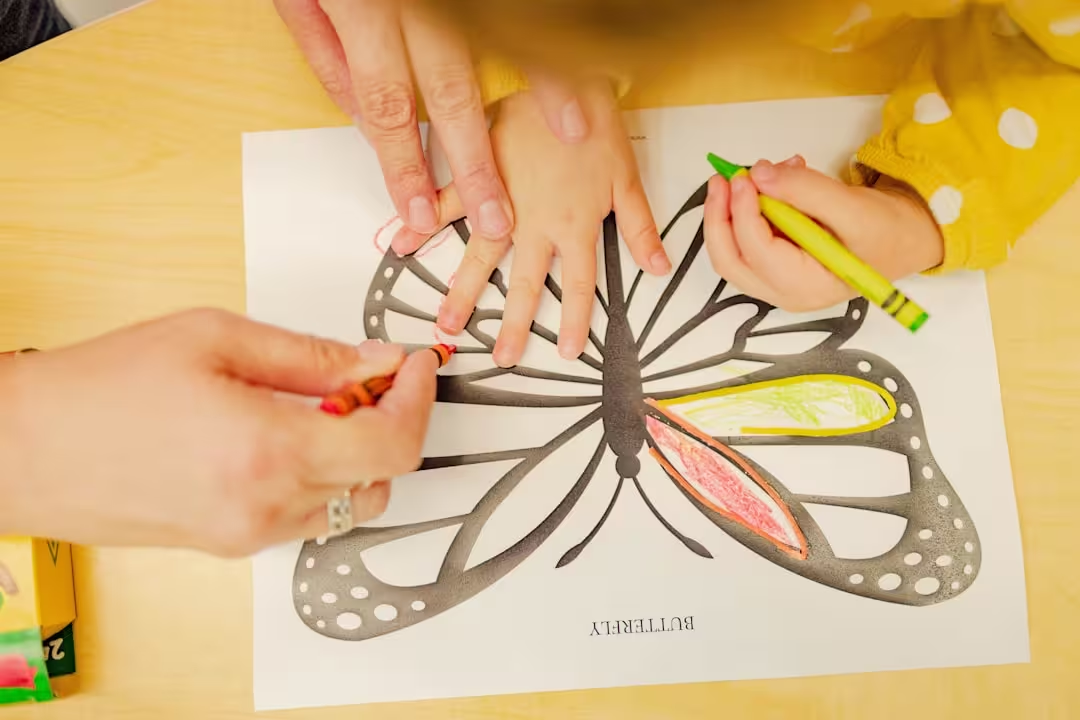
In Montessori pedagogy, there are three teachers: the guide, the child themselves, and the environment. The classroom of a Montessori preschool is meticulously designed to foster independence: low shelves with materials at hand, lightweight tables children can move, and an order that follows developmental logic. Each tray with its material, from cylinders for size discrimination to the continent globe, has a fixed place, providing security and predictability for the child.
Furthermore, contact with nature is central. Many Montessori classrooms have outdoor spaces where children plant, water, and observe insects. At IMS Sotogrande, for example, the outdoor areas invite experimentation with water, earth, and plants, and parents are amazed to see a 4-year-old repotting a plant with the precision of an adult.
Montessori Preschool vs. Traditional: What’s the Real Difference?
Every family asks this when comparing models. In a traditional school, the day is usually fragmented into 30-45 minute periods: now math, now language, now recess. In a Montessori preschool , children have an uninterrupted work block that can last up to three hours. During that time, each child chooses their activities, works at their own pace, and if needed, rests by observing others or looking at a book.
Another radical difference is the role of the adult. While in a traditional class the teacher directs, corrects, and grades, in a Montessori preschool the guide observes, presents materials, and above all, trusts the child’s ability to self-regulate. This doesn’t mean there are no limits, there are, and very clear ones, but they are based on mutual respect and care for the environment, not rewards or punishments.
If you’re considering a Montessori preschool for your child in the Campo de Gibraltar, nothing beats seeing it in person. Book a personalized school visit and watch our children at work. An hour of observation says more than a thousand articles.
How to Choose a Montessori Preschool: Essential Criteria
Not all schools that call themselves Montessori are truly so. The label is not protected, so parents need to be discerning. These are the pillars of an authentic Montessori preschool :
- AMI or AMS Accreditation: The best guarantee of fidelity to the method. Both require guides to be certified by a recognized training center. IMS Sotogrande holds AMI accreditation and international NEASC, a plus that backs its educational quality.
- Staff Training: Ask what certification the guides have. An AMI 3-6 diploma involves at least a year of intensive training, not a weekend workshop.
- Observable Environment: A serious school will open its doors for you to watch a work cycle. Observe: Are the children focused? Do they move freely and respectfully? Does the adult intervene minimally?
- Complete Materials: Classrooms must have original Montessori materials, not photocopies or substitutes. The cost of these materials is high, but essential.
IMS Sotogrande: When a Montessori Preschool Becomes a Trilingual Journey
When talking about a Montessori preschool in the Campo de Gibraltar, you inevitably talk about International Montessori School Sotogrande. With a privileged natural environment, just minutes from Algeciras, La Línea, or Estepona, our school offers a learning oasis where Spanish-English bilingualism starts from day one. From the Children’s House, French is added as a third language, something very few schools can offer at this stage.
Our AMI guides accompany each child with deep respect for their uniqueness. The program also includes yoga, music, art, and emotional intelligence sessions. And for families coming from abroad, more and more expats are settling on the Costa del Sol, the international environment is a plus: we celebrate diversity as an educational value.
Frequently Asked Questions
At what age can a child start Montessori preschool?
The classic Montessori preschool range is from 3 to 6 years old. However, at IMS we also have programs from 0-3 (Nido and Infant Community) that naturally prepare the way to the Children’s House. If your child is about to turn 3, it’s the perfect time to start.
Does Montessori preschool prepare for traditional primary education?
Yes, and with an advantage. Children leaving a Montessori preschool usually have a solid academic foundation, they read, write, and do math before age 6, and most importantly, they possess self-control and problem-solving skills that help them adapt to any environment. In fact, many traditional schools actively seek Montessori students for their maturity.
How can I tell if a Montessori preschool is authentic?
Beyond AMI accreditation, visit the classroom. A genuine Montessori preschool sounds and feels different: there’s a quiet hum of focused children, no adult raising their voice, and an order the children themselves maintain. Be wary of schools that mix Montessori with other methods incoherently or reduce free work time to less than two hours daily.
The True Value of Montessori Preschool
A Montessori preschool is not just a stage: it’s the beginning of a healthy relationship with learning, one that will last a lifetime. Testimonials from parents whose children attended IMS Sotogrande agree on one thing: they notice their children are curious, independent, and above all, happy to go to school. And in childhood, that’s priceless.
If you’re in San Roque, La Línea, Algeciras, Gibraltar, or anywhere in the Campo de Gibraltar, we encourage you not to settle for what you’re told. Come, sit in one of our classrooms, and discover what a real Montessori preschool sounds like. Request information without obligation at our admissions page or call us at +34 653 04 17 39. Choosing your child’s school is too important to leave to intuition.









