Kangaroo on the Line: How Montessori Works on Balance (Practical Guide)
If you have ever watched a preschool child walk a painted line on the floor with precise jumps, you have witnessed one of the most absorbing exercises from the Montessori Practical Life area: the kangaroo on the line . This activity, combining rhythmic movement and postural control, is not just about imitating a marsupial. In Children’s House classrooms, the kangaroo on the line becomes a powerful tool for reinforcing laterality, attention, and self-esteem.
At International Montessori School Sotogrande, every afternoon we see our 3- to 6-year-old students concentrate on the ellipse drawn on the classroom floor. They do it naturally, without need for external rewards, because the mastery of their own body gives them a satisfaction that no adult praise can equal. And that is precisely the spirit that guides the design of this activity.
Maria Montessori introduced line work around 1913, after observing a group of children spontaneously walking along a narrow beam in a courtyard. From there she developed not only walking on the line, but variants involving carrying objects, standing on one foot, or, as in this case, moving with controlled jumps. The kangaroo on the line is a natural evolution of that principle and today forms part of the classic repertoire in prepared Montessori environments.
- What exactly is the "kangaroo on the line" in Montessori?
- Specific benefits of the kangaroo on the line for children aged 3 to 6
- How to present the "kangaroo on the line" step by step (includes downloadable template)
- Movement in the Children's House: more than gymnastics
- For international families: "kangaroo on the line" and the value of the bilingual environment
- Frequently asked questions
- Key conclusions
What exactly is the “kangaroo on the line” in Montessori?
The kangaroo on the line is a fine and gross motor activity typically presented during the 3-6 cycle, although children in the Workshop (6-12) also practice it with more complex variations. The basic version involves jumping with both feet together along a curved line, maintaining balance and moving forward without leaving the trace.
Unlike a simple run or free jump in the yard, the line provides a spatial limit that forces the child to concentrate attention on each movement. The toes come together, knees bend, and eyes scan the path before the body moves. It is not so much a cardiovascular exercise as an act of mind-body connection, characteristic of Montessori pedagogy.
Often, the guide introduces the kangaroo on the line after the child has already mastered slow walking, fast walking, and carrying a bell without ringing. A new challenge is then proposed: “Can you jump like a kangaroo without falling off the line?” The playful factor sparks motivation and repetition, key to motor refinement in childhood.
Specific benefits of the kangaroo on the line for children aged 3 to 6
The effects of this exercise go far beyond balance. In daily practice with families from the Campo de Gibraltar, we have documented improvements in the following areas:
- Body axis control: the child learns to center weight on the pelvis, aligning spine and head.
- Visuomotor coordination: the sight anticipates the next landing point while the feet execute the jump.
- Sustained attention: the need to not deviate from the line increases the time of concentration on a single task, the basis of executive functions.
- Rhythm and sequencing: regular jumps favor pattern perception, a skill predictive of mathematical success according to recent neuroeducation studies.
Moreover, being a self-correcting activity (the child themselves notices if they leave the line), it strengthens self-evaluation and reduces dependence on the adult. It is easy to observe how, after several attempts, the child stops, breathes, and starts again without anyone pointing out the error.
For families living between Sotogrande and Alcaidesa, where outdoor spaces abound, the kangaroo on the line is easily transferable to the garden or terrace. Simply lay a cotton rope on the grass or draw an ellipse with chalk on the pavement. The key is not the material, but the adult’s attitude: demonstrate the exercise, step back, and trust the child’s ability to self-regulate.
Book a personalized visit to the school and come see it in action. At IMS Sotogrande, each Children’s House environment has its own permanently drawn line, and our AMI guides will explain in detail how this and other activities are introduced.
How to present the “kangaroo on the line” step by step (includes downloadable template)
If you want to try it at home with your child, here is a proven sequence that respects the principles of a Montessori presentation: precise movement, economy of words, and total focus on the child.
- Prepare an elliptical line on the floor (with painter’s tape, chalk, or a rope). The ellipse should be at least 2 meters long to allow several jumps.
- Remove nearby obstacles and calm the environment. The presentation is done without music or background noise.
- Sit next to the line and say: “I will show you how to jump on the line like a kangaroo.”
- Perform 3 or 4 slow jumps, exaggerating knee flexion and looking forward. Do not speak during the demonstration.
- Invite him: “Would you like to try?” Step back and observe without intervening.
- When finished, smile and do not correct. If he has stepped out, he will notice sooner or later; if he wants to start again, allow him.
One of the most common pitfalls at home is turning the line into an obstacle course or a long-jump competition. The kangaroo on the line loses its meaning if the focus shifts from motor control to speed. Therefore, Montessori guides prefer that variations (jumping backwards, jumping with hands on hips, carrying a small bell) be introduced only when the basic pattern is internalized.
Movement in the Children’s House: more than gymnastics
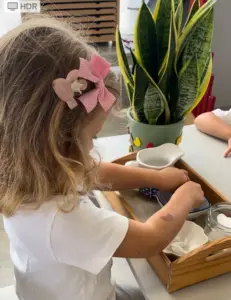
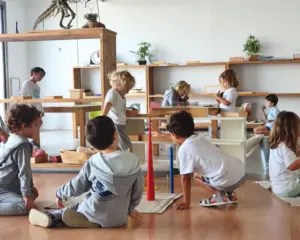
It is worth remembering that in a Montessori school, psychomotor development is not a separate subject. The entire environment, from practical life exercises to sensory material and the line, is designed for the child to move intelligently. At IMS Sotogrande, our Children’s House schedules include long blocks of autonomous work where activities like the kangaroo on the line coexist with table washing, word copying, or the pink tower.
For example, in our 3-6 programs (Raíces, from 9:00 to 14:00, for 650 EUR/month, or Alas, from 9:00 to 15:00, for 750 EUR/month), each student chooses when to practice balance exercises. There is no rigid timetable; if a child needs to repeat the line fifteen times before concentrating on a botany puzzle, the guide respects that rhythm. That freedom with responsibility is the essence of the motto “Education for Life.”
It is no coincidence that many families from the Gibraltar and Estepona area tell us that their children, after a few weeks at school, spontaneously start marking lines at home with toys or chalk. The kangaroo on the line is so absorbing that the child wants to repeat it anywhere, and that genuine interest is the best indicator that the inner need for movement is being met.
For international families: “kangaroo on the line” and the value of the bilingual environment
If you are considering moving to Andalusia with young children, finding a school that maintains a culture of movement together with a language immersion program can be a challenge. IMS Sotogrande is the only school in the area that combines dual Spanish-English immersion with Montessori pedagogy accredited by AMI and NEASC. Our student body includes families from Sotogrande, San Roque, Algeciras, La Línea, but also a large group of expatriates arriving from Gibraltar, the United Kingdom, or Germany.
One of the advantages of a trilingual environment (Spanish, English, French from Children’s House) is that psychomotor activities like the kangaroo on the line become a universal language. When an English-speaking guide presents the activity in English, the child does not need to translate: they see the gesture, understand the challenge, and act. That sensorimotor learning is the same that makes Montessori language material so effective. Therefore, movement on the line also contributes to second language acquisition by reducing anxiety and fostering attention.
If you want to learn more about how we combine the Montessori method with bilingualism, you can consult our fees and programs or write to us directly at [email protected]. We organize personalized visits throughout the year, even in summer, for families moving to the Costa del Sol.
Frequently asked questions
At what age can children start the kangaroo on the line?
In Montessori, it is introduced around age 3, once the child walks confidently and shows interest in controlling their movements. However, in Nido (0-3) we offer preparatory activities with the line without jumping, such as walking on the rope barefoot or tracing the line with a finger, which lay the foundation for later balance.
Do I need special materials to do the kangaroo on the line at home?
No. A cotton rope or a chalk line on the floor is enough. The most important thing is a slow presentation and respect for the child’s pace. If you want to enrich the activity, you can add a bell for the child to carry without ringing, but only when the jump itself is mastered.
Why does my child get frustrated when practicing the kangaroo on the line?
Frustration usually appears when the bar is set too high. Check if the line is wide enough (about 3 cm thick for safety), if the shoes have slippery soles, or if the environment is noisy. Sometimes, by lowering the requirement a little (allowing a fleeting support on the back foot), the child regains confidence and continues practicing.
Is the kangaroo on the line only practiced indoors?
It can be done outdoors if the pavement is safe. In spring, many Montessori classrooms take the line to the garden to take advantage of natural light. The important thing is to keep the ellipse well-defined and away from strong distractions like balls or nearby swings.
Key conclusions
The kangaroo on the line is not just another game, but a manifestation of the inseparable movement-intelligence binomial on which Montessori built her entire work. Giving the child the opportunity to repeat it, without haste or judgment, is equivalent to offering a laboratory to strengthen their body schema and will. The benefits in concentration, laterality, and self-control then transfer to every corner of the academic and personal curriculum.
If you want to experience firsthand how we integrate these practices in a bilingual school, call +34 653 04 17 39 or request your personalized visit today. Come to Sotogrande and discover a prepared environment where your child will move with freedom and purpose.
This article is based on the teachings of Maria Montessori and the daily practice of IMS Sotogrande guides. For further depth, we recommend visiting the official site of the Association Montessori Internationale, the highest authority in the pedagogy.