
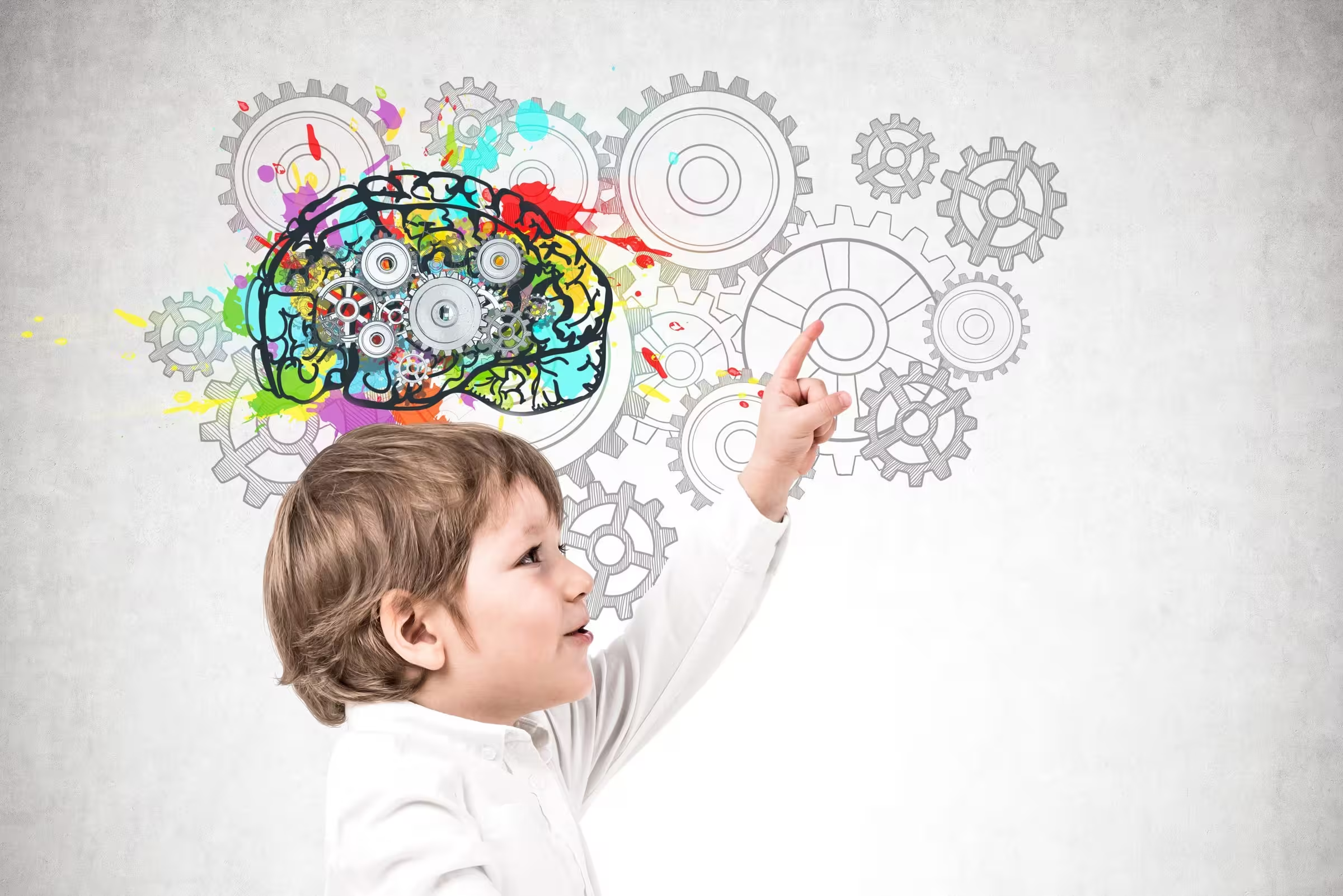
How to help our brain learn?
Parents and educators can help our children and students learn better if we know more about our brain and how it works. The learning capacity is based on the plasticity of the brain and this plasticity depends on how much we use our brain. A few days after birth we already have billions of neurons that can connect with each other every time we learn something new, thus millions of synaptic connections can be created.
Early childhood is where the greatest explosion of these connections occurs, which is why the young child learns so quickly and absorbs everything he can from his environment. This is what, in the words of María Montessori, is known as the absorbent mind of the child.
What is Help brain learn?
It is a capacity that the child from 0 to 3 years old has to learn involuntarily and unconsciously through his interaction with the environment that surrounds him, and that in the stage from 3 to 6 years old occurs in a much more conscious way, allowing the child to assimilate these experiences and integrate them to build his own intelligence and personality. That is why the years corresponding to early childhood education are so important from an educational point of view. In them the foundations for all subsequent development are laid and in them major developmental milestones take place in areas such as language, social relationships, movement and the development of the senses.
However, today we know that the brain continues to learn throughout life and that every time we learn something, our brain changes. We are building our brain throughout our lives. Our intelligence is not fixed, it can always be improved. And the same goes for our personalities. We are born with a temperament marked by genes, but through learning,We can incorporate new skills and habits that modulate our character and configure our own life plan and personal growth.
Healthy eating; the regular practice of physical exercise; resting, sleeping especially after learning favors memory and the integration of new content; train working memory, this is what makes us reason, think, make decisions, solve problems; guiding learning with questions motivates, focuses attention and promotes autonomous learning; emotion, says J. Ramón Gamo, a child neuropsychologist that “to learn we have to be emotional, what does not excite us does not exist in our memory or in our mental world. We live our experiences, and we keep them in our memory thanks to the emotion that accompanies each act and each experience. It is the origin of all memory, beliefs and behavior that we have learned. If we want to change our life, let’s take charge of our way of perceiving and managing emotions.”
And finally, following this author, “the The brain is a social organ that learns by doing things with other people.”









