
Newborn Pacifier for Sleep: When, Which One and How to Use It | Sotogrande Montessori Guide

Offering a newborn pacifier for sleep is safe, and the American Academy of Pediatrics recommends it for naps and at night because it is linked to a lower risk of sudden infant death. If you are breastfeeding, wait until feeding is well established, usually around the third or fourth week. A newborn pacifier for sleep is a 0-6 month size, one-piece teat that you offer when your baby falls asleep and that you do not put back in if your baby spits it out.
Quick summary
- Offer it at bedtime, without forcing it, and do not put it back in once your baby has fallen asleep.
- If breastfeeding, wait about 3-4 weeks. If bottle-feeding, you can offer it from the first few days.
- Choose a 0-6 month size, one-piece design, a shield with ventilation holes and no cords or clips in the cot.
- It is not compulsory: if your baby refuses it, that is fine and there is no need to insist.

How to help a newborn sleep better at night
You cannot force a newborn to sleep through the night: they sleep between 14 and 17 hours a day in stretches of two to four hours. What you can do is help them tell day from night and prepare a safe sleep space.
The basics do not change in 2026. Lie your baby on their back, on a firm mattress, in a cot with no pillows, soft toys or bumper pads, and keep them in your room for the first months. A comfortable temperature (without overdressing them) also prevents waking from heat.
A concrete example: a three-week-old baby who feeds at 2:00 in the morning. Dim light, no conversation, nappy change only if needed, and back to the cot, drowsy but awake. During the day, by contrast, feeds happen in natural light, with voices and the normal noise of the house. With that contrast, many babies start to concentrate a little more of their sleep at night between the sixth and eighth week.
Where the pacifier fits into this routine
The pacifier works best as the last step of the routine, not as a first resort. First check hunger, nappy and temperature. Then, if your baby is still unsettled but fed, sucking helps them calm down and drift off to sleep.
If it falls out after ten minutes, leave it. There is no need to put it back in.

Which type of pacifier suits a newborn
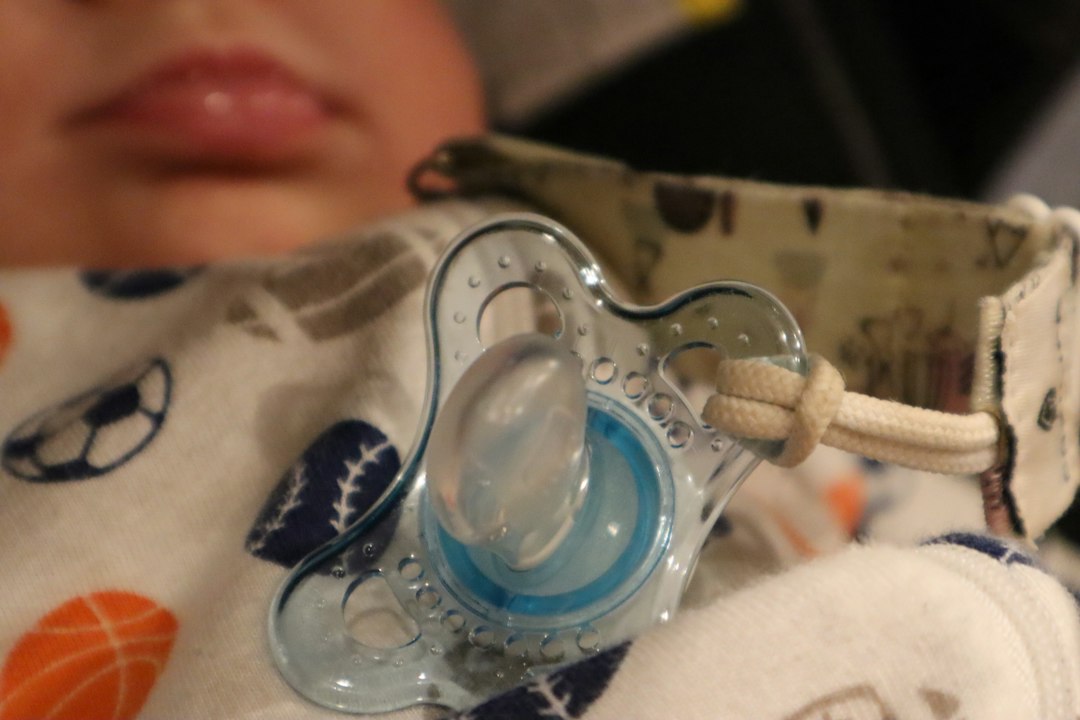
A newborn needs a 0-6 month size pacifier (some brands sell 0-2 months), one-piece and with a ventilated shield. Other features, such as colour or design, matter much less than the aisle in the pharmacy would suggest. However, four details are worth checking:
- Size: the 0-6 month teat is shorter and thinner, suited to a very small mouth.
- One piece: this means there is no risk of the teat separating from the shield.
- Shield: wider than your baby’s mouth and with ventilation holes.
- Standard: look on the packaging for the reference EN 1400, the European safety standard for pacifiers.
Silicone, latex and teat shape
Silicone is more durable, does not retain odours and withstands sterilisation well. Latex (natural rubber), on the other hand, is softer and more elastic, although it deteriorates sooner and can cause allergies. As for shape, you will find round, orthodontic and symmetrical teats.
My view is clear: do not obsess over shape. Studies have not shown that one “physiological” teat is better than another in the first months, so what your baby accepts is what matters.

When to offer a newborn pacifier for sleep
If you bottle-feed, you can offer a pacifier from the first few days. If you breastfeed, the American Academy of Pediatrics recommends waiting until breastfeeding is well established, which usually happens around three or four weeks.
The reason is simple. In the first weeks, each time the baby sucks at the breast they signal to the mother’s body how much milk to produce. So if sucking is diverted to a pacifier too early, that adjustment suffers.
Picture a family who has just arrived in Sotogrande with a twelve-day-old baby who feeds every hour and a half in the afternoon. The temptation is to use the pacifier to “stretch” feeds. If they do, the baby feeds less just when supply is regulating. If they wait another two weeks, the pacifier arrives once breastfeeding is established and does not compete with it.
Common mistake: using the pacifier to delay a feed
This is the most frequent error: the baby searches, sucks on their hands or turns their head, and we offer the pacifier “to see if it settles them”. A pacifier does not replace a feed. The solution is to offer the breast or bottle first and reserve the newborn sleep pacifier for when the baby is already full and only needs comfort.
Why the best newborn pacifier for sleep is the one your baby accepts
There is no universal model: the best one is the one that meets the safety standard and your baby accepts without fuss. For example, if at four weeks they reject a round teat, try an orthodontic one for three or four days. If they do not want that either, do not buy a third: your baby may simply not need one.
Checklist for the first night with a pacifier
- Check that it is a 0-6 month size and that the packaging states EN 1400.
- Sterilise or boil it before the first use, as the manufacturer directs.
- Before each use, gently pull on the teat. If you see cracks or stickiness, replace it.
- Never dip it in honey, sugar or any sweetener.
- No cords, chains or clips while they sleep in the cot.
- Offer it without forcing and do not put it back in once they have fallen asleep.
- Keep a clean spare to hand so you are not searching in the dark at three in the morning.
Point five deserves emphasis. The clip that is so convenient on the pram becomes a suffocation risk in the cot. Likewise, remove any ribbon from clothing before putting them down.
The pacifier from a Montessori perspective
Montessori pedagogy does not ban the pacifier: it proposes using it with intention and by observing the baby. The Association Montessori Internationale stresses that the adult should learn to read the child’s signals before intervening, and that applies here too.
In practice, it is about distinguishing the need to suck from the need for contact. Crying does not always call for a pacifier: sometimes it asks for arms, a familiar voice or simply a change of position. If the pacifier appears at every complaint, the baby loses opportunities to show you what they really need.
It is also worth thinking about the end from the start. Many paediatricians advise reducing its use from six months and phasing it out around the first year, because prolonged use is linked to more ear infections and changes in the bite. Always confirm this with your paediatrician, especially if you have just arrived in the Campo de Gibraltar and do not yet have one assigned.
Frequently asked questions
How do I get a newborn to sleep at night?
To get a newborn to sleep at night, lay them on their back in a cot with no objects, in your room, with dim light and calm night feeds without conversation, while during the day you keep natural light and normal noise. This way they gradually learn to tell day from night. Even so, they will wake every few hours during the first weeks.
What type of pacifier should a newborn use?
A newborn should use a 0-6 month pacifier, made in one piece, with a ventilated shield wider than their mouth and compliant with the European standard EN 1400, preferably silicone because it withstands sterilisation better and does not retain odours. The shape of the teat matters less. Choose the one your baby accepts.
When should I give a newborn a pacifier?
If your baby is breastfed, it is advisable to wait until breastfeeding is well established, which usually happens around three or four weeks of age, whereas with a bottle you can offer one from the first few days. Offer it at the start of naps and bedtime, never to delay a feed when the baby is hungry.
What is the best pacifier for a newborn?
The best pacifier for a newborn is one that meets the EN 1400 standard, is a 0-6 month size and one piece, and that your baby accepts without fuss, because no shape or brand has been shown to be clearly superior in the first months. Try two models at most. If they refuse both, they probably do not need one.
This week, give it a try: check the pacifier with the checklist, offer it only at bedtime and observe for three nights how your baby responds. If you are looking for a school that shares that same respectful outlook from Nido, book a personalised school visit and meet us in Sotogrande.









