Managing Sibling Jealousy with Montessori Methods: Strategies for Families
In short
Managing sibling jealousy is one of the most frequent questions families ask us at IMS, both those living in Sotogrande and those coming from La Línea, Algeciras, or Gibraltar. The direct answer: jealousy is a normal emotion in child development and is managed by validating the child, avoiding comparisons, and dedicating individual time to each child.

Managing sibling jealousy is one of the most frequent questions families ask us at IMS, both those living in Sotogrande and those coming from La Línea, Algeciras, or Gibraltar. The direct answer: jealousy is a normal emotion in child development and is managed by validating the child, avoiding comparisons, and dedicating individual time to each child. It is not eliminated with punishments or phrases like “don’t be like that, he’s your brother.” It is accompanied with presence and concrete tools. In this article we explore sibling jealousy management in depth with practical examples.
Key Points When it comes to sibling jealousy management, it pays to listen to what families and lead guides actually report.
- Sibling jealousy appears because the child perceives that they lose exclusive access to the love of their reference figures.
- Validating the emotion (“I understand you’re angry”) works better than denying or punishing it.
- Daily individual time with each child notably reduces the intensity of jealousy.
- Montessori pedagogy works on cooperation instead of competition between siblings.
- Avoiding labels like “the smart one” or “the sensitive one” prevents long-term rivalry.
Why Does Sibling Jealousy Appear?
Jealousy arises when a child perceives that their place in the family is threatened. It is not whimsy or lack of education. It is an emotional response linked to attachment: the child fears losing the exclusive bond with their parents. Daily practice with sibling jealousy management reveals nuances no handbook fully captures.
In the first years of life, children build their emotional security through the constant attention of their reference figures. When a sibling arrives, that attention is shared. The young child does not have cognitive tools to understand that love is not a limited resource. They simply feel they receive less. Understanding sibling jealousy management from inside the classroom reshapes everyday decisions.
Studies on attachment, such as those published by the American Academy of Pediatrics (AAP), confirm that sibling jealousy is an expected stage of development. It does not indicate a behavioral problem or an educational failure. What makes the difference is how adults accompany that emotion. Concrete data on sibling jealousy management is worth reviewing before acting on assumptions.

Managing Sibling Jealousy in Daily Life
Knowing how to manage sibling jealousy does not require complicated techniques. It requires consistency and empathy. These are the strategies that work best according to our experience in the classroom and with families.
Managing Sibling Jealousy: Validating Without Comparing
When a child says “I don’t want them here” or pushes their sibling, the first thing is to acknowledge their emotion. Phrases like “I see you’re angry” or “I understand that sometimes it’s hard to share mom” open the door to communication.
What doesn’t work is comparing: “look how your brother behaves well.” That phrase does not educate. It generates more resentment and reinforces rivalry. On the contrary, each child needs to feel valued for who they are, not in relation to their sibling.
Individual Time with Each Child
Dedicating even 15 minutes daily of exclusive attention to each child changes family dynamics. No special activity is needed. It can be reading together, walking, or simply talking about their day without interruptions.
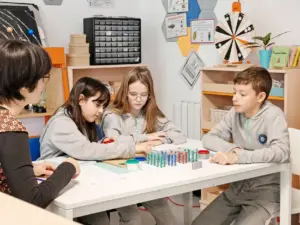
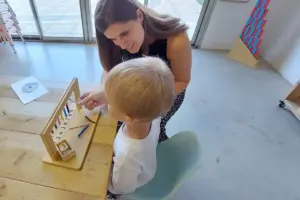
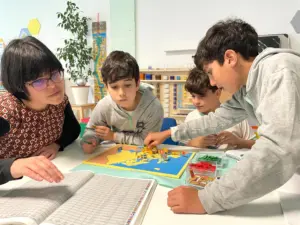
This time tells the child: “you matter, and you don’t need to compete to be seen.” At IMS, we apply this in the classroom with individual Montessori work. Each child progresses at their own pace, without comparisons with the classmate next to them.
Book a personalized visit to the school and discover how we work on respect for each child in our classrooms.

The Montessori Perspective on Sibling Rivalry
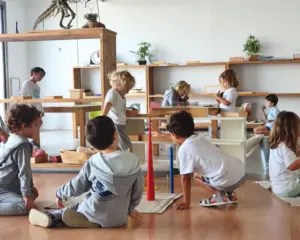
Maria Montessori observed that children cooperate naturally when the environment does not push them to compete. In a Montessori classroom, there are no rewards or punishments. There is no “best in the class.” Each material is used individually and each progress is celebrated without comparing.
This principle translates directly to the relationship between siblings. When at home we avoid classifying (“you’re the athlete, you’re the artist”), children develop their identity without needing to differentiate from the other through conflict.
The AMI (Association Montessori Internationale) emphasizes that respect for individual rhythm is one of the pillars of the pedagogy. Applied to the family, it means that each child has their own times, interests, and needs. Respecting them reduces friction between siblings organically.

Managing Sibling Jealousy When a New Baby Arrives
The birth of a new sibling is the most common time for jealousy to appear. The older child goes from being the center to sharing space. Their world changes abruptly.
Preparing the child before birth helps. Talking to them about the baby, including them in small tasks (choosing a onesie, feeling the kicks), and keeping their routines as stable as possible. After delivery, it is advisable to avoid phrases like “now you have to be the big one” or “be careful with the baby.”
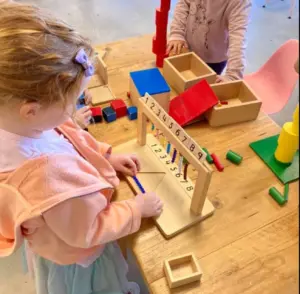
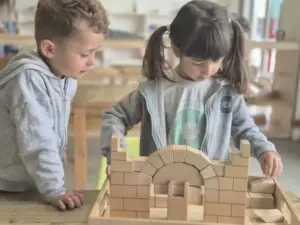
At IMS, we accompany this transition in the classroom. Children in Nido and Casa de Niños work with sensory and practical life materials that give them autonomy. That autonomy reminds them that they are capable, even if at home there is a new member demanding attention.
Mistakes That Worsen Sibling Jealousy
Some common behaviors of parents, well-intentioned, worsen rivalry. These are the most frequent:
- Forcing absolute equality. Buying the same gift for both, giving the same portion, measuring everything with a tape measure. Children do not need equality. They need equity: attending to what each one needs.
- Holding the older child as an example. “You’re already big, you should know.” The older one did not choose to be so. Loading them with maturity expectations that do not correspond to them generates frustration and resentment towards the younger one.
- Ignoring aggression. If a child hits their sibling and the adult does not intervene, the message is ambiguous. Intervening does not mean punishing. It means setting a clear limit: “I will not let you hurt them.”
- Labeling. “The smart one,” “the mischievous one,” “the sensitive one.” Labels create fixed roles. Each child locks into their role and competes with the other to maintain or break it.
Frequently Asked Questions
Is sibling jealousy normal?
Yes. Sibling jealousy is a completely normal emotion in child development. It appears because the child perceives that their bond with the parents is shared. It does not indicate a behavioral problem. The important thing is to accompany that emotion with validation and presence, not with punishments or comparisons.
How to manage jealousy when the older sibling is a baby?
When the older one is still very young (1-2 years), management involves maintaining stable routines, offering abundant physical contact, and not forcing interaction. At this age, the older child does not understand concepts like “sharing” or “being careful.” They need to see that they remain important to their parents. Avoid phrases like “be careful with the baby” constantly, as they generate anxiety. Instead, supervise interactions calmly and offer alternatives: “You can give it to them gently.” Validate their frustration if they seem restless and remember that, at this age, the best tool is example and the loving repetition of routines.