
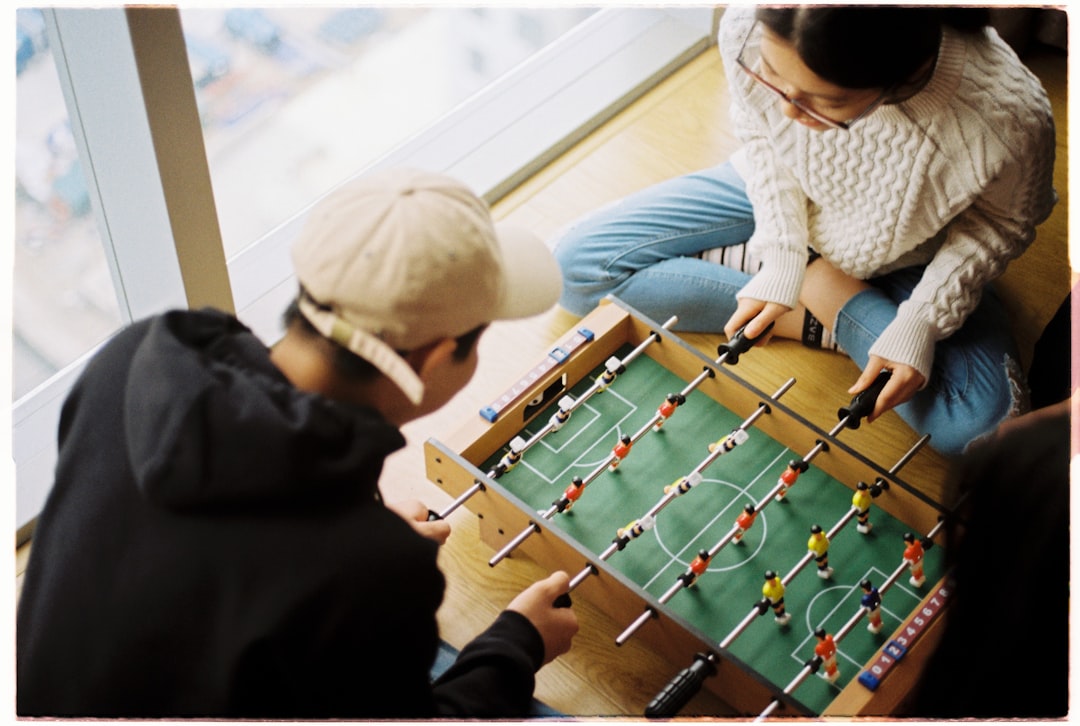
Best Educational Games for Teens That Really Engage

Educational games for teenagers are activities designed to stimulate critical thinking, collaboration, and creativity while the youth learns without pressure. Instead of memorizing data without context, the teenager solves real challenges connected to their interests. This form of learning leverages the natural curiosity of 12 to 18-year-olds and produces results that memorization alone cannot achieve.
Key Points
- They develop critical thinking, autonomy, and social skills in a natural and practical way.
- From age 12, the brain seeks authentic challenges, not repetitive exercises.
- Strategy, simulation, and cooperation games work better than conventional tasks.
- Montessori pedagogy adapts each activity to the adolescent’s developmental plane.
- Choosing the right game and guiding without imposing makes a real difference.

Why Educational Games for Teens Outperform Memorization
The teenage brain constantly reorganizes. The prefrontal cortex, responsible for planning and decision-making, matures slowly until age 25. Educational games for teenagers take advantage of this developmental window by activating reward circuits that consolidate learning. When a young person solves a complex challenge, dopamine is released, strengthening neural connections durably.
A 2019 study published in the Journal of Adolescent Research showed that students participating in game-based learning activities had 23% greater long-term concept retention. This isn’t anecdotal: neuroscience backs that play activates brain areas that passive repetition doesn’t reach. When it comes to educational games for teenagers, it pays to listen to what families and lead guides actually report.
Maria Montessori observed this over a century ago in her research with children and youth. In the Elementary (6-12 years) and adolescent programs, learning starts from manipulation and active exploration. Studies from the Association Montessori Internationale (AMI) confirm that Montessori students develop greater autonomy and creativity than their traditional school peers. Daily practice with educational games for teenagers reveals nuances no handbook fully captures.
Moreover, games eliminate the fear of failure. In a game, failing is part of the process. This reduces anxiety and increases willingness to try new strategies. The teenager learns that making mistakes isn’t a failure but a necessary step to improve.

Types of Educational Games for Teens by Learning Areas
Not all games serve the same purpose. The key is choosing didactic activities that connect with real interests and offer progressive challenges. Here are the three main families of playful learning resources that work best in practice.
Board Games to Train Strategy and Logic
Catan, Pandemic, and Azul demand planning, resource management, and decision-making under pressure. For example, a single turn of Catan involves calculating probabilities, negotiating with other players, and adapting to unpredictable board changes. This kind of critical thinking transfers directly to math problems and everyday situations.
Pandemic adds a collaborative component. Players must coordinate to contain disease outbreaks. This teaches teamwork under real pressure, something traditional classrooms rarely replicate. Azul, on the other hand, trains spatial planning and geometric pattern calculation without the teenager realizing they’re doing math.
The key is that these games offer scalable difficulty. Beginners enjoy from the first game, while advanced players find layers of complexity that maintain long-term interest. This natural progression avoids frustration and fosters perseverance.
Role-Playing and Simulation as Educational Dynamics
Role-playing games like Dungeons and Dragons or simulations like Model United Nations force the teenager to adopt foreign perspectives, negotiate, and make decisions with in-game consequences. A D&D player doesn’t just roll dice: they strategize, manage limited resources, and collaborate with their team to overcome unpredictable obstacles.
In educational contexts, these dynamics develop oratory skills, geopolitical thinking, and argumentation ability. They replicate adult world challenges without real consequences, allowing the youth to experiment, fail, and correct in a safe environment.
Educational Video Games as Playful Learning Resources
Not all screen time is passive. Games like Kerbal Space Program teach orbital physics and aerospace engineering intuitively. Civilization introduces history, economics, and politics dynamics. Minecraft Education Edition allows designing complex structures and solving visual programming problems.
The difference between an educational video game and a purely recreational one lies in challenge design. In these playful learning resources, progress depends on understanding concepts, not just quick reflexes. That’s why they work: the teenager feels they advance because they learn, not because they repeat.

How to Integrate Educational Games into Daily Routine
The effectiveness of these didactic activities depends on consistency. It’s not about replacing all formal teaching, but reserving regular spaces where learning is experienced as something attractive. Even twenty minutes daily with a well-chosen game makes a difference in retention and motivation.
At Home: Concrete Steps to Start Today
First, identify the youth’s interests. If they’re drawn to science, try Kerbal Space Program or experiments in game format. If they prefer humanities, a historical role-playing game will hook them more than a textbook. Second, set a fixed schedule: Friday afternoons as “game night,” for example. Third, join in. When a parent sits to play, the teenager perceives that they value their learning, which multiplies motivation.
Families can start with board games on weekends. Teachers can incorporate brief dynamics at the start or end of each class. Combining both contexts reinforces learning and shows the youth that knowledge doesn’t stay in the classroom.
Avoid turning the game into an exam. Don’t ask “what did you learn?” at the end. Instead, let the conversation flow naturally. The teenager will share what surprised them if they don’t feel evaluated. That trust is the bridge between play and real learning.
Frequently Asked Questions
What educational games for teens work best?
Strategy, simulation, and cooperation games yield better results because they demand active thinking and autonomous decision-making. Catan, Pandemic, Dungeons and Dragons, or Kerbal Space Program are examples that combine intellectual challenge with genuine fun. The key is that the difficulty adapts to the young person: not so easy that it bores, nor so hard that it frustrates.
How much time daily should a teenager spend on educational games?
Between 20 and 40 minutes daily is sufficient to obtain measurable benefits without the game becoming another obligation. On weekends, sessions can extend to an hour. The key is not quantity, but regularity: three short sessions a week yield more than a monthly marathon.
Are board games better than video games for learning?
It depends on the educational objective you seek. Board games favor social interaction, face-to-face negotiation, and collective strategic thinking. Educational video games offer immersive simulations and immediate feedback. The ideal is to combine both formats to cover different developmental areas. Neither replaces the other. They complement each other.
Key Takeaways
Educational games for teenagers aren’t a minor supplement. They are a pedagogical tool backed by neuroscience that develops critical thinking, autonomy, and social skills in a way passive memorization never will. When the game is well-chosen and guidance is respectful, the teenager learns more and with more enthusiasm.
Start simple: a board game this weekend, a digital game with educational purpose during the week. Observe what hooks your child or student and build from there. Learning born from personal interest is the one that endures.









