
Why My Child Won’t Listen: 7 Montessori Keys for Expat Parents
In short
When your child refuses to listen for the fifth time in the same morning, frustration settles into your body. It’s normal to feel anger or exhaustion. What’s not as normal is that no one explains what’s really happening inside that child who won’t put on their shoes, pick up their toys, or stop throwing food on the floor.

When your child refuses to listen for the fifth time in the same morning, frustration settles into your body. It’s normal to feel anger or exhaustion. What’s not as normal is that no one explains what’s really happening inside that child who won’t put on their shoes, pick up their toys, or stop throwing food on the floor. In this article we explore child not listening in depth with practical examples.
Montessori pedagogy has spent over a hundred years studying how young children learn and cooperate. And the answer isn’t in more effective control techniques. It’s in understanding that disobedience has causes and that, almost always, what we call ‘not listening’ is something very different. When it comes to child not listening, it pays to listen to what families and lead guides actually report.
- Disobedience is almost always a signal, not an attack
- Clear, repeatable boundaries work better than yelling
- Offering choices within limits reduces conflict by 70%
- The child’s body needs to move before it can listen
- Your calm is not a luxury: it’s the most powerful tool
- Why ‘My Child Won’t Listen’ Almost Never Means What You Think
- Boundaries That Work: Clear, Brief, and Repeatable
- Offering Choices Within Limits: The Technique That Reduces Conflict
- Body First: Why a Tired Child Can’t Listen
- Why Yelling Destroys Cooperation
- How to Respond When Your Child Says ‘No’ in Every Situation
- Calm Is Not a Gift: It’s a Skill That’s Trained
- What to Do When Nothing Works
- Frequently Asked Questions
- Key Takeaways
Why ‘My Child Won’t Listen’ Almost Never Means What You Think
Let’s start with an uncomfortable truth: a child of two, three, or four years old lacks the neurological capacity for systematic obedience. Their prefrontal cortex, the brain region responsible for inhibiting impulses and regulating emotions, doesn’t mature until age 25. At 25. Not 25 months. Daily practice with child not listening reveals nuances no handbook fully captures.
When a 3-year-old doesn’t listen to you, they’re not defying you. They’re being a 3-year-old. Their brain prioritizes exploration, autonomy, and movement over following complex verbal instructions. This isn’t a parenting failure or a character flaw. It’s basic neuroscience. Understanding child not listening from inside the classroom reshapes everyday decisions.
The Asociación Montessori de España explains it this way: the young child learns through action, not passive obedience. If you ask them to tidy up and they keep playing, they’re probably not ignoring you. They’re likely in a concentration cycle their brain doesn’t know how to interrupt yet.

Boundaries That Work: Clear, Brief, and Repeatable
A Montessori boundary has three characteristics: it’s concrete, stated once calmly, and always enforced. It’s not ‘behave yourself’ or ‘listen to me.’ It’s ‘utensils stay on the table, not on the floor.’ It’s ‘hands are for helping, not hitting.’
The most common mistake among parents is repeating the boundary ten times, each time louder. This doesn’t reinforce the message: it degrades it. The child learns that the first nine times don’t matter and that they only need to move when mom or dad yell.
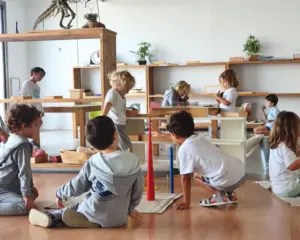
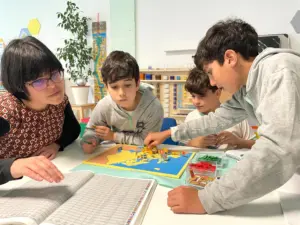
In the Casa de Niños (3-6 years) classrooms at IMS Sotogrande, boundaries are presented in short phrases and modeled with the body. The guide doesn’t say ‘don’t run’: they approach the child, slow their own pace and say ‘here we walk.’ The body understands before the ears do.
Practical tip: repeat the boundary a maximum of twice. If there’s no response, physically accompany the child toward the expected behavior. No threats, no negotiations. Calm action.

Offering Choices Within Limits: The Technique That Reduces Conflict
‘My child won’t listen’ often means ‘my child wants to decide and I’m taking all the decision-making away.’ Children need autonomy. If they don’t get it legitimately, they seek it conflictually.
The Montessori formula is simple: you set the limit, the child chooses within that limit. Instead of ‘put on your shoes’ (an order that can trigger an immediate ‘no’), try: ‘Do you put on the left shoe or the right one first?’ Instead of ‘pick up now’, try: ‘Do you want to pick up the cars or the blocks first?’
This isn’t manipulation. It’s cognitive respect. The child feels they’re participating in the decision and their brain cooperates instead of resisting. Montessori guides use this dozens of times a day and it works because it appeals to the basic human need for agency over one’s own life.
Book a personalized school tour and see how our teams apply this technique in daily classroom life.

Body First: Why a Tired Child Can’t Listen
Forget homework, verbal instructions and long explanations if your child hasn’t moved their body. A child aged 2 to 6 needs between 3 and 5 hours of free movement daily. Not structured extracurricular activities. Free movement: running, climbing, jumping, crawling, carrying heavy things.
When a child hasn’t satisfied that motor need, their nervous system becomes dysregulated. They become impulsive, loud, reactive. They seem disobedient but are actually full of energy their body needs to release before they can attend to a verbal order.
In the Montessori Nido (0-3 years) at IMS, babies and toddlers spend most of the day in free movement: crawling, walking, exploring. There are no harness chairs or playpens. The space is designed for the body to move and the brain to organize itself. When it’s time for a transition (for example, putting materials away), children cooperate because their need for movement has already been met.
Apply this at home: before asking for cooperation, offer 15 minutes of intense motor play. You’ll see the difference.
Why Yelling Destroys Cooperation
A yell activates the child’s amygdala: the survival alarm. When the amygdala fires, the prefrontal cortex disconnects. The child literally stops thinking and enters defense mode: flight, fight, or freeze. It’s not that they don’t want to obey. It’s that their brain can’t.
This doesn’t mean an occasional yell will traumatize your child forever. Parents are human. It means yelling as a habitual discipline tool is ineffective and counterproductive. Long-term, the child learns to obey only when someone raises their voice. And that isn’t obedience: it’s fear.
The American Academy of Pediatrics published in 2018 that severe verbal punishment (yelling, humiliation) produces the same negative effects on child development as physical punishment. It’s not Montessori opinion. It’s pediatrics.
How to Respond When Your Child Says ‘No’ in Every Situation
At home, in the morning
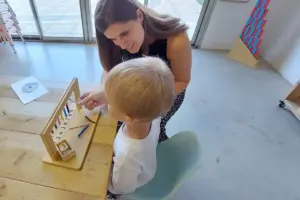
Mornings are the time of greatest conflict because there’s urgency and the child is sleepy. Montessori solution: prepare everything the night before (clothes, backpack, breakfast). Reduce morning decisions to a minimum. And when the child says ‘I don’t want to get dressed’, don’t enter a debate. Approach, lower your body to their level and say: ‘Let’s put the t-shirt on together. Right arm or left arm first?’
In the supermarket
The child wants something and you say no. They cry. They scream. The environment judges. Don’t give in to social pressure. Instead, validate: ‘I can see you want those biscuits. Today we’re not buying them and I understand that makes you angry.’ Then offer a real alternative: ‘Would you like to help me put the oranges in the bag?’ Participation reduces frustration.
At the table
If your child won’t eat or throws food, don’t force them. In Montessori, children eat at small tables at their height and serve themselves the portions they need. Disobedience at the table is almost always a power struggle. Remove the struggle: offer small portions, let the child serve themselves and take the plate away when they’re finished or when they say ‘I’m done.’
Calm Is Not a Gift: It’s a Skill That’s Trained
Telling an exhausted parent ‘don’t yell’ is useless if you don’t give them concrete tools to calm down. Here are four that work:
- 4-7-8 Breathing: inhale for 4 seconds, hold for 7, exhale for 8. Three repetitions reduce cortisol by 30%.
- Physical exit: if you feel you’re about to explode, say ‘I need a minute’ and leave the room. It’s not abandonment: it’s modeling self-regulation.
- Anchor phrase: choose a phrase that reminds you of your intention. ‘I am the adult here’ or ‘This will pass.’ Repeat it mentally before responding.
- Reframing: instead of ‘they’re disobeying me’, think ‘they’re having a hard time.’ Changing the internal script changes your reaction.
In the ‘Acompañando-té’ workshops we offer at IMS for families, we work exactly on this: how to regulate ourselves as adults so we can accompany our children without losing connection.
What to Do When Nothing Works
Sometimes, despite applying everything above, your child still won’t cooperate for days or weeks. This is normal and has an explanation.
Children go through sensitive periods (Montessori term): development windows where all their energy is focused on one skill. During a sensitive period for order, the child needs everything in its place and becomes dysregulated if something changes. During a sensitive period for movement, they can’t be still for a second.
If your child is between 2 and 3 years old, you’re probably in the sensitive period for autonomy . Saying ‘no’ is their way of asserting their identity. It’s not against you. It’s for themselves.
When to seek professional help: if disruptive behavior persists for more than 4-6 weeks, if there are self-harm behaviors, if the child doesn’t respond to their name by 18 months, or if there’s a sudden regression of already acquired skills. Consult your pediatrician or a professional specializing in child development. In our Rainbow classroom for diversity support at IMS, we have specialists who can guide you.
Frequently Asked Questions
Is it normal for my 2-year-old to not listen to anything?
Yes, it’s completely normal and expected. At 2 years old, the child’s brain is building its autonomous identity. Saying ‘no’ is their primary tool for differentiating themselves from their parents. It’s not disobedience: it’s development. Your job isn’t to eliminate the ‘no’, but to offer choices within clear limits so the child can exercise their autonomy safely.
Does Montessori mean there are no limits and the child does what they want?
Quite the opposite. Montessori is a method with very clear and consistent limits. The difference is that limits are applied with respect and focus on the behavior, not the child. You don’t say ‘you’re bad.’ You say ‘rocks stay on the ground.’ The limit is firm but the relationship is protected. Montessori classrooms have very precise rules that children learn to respect because they understand them, not because they fear them.
What do I do if my child only listens when I yell?
It means the yell has become the real signal for ‘now it’s serious.’ To change this, you need to be consistent for a few weeks: state the limit in a low voice once only and follow through with action (remove the object, physically guide the child toward another activity). At first there will be more resistance because the child is testing if the new pattern is real. After 2-3 weeks of consistency, cooperation improves without needing to yell.
At what age can a child reliably listen?
There’s no magic age. The ability to inhibit impulses and follow instructions consistently develops gradually. At 3, a child can follow simple instructions if emotionally regulated. At 6, they can follow 2-3 step sequences. But even adults need context and motivation to cooperate. Don’t expect perfect obedience: seek imperfect but genuine cooperation.
Key Takeaways
Your child not listening doesn’t mean you’ve failed as a parent. It means they’re being a child with a brain under construction, a legitimate need for autonomy and a body that needs to move. The 7 keys we’ve reviewed, from clear boundaries to your own calm as a tool, aren’t tricks: they’re ways of understanding the real child you have in front of you.
Start today with just one thing: the next time your child says ‘no’, instead of repeating the order, lower your body to their level, look into their eyes and offer them a choice within the limit. Practice this for a week and tell me what happens. And if you want to see how cooperation looks in an authentic Montessori classroom, book a visit to IMS Sotogrande and discover it for yourself.
Viviane Dumont, Director of Studies at IMS Sotogrande