
My child won’t listen: 7 Montessori keys for families

When you say out loud “my child won’t listen”, you’re probably exhausted. You’ve repeated the same instruction for ages, your little one is in their own world, and you feel your patience running out. It’s a situation all families experience, and it doesn’t mean something is wrong. At IMS, we support mothers and fathers in the Campo de Gibraltar and Costa del Sol every day, and I can confirm: non-compliance has an explanation and a solution.
- Key Points
- Why your child won’t listen (and it’s not what you think)
- Obedience or cooperation? The Montessori shift in perspective
- 7 Montessori keys to transform non-compliance
- When to actually worry about non-compliance
- How we do it in the IMS Montessori classroom
- Frequently Asked Questions
- Key Takeaways
Key Points
- A child who “won’t listen” is usually communicating an unmet need, not seeking conflict with you.
- Blind obedience is not a healthy goal in childhood. Conscious cooperation is.
- Montessori advocates for prepared environments and clear limits that reduce power struggles.
- Your tone, body language, and repetition matter more than the exact content of your words.
- Between ages 2 and 6, the brain is actively building autonomy: it’s the most intense phase of “non-compliance”.

Why your child won’t listen (and it’s not what you think)
Before looking for techniques, you need to understand what’s happening in a young child’s head. Between 18 months and 6 years, their prefrontal cortex, the part managing planning and impulse control, is still maturing. This means they literally cannot process complex instructions at the same speed you can. When you say “pick up your toys, wash your hands, and come for dinner”, their brain only caught the first part. Or none of it. When it comes to my child won’t listen, it pays to listen to what families and lead guides actually report.
Moreover, according to the AMI (Association Montessori Internationale), from birth to age 6, a child passes through the first plane of development, a stage where they absorb their environment unconsciously and need to experience things for themselves. They aren’t being rebellious. They’re being exactly what their brain needs them to be in order to learn. The key is to support that need rather than fight against it. Daily practice with my child won’t listen reveals nuances no handbook fully captures.

Obedience or cooperation? The Montessori shift in perspective
Many families come to consultations with the phrase “my child won’t listen” as if it’s a diagnosis. But if you replace the word “obedience” with “cooperation”, the entire family dynamic transforms. Obeying implies submission. Cooperating implies understanding and choosing. In Montessori, we don’t seek submissive children, but individuals capable of making informed decisions within clear limits.
Maria Montessori explained it this way: “True discipline comes not from external imposition, but from the child’s inner work.” When a child understands the reason behind a rule and has the freedom to act within it, resistance decreases. It doesn’t disappear (it’s healthy for a child to question), but it stops being a daily battle.
What DOESN’T work (and why we keep doing it)
Punishments, threats, and rewards generate temporary obedience, not real learning. A study published by the American Academy of Pediatrics confirms that positive reinforcement based on material rewards erodes a child’s intrinsic motivation. If your child only listens when there’s a reward or punishment at stake, they aren’t learning to cooperate. They’re learning to negotiate.
Book a personalized school visit: Book a personalized school visit

7 Montessori keys to transform non-compliance
These strategies work both at home and in the classroom. The Montessori guides at IMS use them daily with children in Nido (0-3), Children’s House (3-6), and Elementary (6-12), and families who apply them at home notice changes within a few weeks.
1. Reduce the number of words
Instead of a long speech, use short, direct phrases. Instead of “I’ve told you a thousand times to pick up your toys, don’t you listen to me?”, try “the toys go in the box”. No reproach, no sarcasm. Accompany the phrase by pointing to the object or physically moving closer to the area. Body language carries more weight than verbal language at this stage.
2. Offer two real choices
A child needs to feel they have control. Instead of “put on your shoes”, try “are you putting on the blue shoes or the red ones?” Both options lead to the same result, but they feel they’ve decided. This strategy reduces resistance because it directly addresses the need for autonomy that defines the first plane of development.
3. Adapt the environment before asking
If you want them to dress themselves, place their clothes at their height. If you want them to tidy up, make the container accessible. At IMS, we design our prepared environments with exactly this principle: that the environment invites action without the need for constant adult intervention. At home, small changes like a low coat rack or an open shelf can transform the dynamic.
4. Validate the emotion before the instruction
When your child refuses to do something, there’s usually an emotion behind it. “I see you’re frustrated because you wanted to keep playing. Now it’s time for dinner.” Validating isn’t giving in. It’s acknowledging how they feel before setting the limit. This step, which psychologists call “co-regulation”, is fundamental in respectful parenting and significantly reduces tantrums.
5. Be consistent (not rigid)
Limits work when they are predictable. If today a “no” can become a “yes” with enough insistence, the child will learn to insist. But being consistent doesn’t mean being inflexible. You can maintain the rule while acknowledging their dissatisfaction. “I know you don’t like it, and the rule still stands.” Gentle firmness is the heart of Montessori discipline.
6. Use transition, not command
Children need time to switch activities. Instead of “come now!”, try “we’ll start cleaning up in five minutes” and, after the time, “it’s time now, come with me.” In Children’s House, we use visual timers (hourglasses) so the child can see time passing without depending on your voice.
7. Model what you expect
Children learn more from what they see than from what they hear. If you ask them to speak quietly and you yell, the message is contradictory. At IMS, we believe the adult is the first prepared environment. Your way of reacting to frustration, your tone when asking for something, and your method of resolving conflicts are the best lessons you can give.
When to actually worry about non-compliance
There’s a difference between a child in their autonomy phase and a child who needs additional support. If the non-compliance is accompanied by constant aggression, social isolation, significant language delays, or a sudden, unexplained change in behavior, consult a professional. At IMS, we have the Rainbow classroom , specialized in diversity and support for special educational needs, coordinated by Andrea Torres and her team. You’re not alone in this.
How we do it in the IMS Montessori classroom
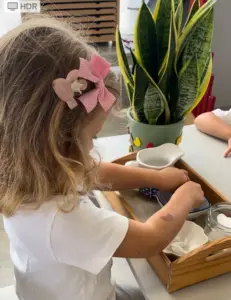
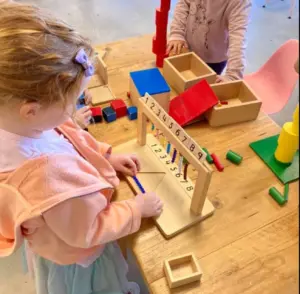
In our Nido, Children’s House, and Elementary, there are no rows or aligned desks. Children choose their work within a clear framework: they can move around the classroom, select the materials they need, and work for as long as required, but they respect the rules of coexistence. If a material is in use, they wait. If a child speaks loudly, a peer naturally reminds them that there are indoor voices and outdoor voices. Cooperation emerges from the environment, not from imposition.
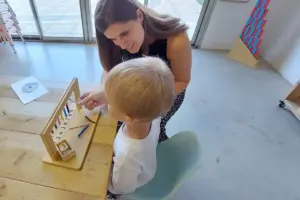
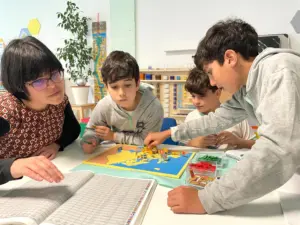
Our guides, including Sara Martín, Vanessa Coso, or Javier Baena, accompany each conflict as a learning opportunity. They don’t isolate the “problematic” child or use shame as a tool. They help them identify what they’re feeling, express it with words, and find a solution. This process, repeated hundreds of times, builds self-discipline that lasts a lifetime.
Frequently Asked Questions
Is it normal for my 3-year-old to not listen to anything?
Yes, it’s completely expected. At age 3, a child is in the full explosion of autonomy of the first plane of development. Their brain is building the capacity for self-regulation, and non-compliance is a sign they’re testing limits to understand how the world works. It doesn’t mean there’s a behavioral problem.
How long does respectful parenting take to work?
There’s no fixed timeline, but most families notice changes in the dynamic within two to four weeks of consistent application. The key factor is consistency: if you apply the keys one day and not the next, the child receives contradictory messages, and resistance remains. Patience is part of the process.
Is Montessori discipline about never saying no?
Quite the opposite. Limits are central to Montessori. The difference lies in how they are set: with respect, firmness, and coherence. A “no” accompanied by an alternative (“you can’t throw the ball inside, but you can do it in the garden”) teaches much more than a flat “no”. The child learns there are rules and they can act within them.
What do I do if my child hits me when I ask for something?
First, stop the action calmly by gently holding their hands: “I’m not going to let you hit me.” Then validate: “You’re very angry, I can see that.” This is not the time for lessons or reasoning. Once they’ve calmed down (minutes later, not seconds), talk about what happened with simple phrases. If the behavior repeats frequently, consult a specialist.
Key Takeaways
The phrase “my child won’t listen” almost always hides a child who is building their identity and an adult who needs new tools. The seven Montessori keys I’ve shared aren’t magic tricks. They are pedagogical principles backed by over a century of practice and validated by organizations like the Asociación Montessori de España. They work because they respect how the child’s brain functions.
If your family lives in the Campo de Gibraltar or Costa del Sol and you want to see these principles in action, I invite you to visit IMS in Sotogrande. On a morning of observation in our classrooms, you’ll understand why so many families from La Línea, Algeciras, Estepona, and even Gibraltar make the journey every day. Email us at [email protected] or book your visit directly on our website.