
Help Your Child Focus: Montessori Activities for Concentration (0-12 Years) | IMS Sotogrande

If your child switches toys every few minutes or struggles to finish a task, you’re not alone. Many expat families in the Campo de Gibraltar and Costa del Sol ask us about activities to improve child focus . The good news is that attention isn’t a fixed gift: it’s a muscle that can be trained. And starting at home, with intention, makes a huge difference.
- Key Takeaways
- How Attention Works in a Child’s Brain
- Activities for Babies and Toddlers (0-3 Years)
- Activities for Children 3-6 Years: The Golden Age of Concentration
- Activities for Children 6-12 Years: Meaningful Projects
- What to Avoid If You Want Your Child to Concentrate
- The Role of Movement and Nature
- The Importance of Sleep and Nutrition
- Frequently Asked Questions
- Key Conclusions
Key Takeaways
- Concentration is a neurological skill that matures with age and strengthens with proper training.
- Montessori activities based on the three-hour work cycle are the most powerful tool for developing deep focus.
- Avoiding interruptions during free play is as important as offering the right materials.
- Physical movement and contact with nature are direct allies of concentration, not enemies.
- Children aged 0-6 need to manipulate real objects. Those aged 6-12 need meaningful projects.

How Attention Works in a Child’s Brain
The prefrontal cortex, responsible for sustained attention, doesn’t fully mature until age 25. This means a 4-year-old child doesn’t “choose” to be distracted: their brain simply can’t maintain focus as long as yours. The World Health Organization points out that the early years are the critical window for building neural attention circuits. When it comes to activities to improve child focus, it pays to listen to what families and lead guides actually report.
In the Montessori classroom, we observe something clear: when a child works with an interesting material, without interruptions, their concentration capacity multiplies. It’s not about forcing attention, but about creating the conditions for it to appear naturally. Daily practice with activities to improve child focus reveals nuances no handbook fully captures.

Activities for Babies and Toddlers (0-3 Years)
At this age, attention is brief and selective. Don’t expect an 18-month-old to sit for 20 minutes. But you can enhance their focus with simple sensory activities. Understanding activities to improve child focus from inside the classroom reshapes everyday decisions.
Treasure Baskets
Offer a basket with 5-7 real objects of different textures: a wooden spoon, a woolen ball, a shell, a piece of silk fabric. No instructions. Let them explore at their own pace. A 10-month-old baby can spend 15 minutes examining a single piece if no one interrupts. Concrete data on activities to improve child focus is worth reviewing before acting on assumptions.
Transfer Tasks with Trays
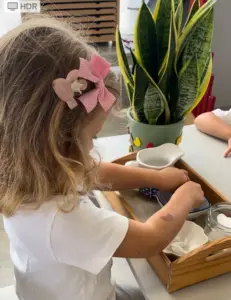
Place chickpeas in a bowl with a small spoon beside it. The child transfers the chickpeas from one bowl to the other. It seems simple, but it demands hand-eye coordination and sustained attention. They will repeat the activity many times, and each repetition strengthens the concentration circuit.
Purposeful Walking
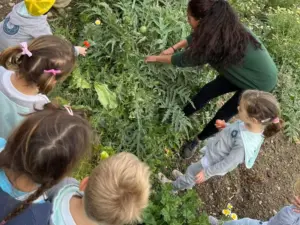
Instead of walking aimlessly, suggest collecting stones, leaves, or pinecones. The concrete goal (“let’s find 5 stones”) gives direction to attention. This works especially well in the gardens of Sotogrande or on the beach in Torreguadiaro.

Activities for Children 3-6 Years: The Golden Age of Concentration
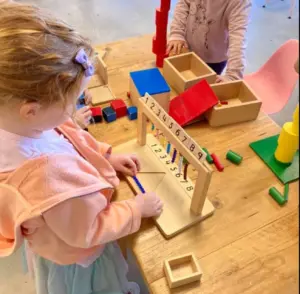
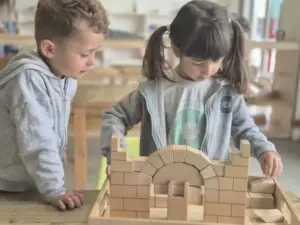
Between ages 3 and 6, the child goes through a sensitive period for order and concentration. Montessori discovered this by observing children who repeated activities up to 40 times in a row, entering a state of deep absorption. This is the ideal moment to intentionally build a child’s focus .
The Three-Hour Work Cycle
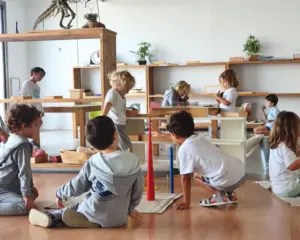
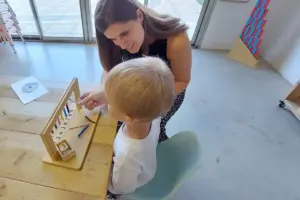
At IMS, the Children’s House morning (ages 3-6) follows a three-hour uninterrupted cycle: individual work, snack preparation, small group activity. At home, you can adapt this by reserving 45-60 minute blocks where the child chooses an activity and you do not interrupt. Don’t ask if they’re hungry. Don’t correct how they do it. Let them finish.
Practical Life: Sweeping, Washing, Cooking
Every household chore is a concentration lesson. Sweeping the floor requires motor planning. Peeling an orange demands attention to detail. Whipping eggs trains coordination. Children at this age love to feel useful, and concentration flows when the hand is busy with a real purpose.
Progressive Puzzles
Start with 6-piece puzzles and increase gradually. The key: let the child choose for themselves. When a child selects their own challenge, their intrinsic motivation activates, and with it, deep focus. Store completed puzzles in a tray so they can repeat them.
Book a personalized school visit and discover how our guides support the development of concentration in the classroom.
Activities for Children 6-12 Years: Meaningful Projects
From age 6, concentration is no longer fueled only by manipulation. The child needs meaning: questions to investigate, problems to solve, projects to share with others.
Research Projects
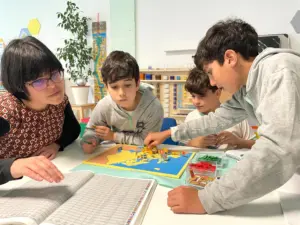
Propose an open-ended question: “Why is the sea salty?” or “How is a bridge built?” The child searches for information in books, experiments, draws, writes. In the Elementary (ages 6-12), we work this way: each child follows their curiosity for days or weeks, and concentration is sustained because the topic matters to them.
Strategic Board Games
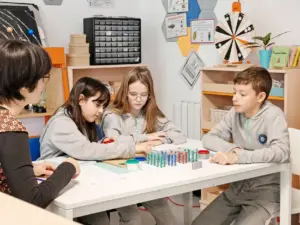
Chess, Go, Blokus, or even strategy cards. These games require anticipating moves, planning, and maintaining focus for 20-40 minutes. They are pure gym for the prefrontal cortex. And they are also fun, which is essential for the brain to release dopamine and consolidate learning.
Cooking a Complete Recipe
Following a recipe step by step, measuring ingredients, waiting for cooking times. All of this requires sustained attention, working memory, and self-regulation. An 8-year-old making a Spanish omelette is training concentration more effectively than with any worksheet.
What to Avoid If You Want Your Child to Concentrate
Sometimes we do more harm than good without knowing it. Three very common mistakes:
- Interrupting when they are absorbed. If your child is building with blocks and you say “come have a snack,” you break a state of concentration that may not return. Wait for them to finish the natural cycle of their activity.
- Overloading with stimuli. A living room with 30 toys in sight competes for their attention. Offer fewer options, rotating them weekly. Less is more.
- Using screens as a babysitter. Screens generate passive, reactive attention. They do not train the voluntary focus needed for reading, studying, or problem-solving. The American Academy of Pediatrics recommends zero screens before age 2 and a maximum of one hour daily between ages 2 and 5.
The Role of Movement and Nature
Many families believe a restless child needs to “sit still.” It’s quite the opposite. Physical movement strengthens the neural connections that later support attention. A study published by the U.S. Centers for Disease Control and Prevention confirms that children who engage in regular physical activity improve their academic performance and attention capacity.
At IMS, we include yoga, mindfulness, and intentional movement at all levels. At home, ensure at least one hour of daily outdoor free play. Climbing, running, jumping, swinging: all of this prepares the brain to concentrate afterwards.
The Importance of Sleep and Nutrition
A tired child cannot concentrate. A hungry child cannot either. It seems obvious, but we often look for activities to improve concentration when the first step is to cover basic needs. A 4-year-old child needs between 10 and 13 hours of sleep per day, according to the American Academy of Pediatrics.
Regarding nutrition, refined sugars cause energy spikes followed by crashes that destroy concentration. Prioritize breakfasts with protein and healthy fat: eggs, avocado, fresh fruit. At IMS, we care for the balanced diet of all children as an integral part of their development.
Frequently Asked Questions
At what age does a child start to concentrate?
Babies show selective attention from the first months, but sustained concentration appears between ages 2 and 3. From age 3 onwards, if the environment is appropriate, a child can maintain focus on an activity of interest for 15-30 minutes. The duration increases progressively until adolescence.
Is it normal that my 5-year-old cannot concentrate for more than 5 minutes?
It depends on the activity. If they choose something they’re not interested in, 5 minutes is even a lot. But if they are absorbed in a puzzle or building something, they might go 20 minutes without looking up. Children’s concentration is selective: it cannot be forced, but it can be facilitated by offering the right materials and environment.
Do screens help improve concentration?
No. Screens generate a form of passive attention that does not transfer to tasks requiring voluntary effort. In fact, several studies link excessive screen use to worse performance in sustained attention tasks. Limiting screen time and offering active alternatives is much more effective.
What do I do if my child has an ADHD diagnosis?
The activities described benefit all children, including those with ADHD. However, a diagnosis requires professional support. At IMS, we have the Rainbow classroom, specialized in special educational needs, where we design individualized learning paths. Consult with your pediatrician and contact us to learn how we can help.
Key Conclusions
Concentration is not a personality trait: it’s a skill built day by day with the right activities, the correct environment, and a lot of patience. From sensory treasures for babies to research projects for pre-teens, each stage offers concrete opportunities to strengthen focus.
If you want to see up close how we work on concentration in the Montessori classroom, we invite you to visit IMS Sotogrande. Book your appointment on the admissions page or call us at +34 653 04 17 39. We will be delighted to welcome you.