
Understanding Toddler Tantrums (Age 2): A Montessori Guide for Expat Parents

If your two-year-old throws themselves on the supermarket floor because they want a cookie, or cries inconsolably because a block won’t fit, you’re not doing anything wrong. Toddler tantrums are a developmental signal, not bad behavior. At this age, the emotional brain is far more developed than the rational one, making outbursts inevitable. The good news: you can learn to navigate them without losing your nerves. In this article we explore toddler tantrums age 2 in depth with practical examples.
Key takeaways
- Toddler tantrums occur because the prefrontal cortex (self-control) isn’t yet mature.
- They aren’t manipulation: the child truly feels an emotion they don’t know how to manage.
- Validating the emotion works better than punishing or giving in.
- Keeping the adult calm is the factor that most reduces the episode’s duration.
- A Montessori environment with clear routines decreases the frequency of outbursts.

Why are tantrums so intense at age two?
At two, your child discovers they are a separate person from you. They want to decide everything: which socks to wear, which path to take, when to eat. But their capacity for decision-making and regulating emotions is still in diapers, figuratively speaking. The result is enormous frustration that explodes in the form of tantrums . When it comes to toddler tantrums age 2, it pays to listen to what families and lead guides actually report.
According to the American Academy of Pediatrics, the prefrontal cortex, the brain area responsible for impulse control and planning, doesn’t fully mature until age 25. At two, it’s just beginning to develop. This means a little child can’t “stop” a tantrum by willpower, any more than you can stop a sneeze. Daily practice with toddler tantrums age 2 reveals nuances no handbook fully captures.
The window of tolerance is almost always open
Imagine your child’s emotions as a glass of water. At two, the glass is very small and fills up in seconds with any drop: hunger, tiredness, a “no” from you, a tower that falls. When it overflows, the tantrum appears. There’s no malice, just a nervous system that doesn’t yet have the tools to contain such intensity. Understanding toddler tantrums age 2 from inside the classroom reshapes everyday decisions.

How to react when the tantrum erupts
How you respond makes the difference between a 5-minute episode and a 30-minute one. It’s not about “winning” the battle, but about teaching your child that their emotions are valid and that they can learn to manage them. Concrete data on toddler tantrums age 2 is worth reviewing before acting on assumptions.
Stay close and calm. Get down to their level, look them in the eye, and say softly: “I see you’re very angry. I’m here with you.” No need for long explanations: in the midst of a crisis, the child can’t process speeches. They just need to feel they’re not alone.
Don’t give in to the demand, but do validate the feeling. If the tantrum is over a whim (a sweet, a toy in the store), don’t give it to them to make it stop. But also don’t say “stop crying” or “it’s not that bad.” Instead: “I understand you want it very much. We’re not buying it today, but I can be with you while you’re sad.”
The most common mistake: rewarding or punishing
Giving in to the tantrum teaches the child that screaming works. Punishing them (“if you cry, no park”) teaches them that their emotions are a problem. Neither option helps them develop emotional intelligence. The middle ground, which in Montessori we call “respectful guidance,” is to maintain the boundary with firmness and affection at the same time.

How to prevent tantrums with environment and routines
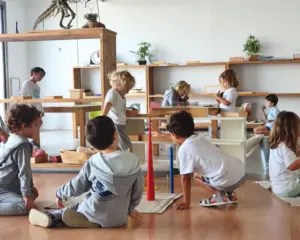
At IMS, we observe every day that children who live in predictable environments have fewer tantrums . Not because they are “calmer” by nature, but because they know what to expect. Uncertainty generates anxiety, and anxiety overflows the emotional glass.
These strategies work both at home and in the classroom:
- Visual routines. A chart with drawings of the day’s activities (breakfast, play, snack, bath, bed) provides security. The child knows what’s coming next and needs less negotiation.
- Offering real choices. Instead of “put on your shoes,” try: “Do you prefer the red ones or the blue ones?” Two valid options give a sense of control without opening infinite negotiation.
- Anticipating changes. “In five minutes we’re going to tidy up the toys” works better than “Right now, we’re already late!” The two-year-old brain needs time to process transitions.
- Respecting hunger and sleep. Many tantrums are triggered by unmet basic needs. A hungry or tired child has an emotional glass almost full before the day even starts.
If you want to see how we apply these routines in a real Montessori environment, book a personalized visit to the school and discover the prepared environment of our Nido and Children’s House.
The tantrum as a learning opportunity
Every crisis is an opportunity to teach your child to recognize what they feel. When the episode passes (and it will), the child is receptive. It’s the moment to put words to the experience: “You felt very angry because you wanted to keep playing. Your body needed to rest.”
Over time, those words become internal tools. A child who hears a hundred times “that made you sad” ends up saying “I’m sad” instead of slamming a door. The Association Montessori Internationale highlights that children who learn to name their emotions before age six develop better empathy and social skills throughout their lives.
Montessori material for working with emotions
In our Children’s House classrooms (ages 3-6), we use concrete materials to make the invisible visible. “Emotion jars” (jars with colored water representing anger, joy, fear) help the child identify what they feel. At home, you can create your own version with plastic bottles, water, and food coloring. Shaking the bottle when angry and watching the water calm down is a powerful and tangible metaphor.
Frequently asked questions
Are two-year-old tantrums normal or should I worry?
Tantrums at age two are completely normal and part of typical development. They are considered part of the “terrible twos,” a stage where the child asserts their autonomy. You should only consult a professional if tantrums last more than 25 minutes on average, occur more than five times a day, or if your child regularly injures themselves or others.
What do I do if the tantrum is in public and people are staring?
First: ignore the stares. Most parents watching have been through the same thing. Take your child to a quieter place if possible (a corner of the park, the car) and accompany the emotion calmly. If you can’t leave, stay by their side, lower your voice, and repeat: “I’m here, when you’re ready we’ll go together.” Don’t try to reason or explain: at that moment, they can’t listen.
At what age do tantrums usually disappear?
Peak intensity usually occurs between 18 months and 3 years. From age 4, most children begin to have verbal and emotional tools to manage frustrations without such large outbursts. However, some episodes can appear up to age 6-7, especially during times of tiredness or major changes. The important thing isn’t that they disappear entirely, but that the child learns to recover faster each time.
Does punishment work to prevent them from happening again?
Punishment doesn’t teach the child what to do with their emotion. It only teaches them that their feeling is wrong. This may reduce the tantrum in the moment, but in the medium term, it generates more internal frustration and can lead to larger outbursts. Instead, maintain the boundary with firmness and offer alternatives: “You can’t hit, but you can squeeze this pillow hard” or “Let’s breathe together three times.”
Key conclusions
Toddler tantrums aren’t a problem of education or character. They are the expression of a brain under construction that needs time, repetition, and a calm adult to show the way. Your job isn’t to eliminate your child’s emotions, but to accompany them as they learn to navigate them.
Start today with one concrete change: name the emotions you see in your child for 24 hours. “I see you’re happy,” “You look tired,” “This made you very angry.” That small daily practice is the foundation of the emotional intelligence that will accompany them for a lifetime.