
Why Won’t My Child Listen? Montessori Guidance for Expat Families in Costa del Sol

When your child ignores you for the third time in a row, your body tenses and your patience runs out. It’s one of the most common frustrations I hear from families in the Campo de Gibraltar and Costa del Sol areas, and also one of the biggest sources of guilt. Before reaching for discipline techniques, you need to understand what’s happening in that brain that’s still under construction. In this article we explore child not listening in depth with practical examples.
- Key Takeaways for Parents
- Why Your Child Won’t Listen (And It’s Not What You Think)
- Signs That Differentiate a Developmental Phase from a Real Concern
- 5 Montessori Strategies to Transform Defiance
- What to Do When Nothing Works
- How This Looks in a Montessori Classroom
- Frequently Asked Questions
- Key Takeaways
Key Takeaways for Parents
- “Disobedience” between ages 2 and 6 is largely due to the immaturity of the prefrontal cortex, which handles impulse control.
- Knowing the difference between a developmental stage and a real red flag saves you from unnecessary punishment.
- Montessori strategies are based on offering limited choices, respecting the child’s pace, and using the environment as an ally.
- Emotional connection before correction is the foundation for any technique to work.

Why Your Child Won’t Listen (And It’s Not What You Think)
Most parents interpret not listening as disrespect or manipulation. The reality is simpler and less personal: a child’s brain isn’t finished yet. The prefrontal cortex, responsible for planning, inhibiting impulses, and regulating emotions, doesn’t fully mature until age 25. At age 3, it’s just beginning to connect. When it comes to child not listening, it pays to listen to what families and lead guides actually report.
This means that when you say “pick up the blocks” and your child keeps playing, they aren’t ignoring you on purpose. Their brain prioritizes what motivates them in the moment because it can’t yet switch tasks smoothly. The American Academy of Pediatrics describes this as a young child’s natural difficulty with multi-step instructions. Daily practice with child not listening reveals nuances no handbook fully captures.
Attention span also plays a role. A 4-year-old can concentrate for about 8 to 12 minutes. If you ask them to do something while they’re deep in imaginative play, their brain takes time to disengage. It’s not disobedience. It’s neurobiology. Understanding child not listening from inside the classroom reshapes everyday decisions.

Signs That Differentiate a Developmental Phase from a Real Concern
Not all lack of obedience is the same. There are clear differences between what’s expected and what might require professional attention. Concrete data on child not listening is worth reviewing before acting on assumptions.
It’s part of normal development when the child listens to some instructions and not others, gets distracted easily but obeys if you repeat calmly, shows opposition especially when tired or hungry, and cooperates better when given choices.
Consider consulting a professional if the child systematically ignores any instruction from around age 5, shows constant aggression towards other children or adults, doesn’t respond to their name or maintain eye contact, or if the disobedience is accompanied by significant delays in language or socialization.
At IMS, we work with families who notice these signs and refer to the appropriate specialist when needed. Observation is the most powerful tool for a Montessori guideand for parents.
Book a personalized school visit and see how we observe each child in our classroom.

5 Montessori Strategies to Transform Defiance
1. Connect Before You Correct
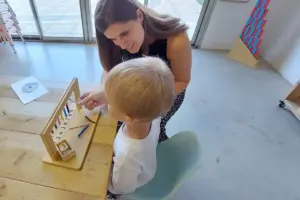
The brain can’t listen when it’s in defense mode. Before giving an instruction, get down to their level, look them in the eye, and say their name softly. This gesture activates social connection and prepares the child to receive what you’re about to say.
2. Offer Two Real Choices
Instead of “clean up now,” try “Would you like to put away the cars first or the blocks?” Giving limited choices respects the child’s autonomy without giving up the boundary. It works especially well between ages 2 and 6, when the need for independence is at its peak.
3. Adapt the Environment Instead of Asking the Impossible
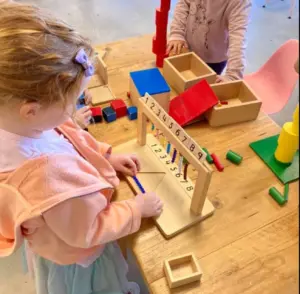
Many conflicts arise because the environment doesn’t facilitate cooperation. If the blocks are in a high drawer, the child won’t put them away. In the prepared environments at IMS, each material has its accessible place. At home, you can apply the same principle: low shelves, hooks at their height, boxes labeled with photos.
4. Use Positive and Concrete Phrases
“Don’t run” tells the brain exactly what not to do, but doesn’t offer an alternative. “We walk inside the house” gives a clear, positive instruction. Young children process what they *can* do better than what they should avoid.
5. Respect Transition Times
Announcing changes in advance reduces resistance. “In five minutes, we’re going to clean up” gives the brain time to prepare. In our classrooms, we use visible hourglasses so the child can see time passing. At home, a visual timer serves the same purpose.
What to Do When Nothing Works
Even with the best strategies, there will be days when your child simply won’t cooperate. Those days, you need a pause. I’m not talking about punishment or a time-out corner. I’m talking about recognizing that you’re also overwhelmed and need to breathe before responding.
Maria Montessori wrote that the adult must prepare themselves as much as the environment. If you’re exhausted, your tone changes, your commands become rigid, and the child senses it. Co-regulation starts with you. Breathe, lower your voice, and try again. It’s not giving in. It’s modeling what you want to teach.
Studies on positive discipline published by the Asociación Montessori Española confirm that children cooperate more when they perceive the adult is emotionally regulated.
How This Looks in a Montessori Classroom
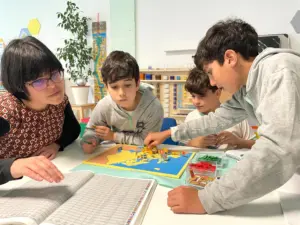
At IMS, each Children’s House classroom (ages 3-6) has between 25 and 30 children with two guides. It might seem like an impossible scenario for obedience, but the opposite happens: children collaborate naturally because the environment is designed for it.
The shelves are open and accessible. Materials have only one copy, which teaches turn-taking organically. Routines are predictable: each morning the child knows what activity awaits them. Freedom has clear boundaries: you can choose any material, but you return it when you’re done.
This invisible structure reduces conflict because the child doesn’t need to defy the adult to feel autonomous. They have it within a framework that gives them security. That’s exactly what you can replicate at home with patience and observation.
Frequently Asked Questions
Is it normal for my 3-year-old to not listen to me?
Completely normal. At age 3, the prefrontal cortex is in a very early stage of development. The child responds better to short instructions, prior eye contact, and an environment that facilitates cooperation. Occasional disobedience isn’t a behavior problem. It’s a sign that their brain is still maturing.
Should I punish my child when they don’t listen?
Punishment creates obedience out of fear, not understanding. Studies in educational neuroscience show that children who receive frequent punishment develop fewer self-regulation skills. Instead, set clear boundaries with natural and consistent consequences. For example, if they don’t put their toys away, the toys are put away until the next day.
When should I be concerned about my child’s disobedience?
When the lack of response is constant and affects all areas (home, school, playground), when it’s accompanied by persistent aggression, or when the child doesn’t respond to their name or make eye contact from around age 3-4. In these cases, consult your pediatrician or a child development specialist.
What’s the difference between a disobedient child and a strong-willed child?
Strong will implies determination, initiative, and having their own opinion: valuable qualities. A strong-willed child can obey when they understand the reason and feel respected. Persistent disobedience, on the other hand, often indicates an unmet need, an environment that doesn’t facilitate cooperation, or, in some cases, a neurodevelopmental difficulty worth exploring.
Key Takeaways
Your child won’t listen because their brain is under construction, not because they want to make your life impossible. Understanding this changes your reaction: you stop taking it personally and start seeking real solutions. Montessori strategies (connecting before correcting, offering choices, preparing the environment, and respecting timing) are backed by neuroscience and work because they put the child at the center.
Start today with just one thing: the next time your child doesn’t listen, kneel down, look them in the eye, and say their name before speaking. That simple gesture opens more doors than any punishment. If you want to see how we apply these principles in the classroom, come visit us in Sotogrande.