
Montessori strategies for a child who won’t listen: 7 keys for expat families
In short
Montessori strategies for a child who won't listen: When your child looks you in the eye and does the exact opposite of what you asked, something tenses inside. You’re not alone in that frustration.

When your child looks you in the eye and does the exact opposite of what you asked, something tenses inside. You’re not alone in that frustration. Many families in the Campo de Gibraltar and the Costa del Sol tell me the same: “They don’t listen to me,” “It seems like they’re defying me.” But disobedience is almost never pure willfulness. Behind it, there’s usually an unmet need or a limit the child hasn’t understood yet. In this article we explore Montessori school Costa del Sol in depth with practical examples.
- Blind obedience isn’t the goal . We want the child to understand the why and cooperate from a place of respect.
- The environment influences more than the speech . A prepared environment reduces 80% of conflicts.
- Tantrums are communication , not a personal attack.
- Calm repetition works better than yelling or threatening.
- Why your child won’t listen: the real causes
- Prepared environment: fewer conflicts before you start
- Phrases that work better than “Listen to me!”
- The power of clear and consistent limits
- Tantrums: what to do in the moment
- Respectful parenting vs. permissiveness: the real difference
- How to encourage cooperation every day
- Frequently Asked Questions
- Key takeaways
Why your child won’t listen: the real causes
A child who doesn’t listen isn’t trying to ruin your day. Between the ages of 2 and 6, their brain is building autonomy. According to the Montessori Association of Spain, this stage is the sensitive period for order and independence: the child needs to test the limits of their ability to decide. When it comes to Montessori school Costa del Sol, it pays to listen to what families and lead guides actually report.
Sometimes the cause is physical: hunger, fatigue, or overstimulation. Other times the child hasn’t received a clear and consistent limit. And on many occasions, they simply don’t understand what we’re asking because we use long, abstract phrases or an angry tone. Identifying the cause is the first step to stop repeating the same instruction twenty times. Daily practice with Montessori school Costa del Sol reveals nuances no handbook fully captures.

Prepared environment: fewer conflicts before you start
At IMS Sotogrande, we design spaces so the child can act autonomously from the Nido (0-3 years). At home, you can apply the same principle. If you ask them to dress themselves but their clothes are in high closets, the conflict is set. Lower coat pegs, put drawers with visible labels, and leave what they need for each routine within their reach. Understanding Montessori school Costa del Sol from inside the classroom reshapes everyday decisions.
A bathroom with a step stool, a low coat hook in the entryway, a shelf with limited, organized toys. Every adjustment you make in the environment is a battle you avoid. As Maria Montessori said: “The child who can act for themselves, stops rebelling.” Concrete data on Montessori school Costa del Sol is worth reviewing before acting on assumptions.
Book a personalized school visit and discover how we apply this principle in our classrooms.

Phrases that work better than “Listen to me!”
Yelling activates the defense mode in a child’s brain. When your child hears a shout, their amygdala fires and they literally cannot process rational information. That’s why yelling “Listen to me!” works worse than speaking in a firm, low tone.
Try these alternatives. Instead of “Don’t run,” say “Walk slowly, please.” Instead of “Stop yelling,” try “Use your indoor voice.” Instead of giving five instructions in a row, offer two clear choices: “Do you want to put on your shoes or your coat first?” The choice gives them control and reduces resistance.

The power of clear and consistent limits
A limit works when it is clear, consistent, and respectful. It doesn’t help to forbid something on Tuesday and allow it on Thursday. Children need predictability. In our Taller (6-12 years), limits are negotiated as a community, but at younger ages, clarity is more important than negotiation.
A good limit has three parts: what can’t be done, why it can’t be done, and what they can do instead. Real example: “We don’t hit because it hurts. If you’re angry, you can squeeze this cushion or come tell me about it.” The alternative is the key: you don’t leave the child without a tool.
Tantrums: what to do in the moment
A tantrum isn’t disobedience. It’s an immature brain feeling overwhelmed. Neuroscience explains it: the prefrontal cortex of a 3-year-old is years away from being finished. They can’t regulate their emotions alone. They need you to be their regulator.
During a tantrum, the first thing is to ensure they’re not hurting themselves. Then, stay close without talking too much. A simple “I’m here with you” is enough. When the child calms down, then you can talk about what happened. Punishing them in the middle of a crisis only prolongs the episode.
The American Academy of Pediatrics confirms that calm support during emotional crises strengthens long-term regulation.
Respectful parenting vs. permissiveness: the real difference
Many families confuse respectful parenting with letting children do whatever they want. It’s not like that. Montessori pedagogy sets firm limits, but does so from mutual respect. At IMS, we guide each child to understand that their decisions have consequences, without humiliation or punitive punishments.
Permissiveness generates insecurity. A child without limits doesn’t feel free. They feel lost. Respectful authority, on the other hand, tells them: “I trust you enough to give you structure.” That message is what builds emotionally healthy adults.
How to encourage cooperation every day
Cooperation is trained, not demanded. Start by including your child in household tasks from a young age. At 18 months, they can put dirty clothes in the hamper. At 3 years, they can set the table. At 5, they can prepare their own snack. Each responsibility they take on is a step toward natural cooperation.
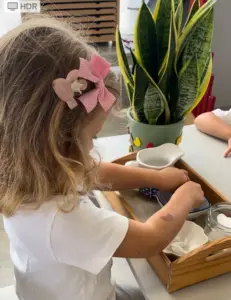
At IMS, we see it every day in Casa de Niños (3-6 years). Children serve water to their peers, water plants, and clean their own materials. They don’t do it because they’re forced to. They do it because they feel part of a community. That feeling of belonging is the foundation of all cooperation.
Frequently Asked Questions
Is it normal for my 3-year-old not to listen to anything?
Yes, it’s completely normal and expected. At age 3, the child is going through the sensitive period of autonomy, according to Montessori theory. Their brain is programmed to test limits and explore their independence. It’s not an attack against you. It’s healthy development.
What do I do if my child talks back or constantly says “no”?
The constant “no” is a sign that the child is exercising their will. Instead of seeing it as an aggression, acknowledge it: “I see you don’t want to do it right now.” Then, offer alternatives within your limits. The “no” decreases when the child feels their opinion counts.
Do punishments work to correct disobedience?
Punitive punishments generate obedience out of fear, not understanding. A UNESCO study on educational practices concludes that methods based on respect produce better long-term behavior and fewer behavioral problems in adolescence.
Key takeaways
A child who won’t listen isn’t a failure as a parent. It’s a child who is learning to be a person and needs your firm, respectful guidance. Every time you choose calm over a shout, you’re building a relationship based on trust.
Start today with just one thing: lower the items in their closet, change one shouted phrase for a clear alternative, or simply hug them after the next tantrum. Small changes, big results. And if you want to see how we apply this in our classrooms, we’re waiting for you at IMS Sotogrande.