
How to Set Boundaries Without Yelling: A Montessori Guide for Parents in Sotogrande

How many times have you said “no” to your child and, before you know it, you’re shouting? You’re not alone. Many families in the Campo de Gibraltar and Costa del Sol areas tell me the same thing: they want to set boundaries without yelling , but frustration builds and the voice rises on its own. The good news is there’s a real path to achieving this, and it doesn’t require being a perfect parent. In this article we explore Montessori parenting tips in depth with practical examples.
At IMS Sotogrande, we have been supporting families for over two decades. What we learn every day in the Montessori classroom applies directly at home: clear limits, stated with calm and consistency, are the ones children truly listen to. When it comes to Montessori parenting tips, it pays to listen to what families and lead guides actually report.
Key Takeaways for Setting Boundaries Without Yelling
- Setting boundaries without yelling starts with regulating your own emotions before you speak.
- A clear, brief limit repeated calmly has more power than a hundred shouts.
- A firm tone replaces a high volume: you don’t need to yell to be respected.
- Consistency between what you say and what you do is the foundation of all rules.
- Children need limits to feel secure, not to feel punished.

Why We Yell (And Why It Doesn’t Work)
When a three-year-old throws their plate on the floor for the third time, your brain goes into alert mode. The amygdala activates, cortisol spikes, and the voice shoots out. It’s a biological reaction, not a parenting flaw. The problem is that yelling, in the short term, may stop the behavior, but in the medium term it generates fear, disconnection, and repetition of the pattern. Daily practice with Montessori parenting tips reveals nuances no handbook fully captures.
According to the American Academy of Pediatrics (AAP), repeated shouting in childhood is associated with self-esteem problems and difficulties with emotional regulation in adolescence. It’s not about not feeling anger. It’s about not using anger as an educational tool. Understanding Montessori parenting tips from inside the classroom reshapes everyday decisions.

The Montessori Method for Setting Limits Without Shouting
Maria Montessori observed something that neuroscience now confirms: young children don’t process long sentences or complex explanations well. They need short, clear messages accompanied by action. This doesn’t mean being cold or authoritarian. It means being precise. Concrete data on Montessori parenting tips is worth reviewing before acting on assumptions.
How to Use a Firm Tone Without Yelling
A firm tone is your best ally. It’s achieved by lowering the volume, not raising it. Get down to your child’s level, look them in the eye, and say the phrase in a low, measured voice. A real example at home: instead of yelling “Don’t throw your food!”, you approach and say calmly, “The food stays on the plate. If you don’t want more, tell me.” Then you remove the plate without further debate.
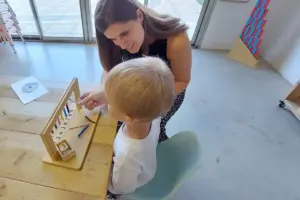
At IMS, we see this daily in our Casa de Niños. When a child pushes another, the guide doesn’t shout from across the room. They approach, get to their level, and say, “We don’t push. Hands are for helping.” The child listens because the message is brief, clear, and consistent.
The Rule of the Brief, Repeated “No”
One of the most common mistakes is over-explaining. When your child asks for something they can’t have, you don’t need a speech. You need to set a boundary without yelling and repeat it with the same calm each time they ask. “No, we’re not buying cookies today.” If they insist: “I’ve already said no. I understand you’re sad.” Validating the emotion doesn’t mean giving in on the limit.
Calm repetition works because the child learns the limit doesn’t change with insistence. In a short time, the requests space out. Not because there’s fear, but because there’s trust in the adult’s word.

What to Do When You’ve Already Yelled
If you yelled yesterday, you’re not ruining your child. Parenting isn’t perfection. It’s repair. The most powerful thing you can do is acknowledge it: “I yelled at you today and I shouldn’t have. I was frustrated, but that’s not okay. I’m sorry.” This act of humility teaches more about emotional management than any theoretical talk.
At IMS, we work on emotional intelligence from the Nido. Children learn to name what they feel with the help of adults who first name what they themselves feel. If you say, “I’m angry because the glass broke,” your child internalizes that emotions can be expressed without losing control.
How to Prevent Situations That Trigger Yelling
Most yelling doesn’t stem from a child’s whim, but from the accumulation of small frictions. Hunger, tiredness, rush, and overstimulation are the real triggers. Preventing them is more effective than managing them.
Observe the times of day you yell the most. Is it during the morning getting-dressed routine? After school? Before dinner? Identify the pattern and adapt the environment. In our Montessori program, environments are designed to reduce frictions: coat hooks are at child height, materials are accessible, and routines are predictable. You can replicate this at home with small changes.
Book a personalised school visitFrequently Asked Questions
From what age can you start setting limits without yelling?
From the first months of life, though limits change with age. A 10-month-old baby approaching a socket gets a gentle “no” and redirection. At 2-3 years, the limit is accompanied by few words and much consistency. At IMS, we start working on autonomy with clear limits from the Nido (0-3 years).
What do I do if my child doesn’t listen until I yell?
This means they’ve learned the real “no” comes with a yell. To reverse it, you need absolute consistency for several weeks: state the limit once in a firm tone, repeat if necessary, and enforce the consequence without yelling. At first, it might get worse, but in 2-3 weeks the child will adjust their behavior because they’ll understand your normal voice is now the real limit.
Is it equally effective with children aged 6 to 12?
Yes, but the strategy adapts. In the Taller stage (6-12 years), children can already participate in defining family rules. Setting a boundary without yelling now includes briefly explaining the “why” and offering alternatives. For example: “You can’t use the tablet now, but we can play cards or read together.” The limit is maintained, but the door to collaboration is opened.
Does occasional yelling harm my child?
An isolated shout doesn’t define your parenting. What makes the difference is the subsequent repair and the general tendency. If most of your interactions are respectful and connected, an isolated incident won’t have a lasting impact. What’s concerning is the habitual pattern, not the isolated incident.
Key Conclusions
Setting boundaries without yelling is not a manipulation technique. It’s a way to respect your child and yourself. Clear limits, stated with firmness and calm, give them security. Yelling, on the other hand, only generates temporary fear. Each time you choose a firm tone over a loud volume, you are teaching your child that emotions can be managed without losing dignity.
Start today with a single situation: choose the time of day you yell the most and practice the calm approach for a week. If you want real support, at IMS Sotogrande we’ve been working on this with families for over 20 years. Visit us and see how we do it.