Montessori School Sotogrande - A Bilingual Guide for International Families (Trilingual AMI-Accredited)
In short
Finding a bilingual Montessori school in Sotogrande that truly prepares your child for a global world is a decision that worries many families. It’s not enough to have English classes: you need an environment where the language is lived, not just studied. At International Montessori School Sotogrande (IMS), we have been proving for years that another model is possible.

Finding a bilingual Montessori school in Sotogrande that truly prepares your child for a global world is a decision that worries many families. It’s not enough to have English classes: you need an environment where the language is lived, not just studied. At International Montessori School Sotogrande (IMS), we have been proving for years that another model is possible.
- What sets a bilingual Montessori school apart from other bilingual schools in Sotogrande?
- Benefits of bilingualism from early childhood
- Real language immersion: how it works at IMS Sotogrande
- International families in Sotogrande: why they choose bilingual schools in Sotogrande
- Frequently asked questions
- Key takeaways
What sets a bilingual Montessori school apart from other bilingual schools in Sotogrande?
Most bilingual schools in Sotogrande separate languages into rigid subjects. Here, the approach is radically different. In a Montessori environment, the child absorbs Spanish and English naturally because they interact with native guides who speak to them exclusively in one of the two languages throughout the day. When it comes to Montessori school Sotogrande, it pays to listen to what families and lead guides actually report.
There is no textbook dictating the pace. It is the child themselves who, through hands-on materials and daily routines, incorporates vocabulary and grammatical structures as easily as breathing. Additionally, we are accredited by the Association Montessori Internationale (AMI), ensuring that every detail in the classroom respects the original philosophy. Daily practice with Montessori school Sotogrande reveals nuances no handbook fully captures.

Benefits of bilingualism from early childhood
Studies confirm that children exposed to two languages before age 6 develop greater cognitive flexibility and better selective attention. According to the American Psychological Association, early bilingualism strengthens the brain’s executive functions. But beyond science, we see it every day: a child who switches languages effortlessly is also a child who understands that there are many ways to see the world. Understanding Montessori school Sotogrande from inside the classroom reshapes everyday decisions.
In our experience, the ideal time to start this immersion is as early as possible. At IMS, from age 0, babies in the Nido program hear songs, stories, and instructions in both languages, almost without realizing they are learning. Concrete data on Montessori school Sotogrande is worth reviewing before acting on assumptions.

Real language immersion: how it works at IMS Sotogrande
The secret of bilingual schools in Sotogrande that truly make a difference lies in constant exposure. At IMS, each group has assigned Spanish-speaking and English-speaking Montessori guides. They don’t take turns by hours. Rather, each always uses their mother tongue. Thus, the child associates the language with the adult, exactly as in bilingual families.
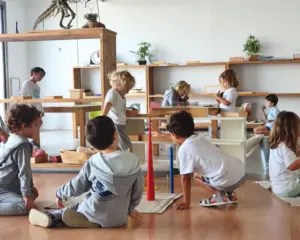
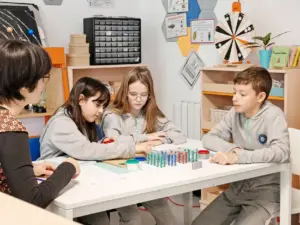
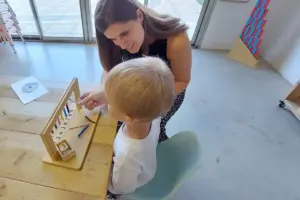
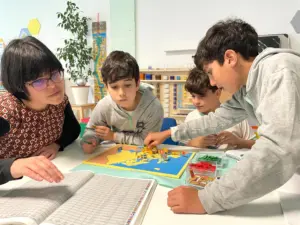
Throughout the day, the children live alongside these native professionals, who accompany them in practical life, projects, and material presentations. Since there are no lecture-style classes, verbal exchange is continuous and contextualized, accelerating natural language acquisition.
Book a personalized school visit and see firsthand how conversation flows in our Children’s House (3-6 years) classrooms.
Spanish and English as vehicular languages
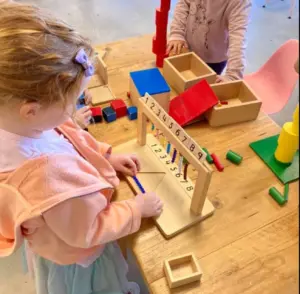
Unlike other bilingual schools in Sotogrande, we do not teach English as a second language. Instead, English is the working language for math, geography, or science. When a 5-year-old can explain in English how to wash a table or count beads in the decimal system, we know the language is rooted. There has been no mental translation or memorization of isolated grammar rules. Something much deeper has happened.
German as a gateway to Europe
Starting from Children’s House, we introduce German with the same immersion philosophy. Viviane Dumont, a native French teacher and head of studies, oversees that each step respects natural development. The reason is simple: many families choosing Sotogrande come from Central Europe or work with German-speaking markets. Mastering three languages from childhood is a real advantage for the future.
Furthermore, this third language is offered without pressure, as another gift of the prepared environment. Children receive it with the same curiosity with which they explore any other material in the classroom.

International families in Sotogrande: why they choose bilingual schools in Sotogrande
The Campo de Gibraltar and the Costa del Sol attract families from all over the world. Alcaidesa, San Roque, Gibraltar, Estepona… more and more expats tell us they moved to Sotogrande looking for an international school with true bilingualism. At IMS, enrollment includes children from 12 different nationalities, and this is reflected in the cultural richness of the classrooms.
Additionally, we are accredited by the Asociación Montessori Española and NEASC, ensuring that our program is compatible with any international system. If you arrive with school-age children, the transition is much smoother than you imagine. One of the most frequent questions from newly arrived families is whether their children will be able to keep up from day one. The answer is clear: immersed in a prepared and respectful environment, linguistic and social integration happens sooner than any adult would expect.
Frequently asked questions
At what age does bilingualism start at IMS Sotogrande?
From age 0, in our Semillas and Nido program. Babies are exposed to both languages through native guides. The earlier you start, the more natural the process.
Do parents need to speak English for the child to become bilingual?
No. The Montessori environment provides sufficient immersion during the school day. The child will acquire the language organically at school, without needing English spoken at home.
How is progress in languages assessed?
In Montessori we do not use exams, but we do observe and document every advancement. The guides record when a child begins to spontaneously use a new word or phrase in the other language. Families receive detailed reports each trimester, as well as personalized tutorials to track each child’s linguistic and emotional development.
What sets a bilingual Montessori school apart from a traditional one?
The main difference is that in Montessori, language is not just another subject. It is the vehicle for all learning. The child does not translate mentally but thinks directly in the language they are using. Moreover, by respecting their own pace, there is no pressure or frustration, which fosters a lifelong positive attitude towards multilingualism.
Key takeaways
Choosing among bilingual schools in Sotogrande is a decision that will mark your child’s academic and personal life. A Montessori environment not only provides fluency in several languages but also cultivates autonomy, confidence, and critical thinking. Families who visit us often say that what surprises them most is the naturalness with which children move from Spanish to English.
If you want to see it with your own eyes, we invite you to book a no-obligation visit. We will be happy to show you how our school works and answer all your questions. Your child’s education deserves this stop.