

Montessori Method Benefits: A Guide for Expat Families in Sotogrande & Costa del Sol
In short
When families in Campo de Gibraltar or Costa del Sol start exploring educational options, the benefits of the Montessori method come up again and again. And for good reason. It's not a passing trend.

When families in Campo de Gibraltar or Costa del Sol start exploring educational options, the benefits of the Montessori method come up again and again. And for good reason. It’s not a passing trend. It’s a philosophy with over a century of proven results, and at International Montessori School Sotogrande (IMS), we live it every day with children from 0 to 12 years old.
Our founder, Olimpia Tardá, sums up the essence: «At IMS, your child will grow up feeling heard, valued, and safe, ready to change the world with their own voice.» Behind that phrase are concrete pillars that explain why the Montessori method makes a difference. When it comes to Montessori school Sotogrande, it pays to listen to what families and lead guides actually report.
What Makes the Montessori Method Unique?
Unlike traditional teaching, where a teacher gives the same lesson to everyone at the same time, the Montessori approach respects each child’s sensitive periods. Maria Montessori observed that children go through phases where they are especially receptive to acquiring a skill: language, order, movement, sensory refinement… The Montessori classroom is designed to take advantage of these windows of opportunity. Daily practice with Montessori school Sotogrande reveals nuances no handbook fully captures.
At IMS, we are accredited by the Association Montessori Internationale (AMI), the most demanding standard worldwide. That means our guides are rigorously trained and the environments, from the Nido to the Elementary Workshop, truly respond to the needs of each plane of development. Understanding Montessori school Sotogrande from inside the classroom reshapes everyday decisions.
Montessori Method Benefits for Your Child’s Development
We could list dozens of benefits, but there are five that families from Sotogrande, Alcaidesa, or La Línea value most when they visit us. Concrete data on Montessori school Sotogrande is worth reviewing before acting on assumptions.
Independence and Confidence from an Early Age
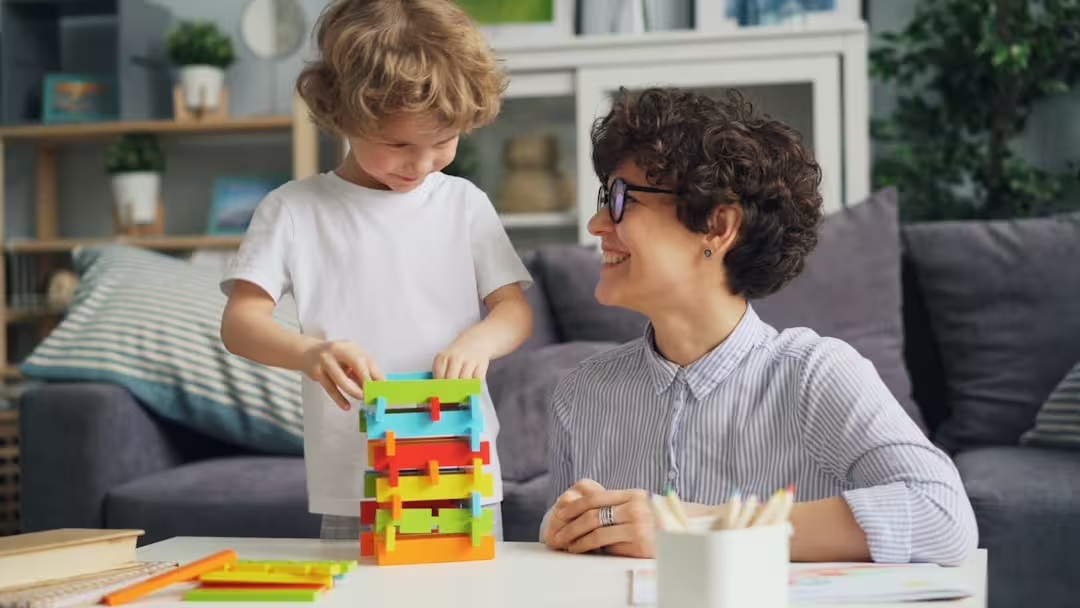
A child who chooses their work, completes it, and puts the material away is building solid self-esteem. They don’t need constant external approval because the material itself shows whether they got it right. That built-in error control is one of the Montessori method benefits with the greatest long-term impact. In IMS’s Children’s House (3-6 years), we see children pouring water themselves, tying their shoes, or preparing a counting tray. Each gesture says, «You can do it.»
Personalized Learning and Respect for Individual Pace
Not all brains mature at the same time. In a traditional classroom, a child who needs more time with addition falls behind. Another who has already mastered it gets bored. Montessori solves this with an environment where each child progresses at their own pace. At IMS, the guide observes and presents new materials when they detect the child is ready. There are no labels like «advanced» or «behind.» This is probably the Montessori method benefit that convinces families torn between a conventional school and a Montessori one.
Prepared Environment: The Classroom as the Third Teacher
The space is not neutral. IMS’s classrooms, located in Sotomarket in Sotogrande, are designed so children can move freely and safely. Open shelves at their height, materials arranged in logical sequence, individual and group work areas, and a calm atmosphere that fosters concentration. It’s not a classroom decorated for adults. It’s an environment tailored to those who learn.
Hands-on Materials That Engage the Senses
From the pink tower and brown stair in Children’s House to the golden bead material for the decimal system in the Workshop, each Montessori piece turns an abstract concept into something tangible. The child doesn’t memorize. They discover. And when they discover, they understand. At IMS, we’ve observed how the move from concrete to abstract happens naturally, without forcing.
If you want to see it firsthand, book a personalized school visit. There’s no better way to understand the benefits of the Montessori method than to step into a classroom and feel the atmosphere.
Bilingualism and Cultural Immersion at IMS Sotogrande
One of our school’s hallmarks is immersion in Spanish and English from age 0, with French starting in Children’s House. These aren’t language subjects. It’s living day-to-day in two, and later three, languages. For expat families moving to Sotogrande, Gibraltar, or Costa del Sol, this is a decisive Montessori method benefit: bilingualism is acquired naturally, taking advantage of language sensitive periods.
In addition, the Bilingual Montessori Programme, co-financed by the European Union, endorses the quality of our language offering.
Frequently Asked Questions
At what age can a child start Montessori?
At IMS Sotogrande, we welcome children from 4 months in the Seeds program, and we have environments for each stage: Nido (0-3), Children’s House (3-6), and Workshop (6-12). The earlier they join, the more natural the adaptation, but any time is good to benefit from the Montessori method.
How is progress assessed in Montessori without exams?
Guides conduct systematic observation and record each child’s milestones. At IMS, families receive weekly reports every Friday via Growappy, at least three parent-teacher conferences per year, and quarterly reports. It’s a qualitative assessment focused on holistic development, far richer than a numerical grade.
Is Montessori suitable for all children?
Yes. Montessori pedagogy respects diversity of intelligences and paces, and the prepared environment adapts to individual needs. At IMS, we also have a specialized Rainbow Classroom for diversity support, so we can accompany children with different educational needs.
Key Takeaways
The benefits of the Montessori method are not just theoretical: independence, concentration, love of learning, and solid self-confidence are qualities that families in Sotogrande, Algeciras, or Estepona see in their children year after year. At IMS, we see it daily: children who couldn’t read now devour books. Kids who couldn’t bear to leave their parents now are the first to arrive in class.
The best way to see if this approach fits your family is to come and meet us. Request an appointment on our admissions page or write to us at [email protected]. We’ll be happy to show you how we nurture childhood every day.









