

Montessori Prepared Environment Guide: Principles, Home Setup & Benefits for Expat Families in Sotogrande
In short
The Montessori prepared environment is one of the pillars of Maria Montessori ’s scientific pedagogy. It’s not about decoration or just a tidy classroom. This environment is meticulously designed so that children develop autonomy, concentration, and a love for learning. Every material, piece of furniture, and corner has a purpose: to meet the developmental needs observed at each stage.
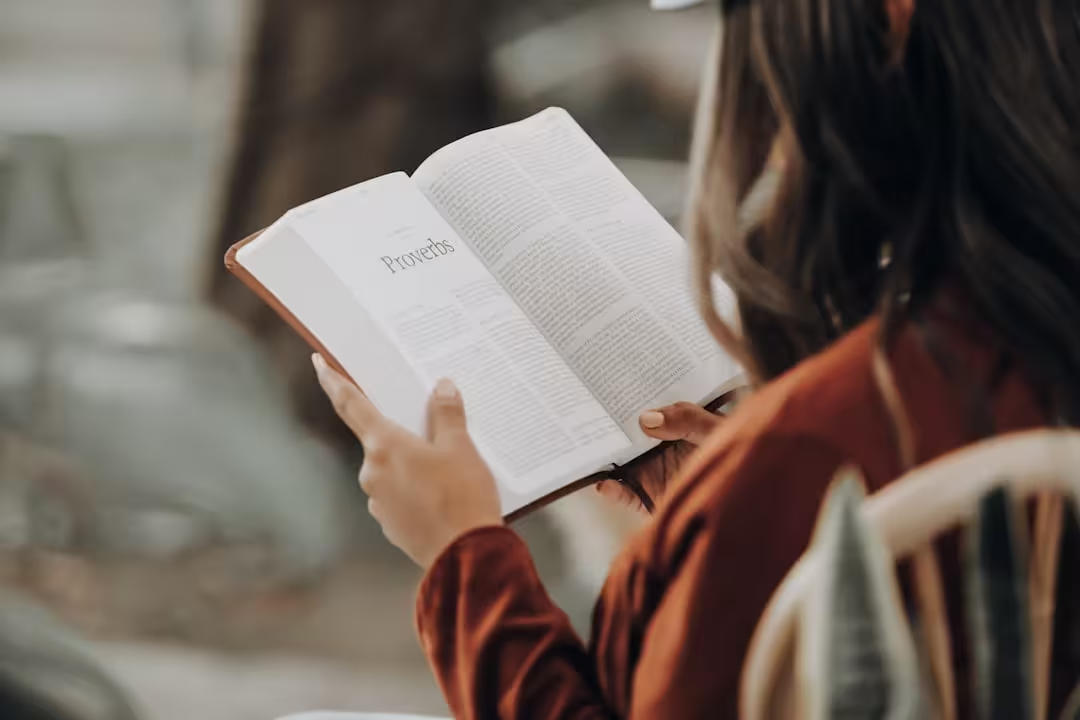
The Montessori prepared environment is one of the pillars of Maria Montessori’s scientific pedagogy. It’s not about decoration or just a tidy classroom. This environment is meticulously designed so that children develop autonomy, concentration, and a love for learning. Every material, piece of furniture, and corner has a purpose: to meet the developmental needs observed at each stage. At International Montessori School Sotogrande, this concept comes to life every day in our classrooms, a top choice for expatriate families seeking an international school near Gibraltar or a bilingual Montessori school on the Costa del Sol .
- The Montessori Prepared Environment: Much More Than a Beautiful Classroom
- The Six Principles of the Prepared Environment According to Maria Montessori
- Freedom Within Limits: The Secret of Order in the Montessori Environment
- How a Child Experiences the Montessori Prepared Environment at IMS Sotogrande
- The Montessori Prepared Environment at Home: Extensions for the Family
- Common Mistakes When Designing a Prepared Environment (and How to Avoid Them)
- Frequently Asked Questions About the Montessori Prepared Environment
- Key Takeaways
The Montessori Prepared Environment: Much More Than a Beautiful Classroom
When you step into a Montessori classroom, the first thing you notice is the calm. There are no rows of desks or a board drawing all attention. Instead, you find low shelves with hands-on materials, plants, artwork at the child’s height, and distinct areas for individual or group work. This apparent simplicity comes from careful observation by the adult of what the child needs at each moment.
The prepared environment is not static. It evolves with the group. What is today a practical life corner with rice pouring may become a writing workshop next week. The key is the daily observation by the Montessori guide, who removes materials that no longer spark interest and introduces new challenges when the child is ready. This flexibility is what makes it such a powerful ‘third teacher’.
The Six Principles of the Prepared Environment According to Maria Montessori
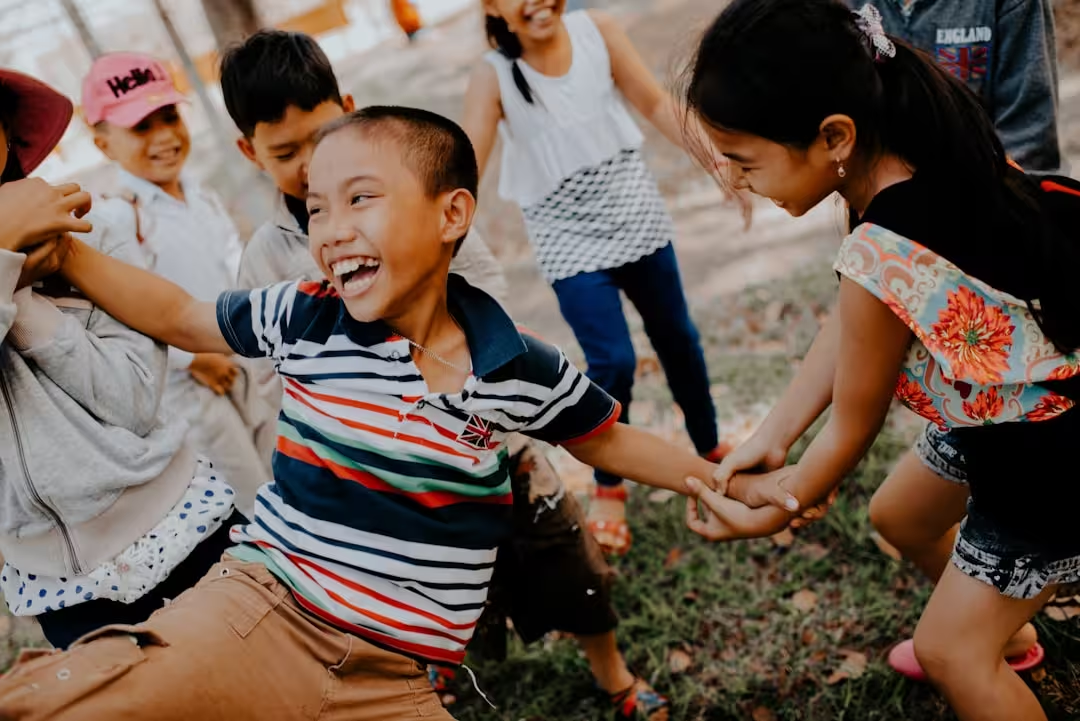
In 1907, when Dr. Montessori opened the first Casa dei Bambini in Rome, she was already clear about the characteristics an environment must have to support child development. Six fundamental principles that we still apply to the letter in schools like IMS Sotogrande:
- Freedom. The child can move and choose their work freely within the limits of the classroom. This builds self-discipline and decision-making ability.
- Structure and Order. Each material has a specific place. External order helps the child build mental order, especially in the 0-6 stage.
- Beauty and Atmosphere. An aesthetically pleasing environment invites respect. Natural plants, soft light, and quality objects convey harmony.
- Nature and Reality. Materials are made of wood, glass, or metal, not plastic. Contact with real elements connects the child to the world.
- Practical Life and Movement. The environment includes everyday activities like sweeping, watering plants, or pouring water, which develop coordination and independence.
- Montessori Materials. Scientifically designed to isolate one quality (color, size, shape) and allow self-correction. This way the child learns without fear of error.

Freedom Within Limits: The Secret of Order in the Montessori Environment
One of the most common misunderstandings is that in a Montessori classroom children do whatever they want. Nothing could be further from the truth. Freedom is framed by clear limits that protect learning and mutual respect. For example, a child may choose between working with the Pink Tower or the button lesson, but cannot disturb a classmate or wander aimlessly.
These limits are not imposed by the adult in an authoritarian way. They arise from the classroom community itself. In our Children’s House classes (3-6 years) in Sotogrande, the children themselves help establish the ground rules during group meetings. This creates a sense of belonging and responsibility that results in a serene working atmosphere.
How a Child Experiences the Montessori Prepared Environment at IMS Sotogrande
At our school, the Montessori prepared environment varies by developmental plane. In the Nido program (0-3 years), you’ll find floor-level mirrors, bars for crawling, and sensory materials adapted to the ‘spiritual embryo’ stage. In Children’s House, young children explore sandpaper letters, the continent map, and the practical life exercises that fascinate them so much.
If you’d like to see how we apply these principles in our classrooms, book a personalized visit to the school and see for yourself. Families arriving from Estepona, La Línea, or Gibraltar tell us that when they walk through the door, they feel a different energy.
One detail that often surprises is the mixed-age grouping. In the Primary Workshop (6-9 years and 9-12 years), older children help younger ones, and these learn by imitation. The prepared environment at this stage includes research projects, science experiments, and learning outings that connect the classroom to the real world.
The Montessori Prepared Environment at Home: Extensions for the Family
Montessori doesn’t end when you leave school. Many families ask us how they can create a prepared environment at home. The good news is that you don’t need to buy expensive furniture or replicate the classroom exactly. It’s about adapting some areas to foster the child’s independence in daily life.
Start with their bedroom: place a low mattress or Montessori floor bed so they can get in and out on their own, shelves with a few neatly organized toys, and a mirror on the wall. In the bathroom, a step stool and a toilet adapter will let them wash their hands and use the toilet without help. In the kitchen, a learning tower and child-sized utensils invite them to take part in preparing food. According to the Association Montessori Internationale, involving children in these daily routines strengthens their self-esteem and sense of competence.
Don’t forget external order. A basic Montessori principle is that everything has its place. This not only makes tidying up easier but also gives the child a sense of security. Notably, UNESCO highlights the importance of structured environments in early childhood for brain development.
Common Mistakes When Designing a Prepared Environment (and How to Avoid Them)
Even though the theory is clear, in practice we fall into traps. One of the most frequent mistakes is overcrowding the space. Sometimes, wanting to offer everything, we fill shelves with too many materials. The child becomes overwhelmed and doesn’t choose. The Montessori rule is ‘less is more’: preferably few materials that rotate each week.
Another mistake is forgetting observation. A prepared environment without an adult observing it is a static museum. If we don’t remove what is no longer used or introduce new challenges, the child loses interest. At IMS, our guides dedicate daily time to recording the children’s work to adjust the environment.
It is also common to force the ‘Montessori look’ with imitation plastics. A cheap material does not fulfill the function of self-correction. The Asociación Montessori Española insists on the quality of materials: if the pen doesn’t write, the child becomes distrustful. If the glass breaks, the child learns care.
Frequently Asked Questions About the Montessori Prepared Environment
At what age can you start with a Montessori prepared environment?
From birth. In fact, the prepared environment of the first plane of development (0-6 years) is crucial because it lays the foundations of personality. At IMS, our Nido program welcomes babies from 18 months, but at home you can start with a felt mobile over the mattress from the first weeks.
Is it true that there are no toys in a Montessori classroom?
Instead of toys, we offer purposeful materials. But in Nido there are dolls and symbolic play items, and in Children’s House there are animal figures and maps. The difference is that each object has a clear educational function. We don’t prohibit play. We channel it toward learning.
How does the prepared environment benefit a child with special needs?
It greatly benefits them. The structure, the clear sequence of materials, and the possibility to repeat without pressure are ideal for children with diverse abilities. In our Rainbow Classroom at IMS, the prepared environment is further adapted to give each child what they need, respecting their pace.
Key Takeaways
The Montessori prepared environment is not an educational fad. It is an intentional design that places the child at the center and has over a century of evidence. When you see a three-year-old focused for twenty minutes on an activity, you understand that the environment matters more than any lecture.
If you are in the Campo de Gibraltar or on the Costa del Sol and looking for a school that rigorously applies these principles, we invite you to visit IMS Sotogrande. Not all centers that call themselves Montessori apply the complete method. We are accredited by AMI and NEASC, and it is in our DNA.









